By Humeyra Pamuk
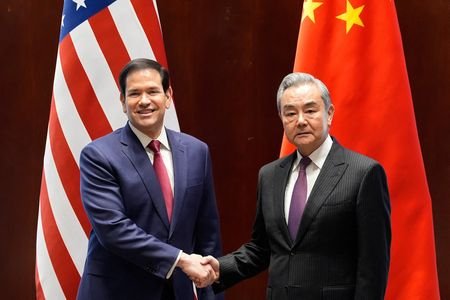
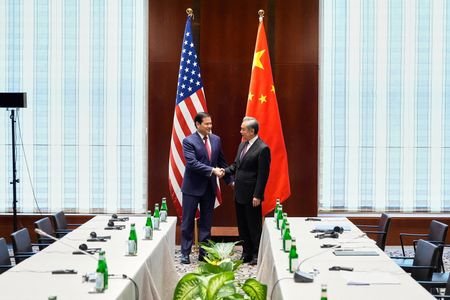
MUNICH, Feb 13 (Reuters) - U.S. Secretary of State Marco Rubio met Chinese Foreign Minister Wang Yi on Friday on the sidelines of the Munich Security Conference, as Washington and Beijing gear up for a potential visit by President Donald Trump to China in April.
The meeting was at least the second in-person encounter between the top U.S. diplomat and Wang. Washington and Beijing have sought to ease tensions over issues including trade and tariff confrontations and the future of Taiwan.
Rubio and Wang shook hands and posed for the cameras before the two delegations, flanked by their senior aides, sat opposite each other in a hotel conference room in central Munich. They made no remarks and ignored a shouted question from a Reuters reporter.
The meeting lasted about an hour, according to a senior U.S. official.
This month, Trump held a phone call with Chinese President Xi Jinping, which the Republican president described as “very positive”.
Following months of trade tensions triggered by Trump's tariffs, Xi and Trump reached a framework trade agreement in South Korea on October 30. Washington agreed not to impose 100% tariffs on Chinese imports and China would hold off on an export licensing regime for crucial rare earth minerals and magnets.
BEIJING CONSIDERS BUYING MORE US SOYBEANS
In a goodwill gesture two months before Trump's expected visit to Beijing, Trump said after his phone call with Xi last week that Beijing would consider hiking soybean purchases from the United States to 20 million metric tons in the current season, up from 12 million tons previously.
Trump said on Truth Social that his relationship with Xi is "extremely good," and that "we both realize how important it is to keep it that way." An official Chinese government account said that Xi had said, "I attach great importance to Sino-U.S. relations."
But the risk of the bilateral ties souring persists over Taiwan. In his phone call with Trump, Xi said Taiwan was the most important issue in China-U.S. relations and Washington must handle the issue of arms sales to Taiwan with prudence.
In December, the Trump administration announced $11.1 billion in arms sales to Taiwan, the largest ever U.S. weapons package for the island.
The United States is Taiwan's most important international backer and arms supplier, despite a lack of formal diplomatic ties. China, which claims Taiwan as its territory, held war games around the island in late December after the latest deal was announced.
(Reporting by Humeyra Pamuk; editing by James Mackenzie, Kevin Liffey and Sharon Singleton)