By Gram Slattery and Jana Choukeir
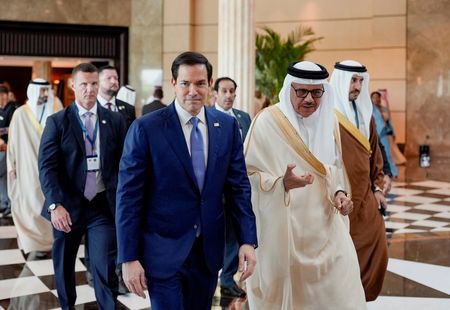
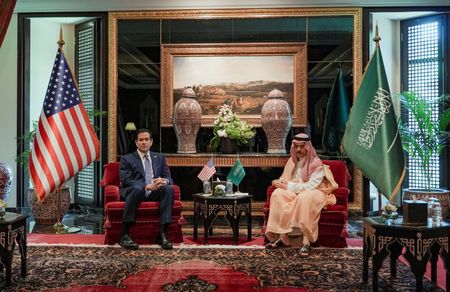
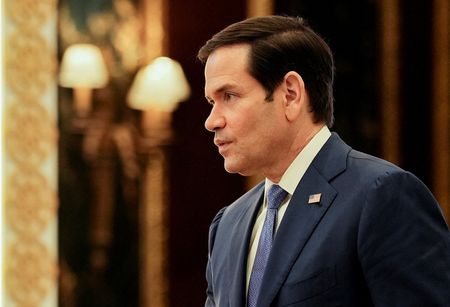
MANAMA/DUBAI, June 25 (Reuters) - U.S. Secretary of State Marco Rubio told Gulf allies on Thursday that any deal with Iran would take their interests into account, as he wrapped up a Middle East trip aimed at winning over regional partners with deep reservations about the preliminary accord.
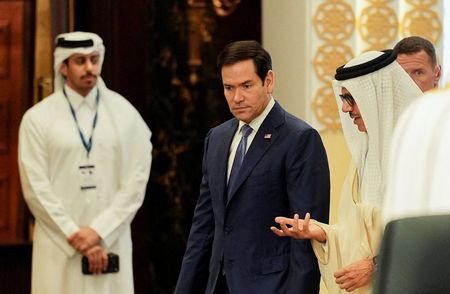
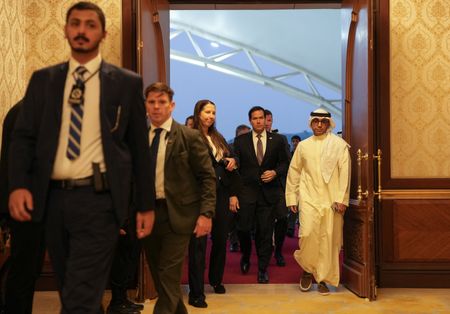
Speaking at a meeting of Gulf Arab foreign ministers in Bahrain — home to the U.S. Navy's Fifth Fleet — Rubio said Washington was seeking an enduring peace with long-time foe Iran that would not come at the expense of the security of allies in the oil-rich region, many of whom see the deal as too soft after coming under Iranian attack during the conflict.
Iran fought two of the world's most powerful armies — the U.S. and Israel — during the conflict and took effective control of the vital Strait of Hormuz, heavily disrupting oil flows and rattling global energy markets and the wider economy.
He told reporters that Gulf allies shared some very serious concerns and that they wanted to be informed of every step of the peace accord, which includes provisions on Hormuz.
In a joint statement later on Thursday, the U.S. and the six-member Gulf Cooperation Council (GCC) said a lasting peace would mean addressing Iran's ballistic missiles, drones and support for proxy groups. They also backed "free, unconditional, and unrestricted navigation" in the Strait of Hormuz without "any tolls, fees, or attempts to assert control."
If Iran threatens or blocks ships in the strait, "then we're going to have a problem," Rubio said, having earlier told ministers that "no country on Earth has the right to charge for the use of international waterways" and that fees for shipping would never be part of any deal.
Bahrain's Foreign Minister Abdullatif bin Rashid Al Zayani, who chaired the gathering, welcomed Oman's announcement of a corridor for the safe passage of vessels through the strait. Oman told the meeting that future arrangements for the strait would not involve transit tolls.
Rubio said he did not discuss a $300 billion reconstruction fund for Iran that is part of the peace proposal. Gulf states fear Iran would use that money to revive its military capacity.
REASSURING WARY REGIONAL ALLIES
Rubio's three-day tour of the Gulf was the first high-level diplomatic mission since the U.S.-Iran framework agreement last week to end the conflict, which started on February 28 with U.S.-Israeli strikes on Iran.
At his previous stops in the UAE and Kuwait, Rubio sought to assure officials that the proposed deal was not overly favorable to Iran, which struck several Gulf states during the war.
"We're not going to do anything that undermines the security of our allies, our longstanding allies in the region," he told reporters in Kuwait.
U.S. President Donald Trump on Tuesday said Iran had agreed to nuclear inspections into "infinity," while Tehran said it had made no such concession.
The two countries, which ended a first round of negotiations in Switzerland on Monday, have also offered conflicting accounts about financial incentives for Iran, control of the Strait of Hormuz, and Israel's parallel war in Lebanon.
All six GCC nations — Saudi Arabia, Qatar, Oman, the United Arab Emirates, Bahrain and Kuwait — are strategic U.S. allies that offered some degree of logistical support to Washington during the war, and all were buffeted by Iranian airstrikes as a result.
They make up the backbone of America's security architecture in the Middle East, and any countries rethinking their security relationship with the U.S. could have a significant impact on U.S. military strategy in the region.
The draft U.S.-Iran agreement includes no limits on Iran's ballistic missiles, a proposed $300 billion reconstruction fund and provisions that could expand Tehran's regional influence and control over critical oil shipping lanes.
Some U.S. Gulf allies are privately concerned that the interim deal could open the door to U.S. normalization with Iran, a predominantly Shi'ite country that most Sunni-led GCC states consider their main adversary.
The U.S. and Gulf nations, in their statement, also stressed the need for continued talks on Lebanon that are "not conditional on the outcomes of other conflicts" and for non-state groups to disarm.
The nations also backed continued efforts to support Syria, end the Gaza conflict and respect Kuwait's territory.
(Reporting by Gram Slattery and Jana Chouceir; Writing by Michael Martina, Michael Georgy and Susan Heavey; Editing by Don Durfee,Sanjeev Miglani and Ros Russell)