By Dmitry Antonov and Mark Trevelyan
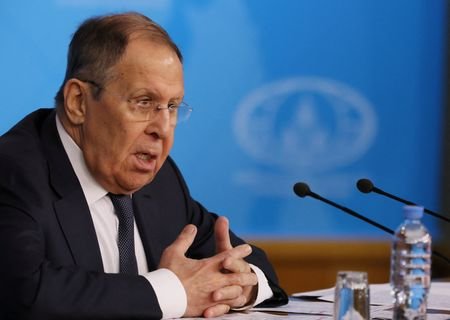
MOSCOW, Feb 11 (Reuters) - Russia will keep observing the missile and warhead limits in the expired New START nuclear treaty with the United States as long as Washington continues to do the same, Foreign Minister Sergei Lavrov said on Wednesday.
The 2010 treaty ran out on February 5, leaving the world's two biggest nuclear-armed powers with no binding constraints on their strategic arsenals for the first time in more than half a century.
U.S. President Donald Trump rejected an offer from Russian President Vladimir Putin to voluntarily abide by the New START limits for another year, saying he wanted a "new, improved and modernized" treaty rather than an extension of the old one.
"Our position is that this moratorium on our side that was declared by the president is still in place, but only as long as the United States doesn't exceed the said limits," Lavrov told the State Duma, Russia's lower house of parliament.
"We have reason to believe that the United States is in no hurry to deviate from these indicators, and for the foreseeable future these indicators will be observed," he said, without explaining the basis for that assumption.
Lavrov reiterated that Russia wanted to start a "strategic dialogue" with the U.S., saying it was "long overdue".
NEW THREAT ENVIRONMENT
New START's expiry has spurred fears of a three-way arms race involving Russia, the U.S. and China, which has far fewer warheads than the other two countries but is arming rapidly.
Some U.S. politicians and analysts say Trump was right to free himself from the treaty's constraints in order to build up the U.S. arsenal in preparation for a new threat environment where it will face not one but two nuclear peers.
Georgia Cole, a security analyst at Chatham House in London, noted that Russia's latest pledge still leaves it free to keep developing new nuclear systems that did not fall under the scope of New START.
And it paves the way for Moscow to cast Washington as "a more irresponsible actor" if the U.S. breaches the previous limits on systems that were covered by the treaty, she added.
Cole said Russia, whose state budget is under strain from the four-year war in Ukraine, is also mindful of the economic implications of being drawn into a Cold War-style arms spiral, though she said it would try to match any big expansion by the U.S. of its nuclear programme.
"If we do see an end to the war in Ukraine, then that would free up money for their (Russia's) nuclear programme. But at the same time, Russia would still need to rebuild their conventional capabilities," Cole said.
"So I think that is definitely one of the reasons that Russia is making these offers."
(Reporting by Dmitry Antonov in Moscow and Mark Trevelyan in LondonEditing by Gareth Jones)