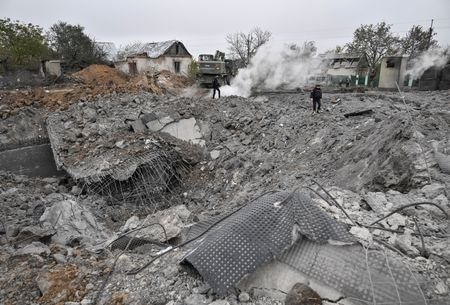
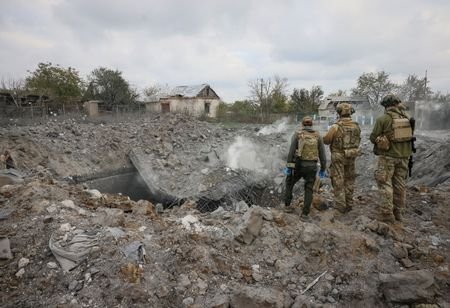
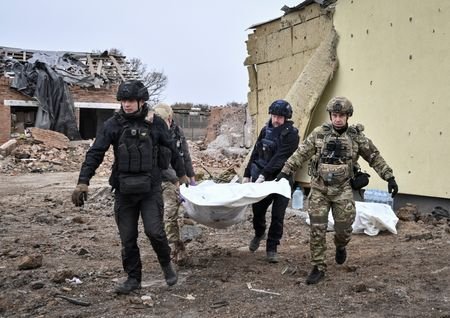
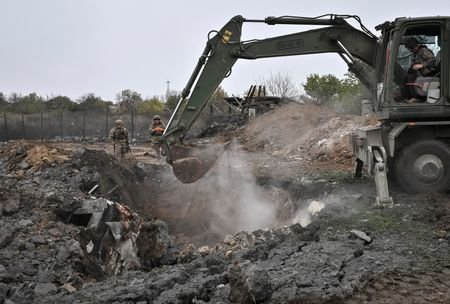
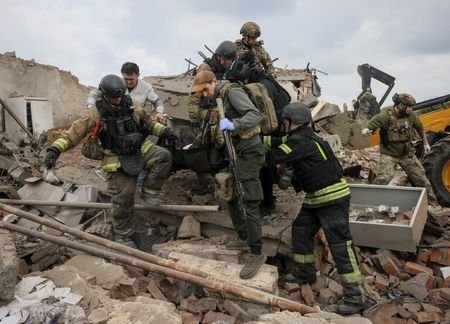
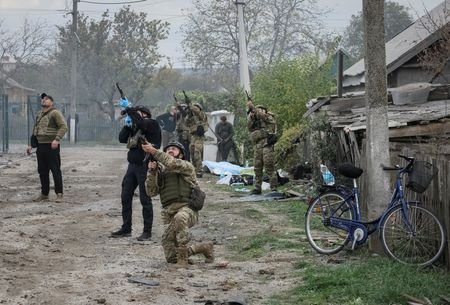
Nov 2 (Reuters) - At least 31 people were killed when Russian forces bombed a school being used as an aid distribution point in a village near the front line in Ukraine's southeastern region of Zaporizhzhia on Monday, a regional official said.
Mykhailo Semikin, acting head of the Regional Military Administration of Zaporizhzhia, said during a live broadcast on national TV that five people were also injured and almost 50 people were still missing after the attack in the village of Komyshuvakha.
Two members of a rescue crew and four police officers were among those killed, emergency services said, after Russia launched a double-tap strike in the wake of the initial attack. Two more rescue workers were among those being treated in hospital.
Ukrainian President Volodymyr Zelenskiy had earlier said that Russian forces initially dropped aerial bombs on the school, which was being used as a shelter and for distributing humanitarian assistance every Monday.
There were no classes at the school, he said, as the village, lying southeast of the region's main city, also called Zaporizhzhia, was too close to the front line in the 4-1/2-year-old war.
"The Russians struck first just as people were arriving – a few aerial bombs," he said. "Then there was a second strike – more air bombs, this time on the shelter. A vile terrorist strike."
Zelenskiy said the Russians could not have been unaware that residents remaining in Komyshuvakha gathered each week to pick up humanitarian packages.
The Russian Defence Ministry said the attack had targeted Ukrainian military units in areas around Komyshuvakha and two other settlements in the Zaporizhzhia region.
It said in a statement on Tuesday that up to 25 Ukrainian servicemen had been killed, with 15 vehicles and an electronic warfare station also destroyed.
Russia and Ukraine both deny deliberately targeting civilians in the conflict.
In August, UN monitors said that casualties have risen sharply from last year, adding that more civilians were killed or injured in the war in Ukraine in July than in any month since March 2022.
ZELENSKIY: MISSED OPPORTUNITY FOR HUMANITARIAN STEPS
Zelenskiy said the attack had shown that Moscow was intent on killing people instead of building on the past week's humanitarian mission in the southern city of Oleshky, brokered by US first lady Melania Trump.
"Russians continue to demonstrate, time and again, their hatred of Ukraine and everything that exists here," he said.
"If Russia genuinely wanted de-escalation, there was an opportunity following the situation in Oleshky to continue taking humanitarian steps. We proposed this. But Russia continues to kill people."
Ukrainian Foreign Minister Andrii Sybiha also condemned the attack on Tuesday.
"Another barbaric and cynical Russian attack," he said. "Russia's cruelty knows no bounds, and its disregard for human life has no moral justification."
Earlier, Sybiha, citing the attack, urged countries to shun Russian participation in top-level sport following a ruling by sport's highest court ordering the country's reinstatement in major tournaments.
"Russia deserves condemnation, isolation, and consequences, not a return to international respectability," Sybiha wrote on X. "Its crimes cannot be separated from its flag, its national teams, or its attempts to regain international legitimacy."
Regina Kharchenko, secretary of the Zaporizhzhia City Council, said 27 people were missing in the attack.
Zaporizhzhia region police said officers and rescue teams were trying to reach residents believed to be trapped under rubble.
Photographs posted online showed smouldering rubble strewn throughout the area.
The attack occurred a day after the expiry of a six-day local ceasefire arranged to bring aid into Oleshky to the southwest in Kherson region and evacuate residents wishing to leave.
In Washington, a senior US official told Reuters that the US will bring together delegations from Ukraine and Russia in Abu Dhabi on November 10 to 11 to discuss moves toward ending the war, post-war security agreements and de-escalation.
US negotiators have been seeking a breakthrough before winter in the long-running conflict. The last US-mediated peace talks took place in February before the US and Israel launched a war against Iran.
(Reporting by Ron Popeski and Oleksandr Kozhukhar, additional reporting by Steve Holland in Washington; Editing by Bill Berkrot, David Gregorio, Daniel Flynn and Sharon Singleton)