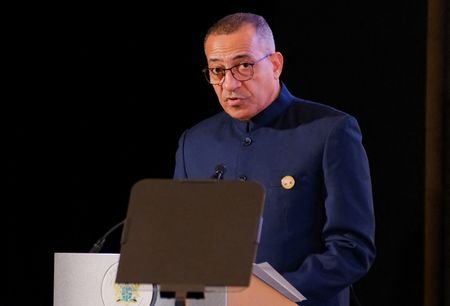
SAO TOME, July 19 (Reuters) - Sao Tome and Principe is voting in a presidential election on Sunday, with incumbent Carlos Vila Nova seeking a new five-year term in the small, cocoa-producing island nation despite recently falling out with its most powerful political party.
Vila Nova, a former public works and infrastructure minister, won the last election in 2021 in a runoff. In that race he had the backing of the Independent Democratic Action party, known by its Portuguese acronym ADI, which holds a majority of seats in the National Assembly.
But last year Vila Nova dismissed Patrice Trovoada as prime minister, prompting a split with the ADI that has left him running as an independent on Sunday against three other candidates.
His main challenger, Nito Abreu, has vowed to focus on creating jobs for youth and stem what he describes as an exodus of young people from the country, which is made up of two main islands and has a population of around 240,000.
REPORTED COUP ATTEMPT JOLTED INCUMBENT'S FIRST TERM
A former Portuguese colony situated off the western coast of Africa, Sao Tome and Principe has enjoyed a history of free and peaceful elections since the adoption of multiparty politics in 1990.
But in 2022, the government announced it had thwarted a coup attempt, the first in nearly two decades, involving at least one member of a South African apartheid-era militia known as the Buffalo Battalion.
The Africa Center for Strategic Studies, linked to the U.S. Department of Defense, said in a briefing that Sunday's election is a chance to show such violence is "an isolated aberration rather than an ongoing feature of national politics".
There are 142,298 eligible voters, according to the election commission. Polls opened at 7 a.m. (0700 GMT) and are scheduled to close at 6 p.m., with preliminary results expected late on Sunday or on Monday.
A second round will be held if no candidate secures more than 50% of the vote.Legislative elections are planned for September.
Sao Tome and Principe was once seen as a potential oil producer but the sector has failed to produce major finds.
(Reporting by Guilherme Neto; Writing by Robbie Corey-Boulet; Editing by Kirsten Donovan)