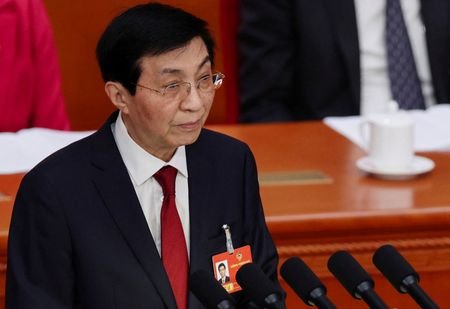
BEIJING, July 22 (Reuters) - China's fourth-ranking leader, Wang Huning, called on Tibet to safeguard social stability, enforce a new ethnic unity law and bring Tibetan Buddhism into closer alignment with Communist Party priorities during a visit to the region this week.
Wang, part of the ruling Communist Party's seven-member Politburo Standing Committee, visited Tibet's capital Lhasa and the Ngari prefecture, which borders India and Nepal, on a four-day tour of the high-altitude region that concluded on Wednesday, state media said.
"To govern Tibet is foremost to stabilise Tibet," Wang, 70, said. Efforts must be made to "consolidate a political and social environment of unity and stability," he added.
Wang made his visit weeks after a new Chinese law on ethnic unity went into effect on July 1. The law, which drew criticisms from the U.S. and the European Union, gives Beijing the basis to take action against people outside its borders it deems to have undermined "ethnic unity and progress or inciting ethnic separatism."
That same week, a Tibetan man died after setting himself on fire near U.N. headquarters in New York. Activists identified him and said the act was an appeal for independence.
The full implementation of the law should be ensured, Wang said during his Tibet tour.
The Communist Party established the Tibet Autonomous Region in 1965. The designation was meant to offer local ethnic minority groups such as the Tibetans greater say over policy matters, including freedom of religious belief. But international human rights groups and exiles routinely describe China's rule in Tibet as "oppressive", an accusation that Beijing rejects.
ADAPTING TIBETAN BUDDHISM TO SOCIALISM
Efforts must be made "to continuously guide Tibetan Buddhism to adapt to socialist society in line with the requirement to ... systematically promote the Sinicisation of religion in China," Wang said, referring to Beijing's policy of aligning religious practice more closely with Chinese culture and Communist Party doctrines.
As a top Communist Party strategist who has advised three successive Chinese leaders, Wang oversees the party's ideological and united front work, including ethnic and religious affairs. His visit to the northwestern region of Xinjiang in June carried a similar emphasis on stability and ethnic unity.
In footage shown by state broadcaster CCTV on Wednesday, Wang could be seen visiting a Tibetan Buddhist monastery and studying a Ming dynasty imperial eulogy to the Buddhist canon, dating to the early 15th century. For the Chinese leadership, the text fits into a broader narrative emphasising Tibet and Tibetan Buddhism's historical ties to dynastic Chinese rule.
Display boards around the monastery compound promoted the Sinicisation of Tibetan Buddhism and called for "stepping up law-based management of temples and monasteries," CCTV footage showed.
Publicity and education campaigns must be carried out to forge a unified national identity "in a tangible, perceptible and effective way," Wang said. "The party's strategy for governing Tibet in the new era ... should be fully implemented," he added.
(Reporting by Beijing Newsroom, Editing by William Maclean)