
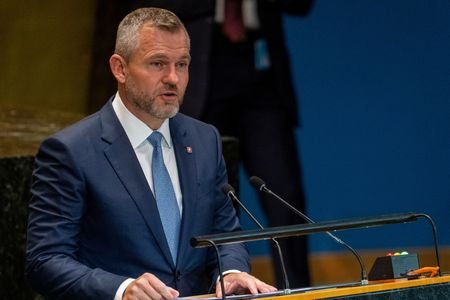
Dec 11 (Reuters) - President Peter Pellegrini on Thursday vetoed a law aiming to revamp Slovakia's whistleblower protection office, a move critics say undermines anti-corruption safeguards and the country's commitments as a European Union member.
The law, proposed by Prime Minister Robert Fico's leftist-nationalist government, was approved on Tuesday and abolishes the Whistleblower Protection Office (UOO), replacing it with a new body under a new leadership.
Fico's government, in power since 2023, had previously weakened criminal codes for financial crime, revamped the public broadcaster and pushed constitutional changes asserting national sovereignty over some European Union laws, raising criticism of the weakening of the rule of law and international commitments.
The president, in a rare clash with the government he is normally allied with, said there were no reasons to rush the legislation through and concerns voiced by the European Commission were not addressed.
"I am convinced that the government can legitimately fulfil its goals without violating legislative rules, potentially breaking rule of law principles and without threatening Slovak interest in the European Union," Pellegrini said in a statement.
The veto means that the law will go back to parliament for a new vote, where the veto can be overturned if all three government parties back it.
Pellegrini said the law could threaten Slovakia's ability to draw EU subsidies.
The government argues the UOO had been politically abused in the past.
The bill replaces the current UOO leadership and weakens the whistleblowers' position by making their protection subject to repeated re-evaluation, according to Slovak media.
It came weeks after the UOO fined the Interior Ministry in three cases involving police officers, who were reassigned during corruption investigations without the office's consent.
The European Commission said before the final version of the bill was approved that it was concerned about cancelling the mandate of the current chief of the UOO, as well as other provisions.
(Reporting by Jan Lopatka in Prague: Editing by Sharon Singleton)





