By Abdi Sheikh
MOGADISHU, Dec 25 (Reuters) - Residents of Somalia's capital Mogadishu voted on Thursday in municipal elections meant to pave the way for the East African country's first direct national polls in more than half a century.
With the exception of votes in the semi-autonomous region of Puntland and the breakaway region of Somaliland, Somalia last held direct elections in 1969, months before military general Mohamed Siad Barre took power in a coup.
After years of civil war that followed Barre's fall in 1991, indirect elections were introduced in 2004. The idea was to promote consensus among rival clans in the face of an Islamist insurgency, although some Somalis say politicians prefer indirect elections because they create opportunities for corruption.
Under the system, clan representatives elect lawmakers, who then choose the president. The president, in turn, has been responsible for appointing Mogadishu's mayor.
The vote in Mogadishu, a city of some 3 million people where security conditions have improved in recent years despite continuing attacks by al Qaeda-linked al Shabaab militants, is seen as a test run for direct elections at the national level.
Around 1,605 candidates are running for 390 posts in Mogadishu's district councils, said Abdishakur Abib Hayir, a member of the National Electoral Commission. Council members will then choose a mayor.
"It shows Somalia is standing on its feet and moving forward," Hayir told Reuters. "After the local election, elections can and will take place in the entire country."
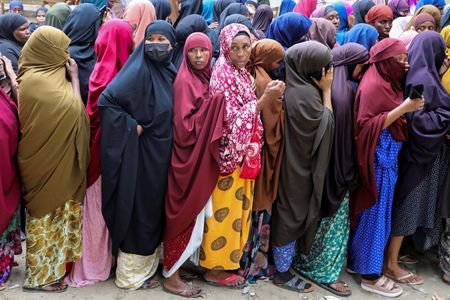
Residents waiting to vote formed long lines outside polling stations early in the morning, a Reuters witness said.
The streets were closed to vehicle traffic, and the airport, port and businesses remained closed.
The electoral commission said about 10,000 security personnel were deployed at polling stations.
"This is my first time to vote. I am very happy and I came here early in the morning, walking with other mothers," Addey Isak Abdi, 65, who was covered with a pink veil, told Reuters.
A 2024 law restored universal suffrage ahead of federal elections expected next year. However, President Hassan Sheikh Mohamud reached a deal in August with some opposition leaders stipulating that while lawmakers would be directly elected in 2026, the president would still be chosen by parliament.
Opposition parties have argued the rapid introduction of a new electoral system would benefit Mohamud's re-election prospects.
They also question whether the country is safe enough for mass voting given al Shabaab's control over vast areas of the countryside and regular strikes on major population centres.
(Reporting by Abdi Sheikh in Mogadishu and Vincent Mumo Nzilani in Nairobi, Writing by George Obulutsa; Editing by Aaron Ross and Michael Perry)