By David Latona and Maria Alejandra Cardona
CEUTA, Spain, Aug 14 (Reuters) - Spain has beefed up police and military presence in its North African enclave of Ceuta amid social media messages encouraging migrants to attempt another mass border breach on Saturday, two weeks after tens of thousands rushed into the city.
Soldiers in combat fatigues stood watch outside supermarkets and official buildings on Friday evening, while police cars heavily patrolled the enclave's main avenues. Still, outdoor cafes were packed with diners and the downtown area was calm compared to the tense scenes from the days following the deadly rush on July 30.
On the other side of the border, dozens of black-clad Moroccan security personnel surveilled the beach in Fnideq from which many migrants who swam around Ceuta's Tarajal breakwater departed. At least 96 people died in the attempt and over 72,000 managed to enter Ceuta, according to Spanish government estimates.
While the vast majority of them voluntarily returned to Morocco shortly thereafter, the crisis sparked a rift within the European Union and fuelled anti-immigration rhetoric among far-right parties worldwide.
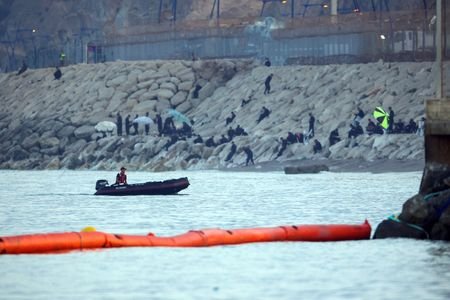
Spain has since installed a maritime barrier and sent over 500 additional police officers from the mainland. The Interior Ministry said they would remain as long as the situation required.
"We'll continue to deploy whatever personnel are necessary to restore normality as soon as possible and prevent events like those of July 30 from happening again," Interior Minister Fernando Grande-Marlaska told reporters in Ceuta on Thursday.
About 5,000 migrants remained in Ceuta, the minister said. Officials have started screening adults and decided more than 500 asylum cases, most of them rejected.
Grande-Marlaska added that people who entered irregularly would not be allowed to stay in the enclave, travel to mainland Spain or obtain legal status, except in rare cases of extreme vulnerability. Spain would return to Morocco those without a right to remain, he said.
MOROCCO STEPS UP CHECKS
Earlier this week, Rabat said it was monitoring "the circulation of social media posts and messages of unknown origin" calling for a mass crossing on August 15, warning it would prosecute organisers and participants.
Local media showed a reinforced security apparatus near the border with Ceuta and Spain's other African enclave, Melilla, including the installation of new razor wire on the fences separating the territories.
Authorities prevented several groups from boarding trains and buses to the north in cities such as Casablanca, Fez and Kenitra. However, witnesses told Reuters that some groups from sub-Saharan Africa were sidestepping security checks on the road to Fnideq, taking mountainous routes instead.
One witness said the schools in Fnideq had been turned into dormitories for security forces deployed near the border.
'MY ADVICE - DON'T CROSS'
Many of the youths who entered Ceuta on July 30 were fishing, swimming or showering at Ceuta's Tarajal beach on Friday.
Fez native Driss Sadik, 22, swam for five hours to reach Ceuta. He warned against others emulating him.
"The important thing I would advise people trying to cross: Don't cross now, my brothers. You're only going to suffer," he told Reuters.
The sentiment was echoed by 17-year-old Adil Jamil.
"Those who enter aren't going to benefit from anything. There will just be more and more of us, and they won't find a solution for all," he said.
Jamil added that the mass border rushes were "planned by the people" after choosing a day, gathering in Fnideq and crossing together to find strength in numbers.
"If I had stayed with my parents, I would've died slowly. But if I risk my life, arrive and build my future... it will be better," he said.
(Reporting by David Latona, Maria Alejandra Cardona and Achmed El Jechtimi; Additional reporting by Victoria Waldersee; Editing by Rosalba O'Brien)