By David Latona and Victoria Waldersee
MADRID, Nov 3 (Reuters) - Services on the Madrid-Seville rail line will be reduced after last week's crash until Spain's Railway Safety Agency reviews the line's safety system and the government completes the delayed rollout of the European Rail Traffic Management System (ERTMS), Transport Minister Oscar Puente told reporters on Tuesday.
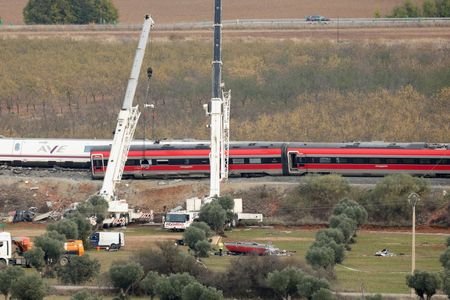
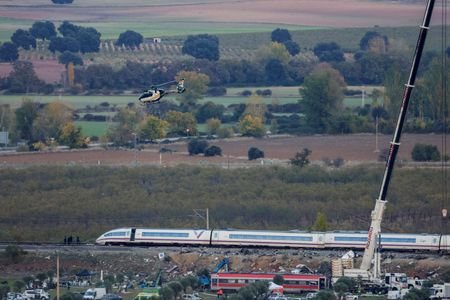
The crash killed 69 people near the town of Urda in central Spain. Another in January, involving the same companies on the same line, killed 46.
Several trains were automatically stopped last Wednesday due to the failure of a signalling system, after which central controllers in Madrid took over. A train operated by state-owned Renfe was authorised to proceed, even though there was a stationary Iryo-operated train ahead, according to Puente.
Investigators estimated an impact speed of 160 to 200 kph (100 to 125 mph).
TRANSPORT MINISTER TO FACE LAWMAKERS
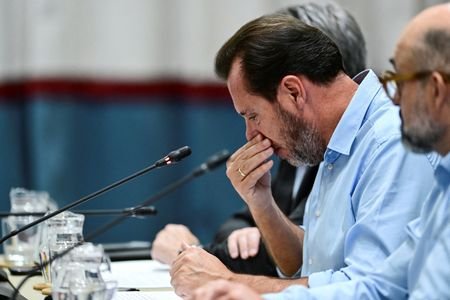
Puente, who has ruled out resigning, was to face questions from lawmakers at 5 p.m. (1600 GMT) over his handling of Europe's worst train crash since 2013, as the leftist government of Prime Minister Pedro Sanchez, seeking re-election on November 29, approved an emergency aid package for victims and their families.
It has promised to double compulsory passenger insurance payouts for crash victims, speed up compensation payments and improve temporary incapacity cover.
Puente presented new safety measures, including a 40 kph (25 mph) speed limit when relying on a driver to spot obstacles ahead if a signal system fails, hiring more staff and improving conditions in rail control centres.
The government will also push for a faster rollout of the standardised ERTMS for safety and signalling across its network. Its implementation is behind schedule on the line where the accidents occurred, government contracts show.
In addition, in what Puente said would be a world first, the railway system will introduce an AI agent to "detect anomalies and monitor conversations" between train drivers and controllers to minimise the likelihood of human error.
"We are not aware of any other railway system that uses this type of mechanism or technology. We will be the first to go down this path," Puente said, adding that Spain would also create a real-time digital model of the network.
(Reporting by David Latona, Victoria Waldersee and Emma Pinedo; Writing by Charlie Devereux; Editing by Andrei Khalip, Sharon Singleton and Kevin Liffey)