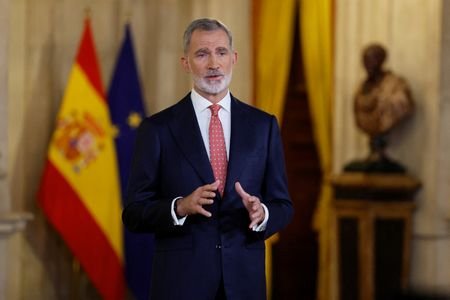
MADRID, March 16 (Reuters) - Spain's King Felipe VI acknowledged abuses in his country's colonial past on Monday, a rare admission by the Spanish crown which has never issued a formal apology to former colonies.
At its height in the 16th to 18th centuries, Spain ruled one of the largest empires in world history, spanning five continents including much of Central and Latin America, and practiced forced labour, land expropriation and violence against Indigenous people.
Spanish colonial laws "wanted to protect. But in reality things didn't work out as they were originally intended and there was a lot of abuse," the king said during a visit to the museum of archaeology in Madrid.
"When we study certain things under modern-day criteria, with our values, obviously we can’t feel proud. But we must learn from this, within its context, without too much moralising. We must learn lessons through objective and rigorous analysis,” Felipe added.
He toured an exhibition about indigenous women in Mexico and was accompanied by the Mexican ambassador to Spain, Quirino Ordaz.
Spain and Mexico have had diplomatic tensions over the legacy of Spanish colonial rule.
In 2019, Mexico's then-President Andres Manuel Lopez Obrador asked the Spanish government and late Pope Francis to apologise to indigenous Mexicans for wrongs committed during the Spanish conquest, often in the name of spreading Catholicism and civilisation.
Five years later, Lopez Obrador's successor, Claudia Sheinbaum, decided to not invite the Spanish king to her inauguration after the monarch declined to apologise for colonial-era abuses, a snub that Spain's Prime Minister Pedro Sanchez called "unacceptable".
(Reporting by Paolo Laudani; editing by Aislinn Laing and Cynthia Osterman)