By Florence Tan, Mariko Katsumura and Jonathan Saul
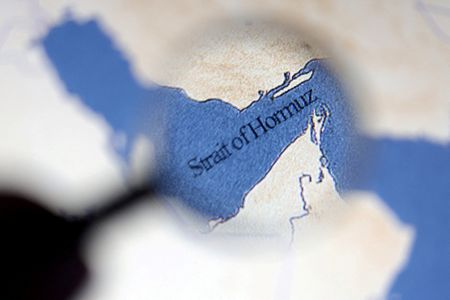
SINGAPORE/LONDON, April 14 (Reuters) - The first full day of a U.S. blockade on vessels calling at Iranian ports made little difference to Strait of Hormuz traffic on Tuesday, with at least eight ships including three Iran-linked tankers, crossing the waterway, shipping data showed.
U.S. President Donald Trump announced the blockade on Sunday after weekend peace talks in Islamabad between the U.S. and Iran failed to reach a deal.
The blockade has created even further uncertainty for shippers, oil companies and war risk insurers. Traffic remains at only a fraction of the 130-plus daily crossings before the U.S. and Israel's war on Iran began on February 28, industry sources said on Tuesday.
"During the first 24 hours, no ships made it past the U.S. blockade," the U.S. Central Command said on X, adding that six vessels complied with direction from U.S. forces to turn around to re-enter an Iranian port.
The three Iran-linked vessels that transited the strait were not heading to Iranian ports and were not affected by the blockade.
Panama-flagged Peace Gulf, a medium-range tanker, is heading to Hamriyah port in the United Arab Emirates, LSEG data showed.
The vessel typically moves Iranian naphtha, a petrochemical feedstock, to other non-Iranian Middle Eastern ports for export to Asia, Kpler data showed.
Prior to this, two U.S.-sanctioned tankers passed through the narrow waterway.
Handy tanker Murlikishan is heading to Iraq to load fuel oil on April 16, Kpler data showed. The vessel, formerly known as MKA, has transported Russian and Iranian oil.
Another sanctioned tanker, Rich Starry, would be the first to make it through the strait and to exit the Gulf since the blockade began, data from LSEG and Kpler showed.
The tanker and its owner, Shanghai Xuanrun Shipping Co, were placed under U.S. sanctions for dealing with Iran. The company could not be reached for immediate comment.
Rich Starry is a medium-range tanker carrying about 250,000 barrels of methanol, according to the data. It loaded the cargo at its last port of call, the UAE's Hamriyah, the data showed.
The Chinese-owned tanker has Chinese crew on board, the data showed.
China's foreign ministry said on Tuesday that a U.S. blockade of Iranian ports is "dangerous and irresponsible", warning that it would only aggravate tensions. The ministry did not mention whether Chinese ships were passing the strait.
FURTHER SAILINGS THROUGH THE STRAIT
Five other vessels had sailed through the strait since the blockade began at 1400 GMT on Monday. These comprised two other chemical and gas tankers, two dry bulk vessels and the Ocean Energy cargo ship that docked at Iran's Bandar Abbas port.
A U.S. military note sent to mariners and seen by Reuters said that humanitarian shipments would be exempt from the blockade.
"The United States does not need to block every type of ship or enter the Strait of Hormuz; it can carry out an intermittent blockade," said Fabrizio Coticchia, professor of political science at Italy's University of Genoa.
"Ships will not be attacked, but rather diverted," Coticchia said, adding that U.S. warships would be located outside of the strait in the Gulf of Oman.
While the cost of war-risk insurance has not increased since the blockade began, it remains at hundreds of thousands of dollars in additional weekly costs, with cover typically reviewed by underwriters every 48 hours, industry sources said.
"A return to ‘normality’ in the Middle East arguably now appears more distant than it did one week ago, especially given that the U.S. navy has started a blockade," ship broker BRS said in a report.
"It is anticipated that there will be little or no commercial traffic in the strait for the foreseeable future."
(Reporting by Florence Tan in Singapore, Mariko Katsumura in Tokyo, Jonathan Saul in London, Arathy Somasekhar in Houston and Francesca Landini in MilanEditing by Himani Sarkar, Jamie Freed, Sharon Singleton and David Goodman)