By Dave Sherwood
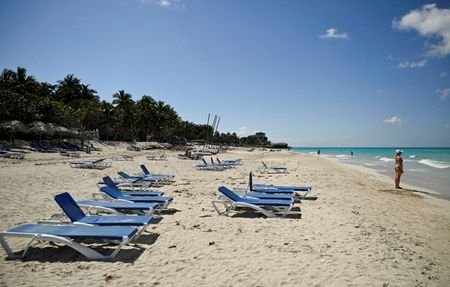
VARADERO BEACH, Cuba, Feb 18 (Reuters) - Cuba's Varadero peninsula is a postcard of a tropical paradise: turquoise waters, powder-white sand and palm trees.
But the resort's beaches, once crowded with tourists enjoying the sand and sunshine, began to clear out shortly after Cuba announced on February 8 it was running out of jet fuel.
And they may not be coming back anytime soon.
A Reuters survey of hotel and travel companies, airlines and on-island tourism industry workers found virtually every sector suddenly crippled by the fuel shortage. That could sound a death knell for an already hobbled industry vital to what remains of Cuba's devastated economy.
Air Canada, WestJet and Transat - the top carriers from Canada, the largest source of visitors to Cuba - have announced they are suspending flights to Cuba. That will lead to the cancellation of as many as 1,709 flights through April, according to analytics firm Cirium, a disruption likely to slash visitor numbers by the hundreds of thousands during the peak northern hemisphere winter season.
Russia, the third-largest visitor group, plans to fly its tourists out of Cuba in the coming days and then suspend all flights until the fuel shortage eases, aviation regulator Rosaviatsia said last week.
Hotel giant NH said on Friday it had closed all of its hotels in Cuba, and Spanish hotel chain Melia, the largest in Cuba, said the same day it had closed three of its 30 Cuban hotels and had begun concentrating tourists in better-equipped hotels with higher occupancy rates.
"There is just total uncertainty," said Alejandro Morejon, a 53-year-old tourism guide who began work in Varadero shortly after Cuba re-opened to international tourism in the 1990s. "Everything is beginning to fall apart."
Tourism is poised to become the first major domino to fall in a U.S. push to pressure Cuba's government into submission by blocking shipments of oil from reaching the island nation.
U.S. President Donald Trump's administration has declared Cuba "an unusual and extraordinary threat" to U.S. national security, cutting off the flow of Venezuelan oil to the island and threatening to slap tariffs on any nation supplying Cuba with fuel.
Tourism earned the communist-run nation $1.3 billion in foreign exchange in 2024, the last time those statistics were reported in dollars, for a total of around 10% of export earnings.
Paolo Spadoni, an economist at Augusta University in Georgia who studies Cuba's economy, said the tourism sector combined with the export of Cuban doctors and remittances are the country's top sources of desperately needed hard currency.
All are under renewed attack by the Trump administration, whose tough sanctions had already helped prevent the island's resort sector from fully bouncing back from the pandemic.
"The complete collapse of Cuba's tourism sector would create an unsustainable situation for the Cuban economy and threaten its survival," Spadoni said.
Cuba attracted just 1.8 million visitors in 2025, down from 2.2 million the prior year, and its lowest point in more than two decades.
Visitors said they were having a hard time unwinding, anxious over Cuba's announcement just days prior that it was fast running out of jet fuel.
"We're just winging it, trying not to stress, because we don't want it to ruin our trip," said Tyler LaMountaine, an Alberta-based oil and gas industry worker who had come to Cuba with his wife to escape Canada's cold winter but worried they could end up stranded by the canceled flights. "But you get scared because everyone else is scared."
Cuba's communist-run government earlier in February announced a contingency plan to protect vital services like emergency care and primary education.
Top officials initially said tourism and international flights would also be unaffected, but two days later, the government notified aviation interests that the island would shortly run out fuel.
Airlines across Europe, South America, the United States, Russia and Canada have since slashed flights or been forced to change flight patterns to deal with the fuel shortfall.
STORM CLOUDS LOOMING
On the surface, all appears normal in Varadero, a beach resort once a favorite wintering ground of the DuPont family prior to Cuba's 1959 revolution, but now a favorite getaway for Europeans and Canadians during the northern winter.
Until late last week, trinket shops and most restaurants remained. Beach chairs and sun umbrellas dotted the beaches, and sunburned tourists picked up shells and swam in almost perfectly transparent water.
But at least two hotels had closed on the peninsula, Reuters confirmed.
A security guard at the Domina Marina resort, a massive complex with several towers overlooking a sprawling marina built in the early 2010s, stopped a reporter from entering the hotel and said it was closed. The hotel's local phone number was out of service.
Keeping the doors at hotels and restaurants open will become harder as the U.S. fuel siege enters its third full week, local workers said.
Jorge Fernandez, who takes tourists for tours of the peninsula in a pink 1950s-era convertible, said late last week that he had enough fuel to last him for just one more day.
"After that, it's back home to invent something else to do," the 53-year-old said.
"Trump and (Cuban President) Miguel Diaz-Canel need to come to some agreement because the only ones that are suffering here are the people," Fernandez said. "The country is shutting down."
(Reporting by Dave Sherwood in Varadero, additional reporting by Marc Frank in Havana, Allison Lampert in Montreal, and Inigo Alexander and Natalia Siniawski in Mexico City; Editing by Christian Plumb and Alistair Bell)