By Andrew Chung
WASHINGTON, April 29 (Reuters) - The U.S. Supreme Court appeared inclined on Wednesday to let President Donald Trump's administration strip humanitarian protections from hundreds of thousands of Haitian and Syrian immigrants, part of his signature immigration crackdown.
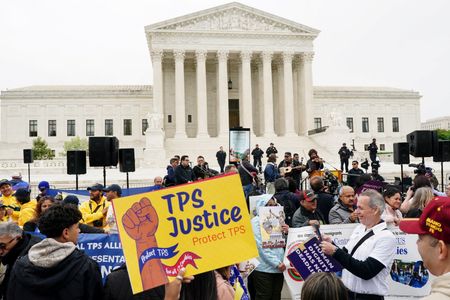
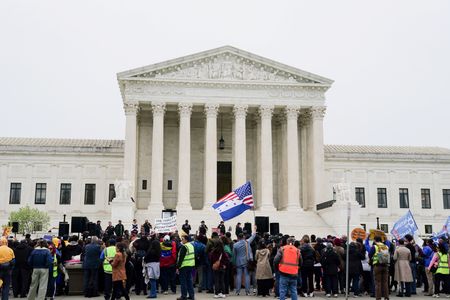
The justices heard arguments in the administration's appeal of rulings by federal judges in New York and Washington, D.C., halting its actions to terminate Temporary Protected Status, or TPS, previously provided by the U.S. government to more than 350,000 people from Haiti and 6,100 from Syria.
The State Department currently warns against traveling to either Haiti or Syria, citing widespread violence, crime, terrorism and kidnapping.
The court has a 6-3 conservative majority. Several of the conservative justices appeared sympathetic toward the administration's arguments that courts cannot second-guess its decisions to end TPS protections. Some of the justices, including liberal Elena Kagan, questioned the claim by the challengers that the administration did not follow mandatory protocols for making such decisions under the law governing TPS.
The legal dispute presents a test of Trump's executive power and the Supreme Court's traditional deference to presidents on matters of immigration, national security and foreign policy. The court last year let the administration end TPS for hundreds of thousands of Venezuelans.
Groups of Syrian and Haitian TPS holders filed class-action lawsuits separately challenging the administration's moves.
JUDICIAL REVIEW
Much of the argument centered on language in the TPS law that bars judicial review "of any determination" with respect to granting, extending or ending TPS.
"If we apply ordinary meaning of that term here, I really don't understand how you can prevail," conservative Justice Samuel Alito told Ahilan Arulanantham, a lawyer for the Syrian immigrants.
Arulanantham said the statute allows courts to review whether the administration complied with procedures that Congress set out in the law.
"The government reads this statute like a blank check," Arulanantham said.
Arulanantham said that if the court endorses the Trump administration's view of the TPS law, a future administration could use the statute to provide mass immigration relief and "the courts could do nothing."
U.S. Solicitor General D. John Sauer, arguing for the Trump administration, said the lawsuits by the plaintiffs "challenge the very kind of foreign policy-laden judgments that are traditionally entrusted to the political branches."
Revoking TPS and other humanitarian protections is part of Trump's broader rollback of legal and illegal immigration since returning to office in January 2025. In defending its actions on TPS, the administration has said such protections were always meant to be temporary. The United States first provided TPS to Haitians after a major earthquake in 2010 and to Syrians after their country descended into civil war in 2012.
TPS is a designation that allows migrants from countries stricken by war, natural disaster or other catastrophes to live and work in the United States while it is unsafe for them to return to their home countries.
The dispute could have wide implications, affecting 1.3 million immigrants from all 17 countries currently designated for TPS, according to the plaintiffs. Trump's administration has sought to rescind the protections for 13 of those countries so far.
Liberal Justice Sonia Sotomayor expressed doubt that Congress intended there to be no judicial scrutiny of TPS decisions given that it wrote specific procedural steps into the statute.
"What you are basically saying is Congress wrote a statute for no purpose," Sotomayor told Sauer.
Responding to a question about judicial review from conservative Justice Brett Kavanaugh, Sauer cited foreign-policy implications of TPS decisions that belong to the executive branch.
"It's almost like these district court judges (are) appointing themselves junior varsity secretaries of state," Sauer said.
REQUIRED PROTOCOLS
Lower courts ruled that administration officials failed to follow the required protocols to assess conditions in a country before revoking its designation. The consultation consisted only of a State Department official replying to a Homeland Security Department official's email to say there were "no foreign policy concerns" with ending the designations.
"There was some consultation," Alito told Arulanantham. "It was very brief, and maybe it was not what one would hope for, but still."
Kagan asked Arulanantham that if the State Department says it has no foreign policy concerns, "Is that really going to make the difference between what is permissible consultation and what is not permissible consultation?"
At issue are actions taken last year by Kristi Noem, Trump's former Department of Homeland Security secretary, to revoke the TPS designations for Syria and Haiti, stating that providing this status to them was contrary to U.S. national interests. Noem's TPS decisions were not at issue when Trump fired her in March.
The Supreme Court has granted the Republican president's requests to immediately implement various hardline immigration policies while legal challenges continue to play out in courts. For instance, it let Trump deport immigrants to countries where they have no ties and let federal agents target people for deportation based in part on their race or language.
'RACIAL ANIMUS'
The plaintiffs said Noem's actions and the pattern of ending humanitarian designations for various countries show that the decisions were a preordained effort to eliminate the TPS program.
In the Haitian case, Washington-based U.S. District Judge Ana Reyes said the administration's action likely was motivated in part by "racial animus," violating the U.S. Constitution's Fifth Amendment promise of equal protection under the law. Reyes said it was likely that Noem preordained her termination decision "because of hostility to nonwhite immigrants."
Trump has long sought to rescind TPS protections, and while running for reelection in 2024 vowed to revoke TPS for Haitian immigrants after making false and derogatory claims that they were eating household pets in Ohio.
On Wednesday, Sotomayor and liberal Justice Ketanji Brown Jackson pressed Sauer on Trump's prior statements including that immigrants in the country illegally are "poisoning the blood of our country," suggesting that in context they showed a discriminatory purpose in revoking TPS.
(Reporting by Andrew Chung, Jan Wolfe, John Kruzel and Blake Brittain in Washington; Editing by Will Dunham)