By Ben Blanchard and Angie Teo
TAIPEI, Nov 6 (Reuters) - Taipei's mayoral election this month will be a victory for democracy in the face of pressure from China whoever wins, said the ruling party's candidate who Beijing detests as a "separatist".
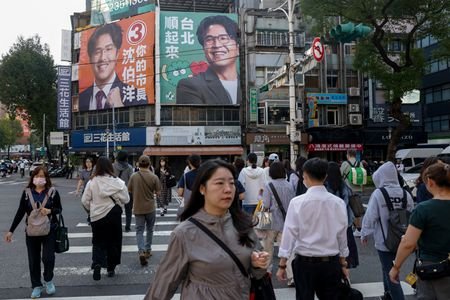
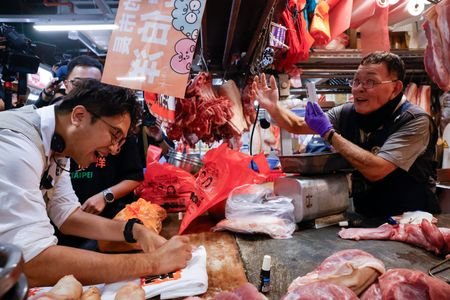
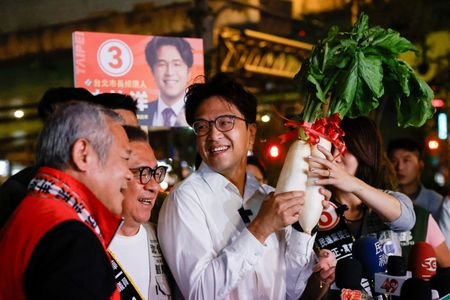
The Democratic Progressive Party's (DPP) Puma Shen, an academic-turned-lawmaker, is vying to win back the capital for the party for the first time in three decades.
Shen has been repeatedly attacked by Beijing, which has opened a police investigation into him.
China, which views Taiwan as its own territory in claims rejected by Taipei, is not directly on the ballot for the local elections on November 28. Shen and incumbent Taipei mayor Chiang Wan-an, who has been in office since 2022, have focused on issues such as urban renewal.
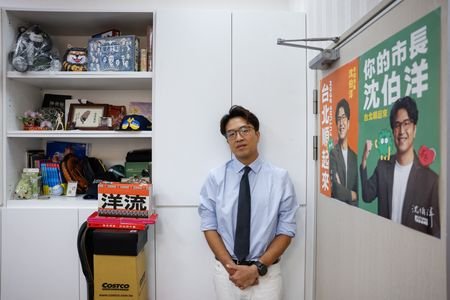
Speaking to Reuters at his legislative office this week, Shen said China was unhappy at the fact that Taiwanese could freely choose their leaders. Some polls have put Shen within striking distance of Chiang or even ahead of him.
"For me, even if Chiang Wan-an got elected, it's also a slap to China. Because we proved that democracy works here in Taiwan and we're not interfered (with) by China," he said.
"If I got elected, I don't think it's even a slap: it's because of democracy."
Chiang's campaign team did not respond to a request for comment.
Last year, police in the Chinese city of Chongqing said they had opened a probe into Shen over separatism charges.
While China's legal system has no authority or jurisdiction in Taiwan, it has put sanctions on senior Taiwanese officials it does not like, including Shen and Vice President Hsiao Bi-khim.
The Chongqing government did not respond to a request for comment on the state of the police investigation into him, and Shen said police there had never tried to contact him.
TAIPEI-SHANGHAI FORUM
China's government refuses to talk to President Lai Ching-te, saying he is a "separatist". Lai says only Taiwan's people can decide their future.
The main remaining high-level government interaction between the two sides is the annual Taipei-Shanghai city forum. Mayor Chiang is from the main opposition party, the Kuomintang, which traditionally favours close ties with Beijing.
Shen said he would be willing to continue the forum as long as there were no political preconditions attached to it or "harassment", and China was probably wondering what to do about the event if he became mayor.
"Because they still need a certain kind of exchange between Taipei and Shanghai. They need that mechanism. So my hypothesis is that, because China still needs that, they still need exchanges, they still want to talk with you," he said.
China's Taiwan Affairs Office did not respond to a request for comment. Referring to Shen last month, it said "diehard" separatists "have no qualifications to speak glibly of cross-strait exchanges and cooperation."
'OCEAN CURRENT'
Shen was previously better known for his work on Chinese disinformation, and as co-founder of the Kuma Academy, which runs civil defence courses to prepare people to deal with a possible attack from Beijing.
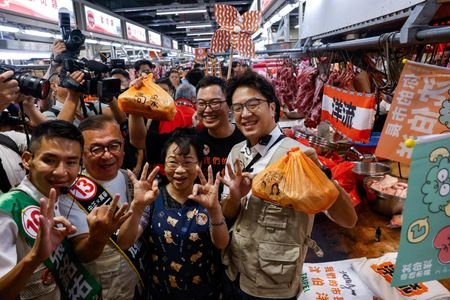
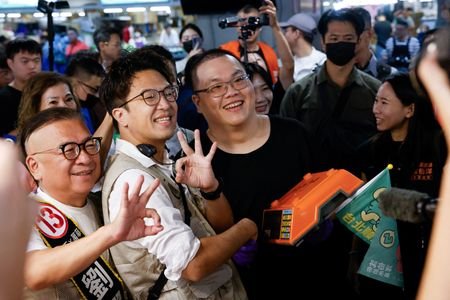
Over the past few weeks, helped by a savvy social media campaign, Shen's events have been packed in what has become known as the "Ocean Current", a play on one of the Chinese characters in his name which literally means "the ocean".
Shen said his campaign was not focused on China because he was running for mayor not president, and what attracted support was his push on bread-and-butter issues.
"So you need to talk to people who didn't really support you before, or they really have some opposite ideas compared to my beliefs about China," he said.
(Reporting by Ben Blanchard and Angie Teo; Editing by Kate Mayberry)