TAIPEI, May 15 (Reuters) - Taiwan will deepen ties with the United States following talks between President Donald Trump and Chinese leader Xi Jinping in Beijing, its foreign minister said on Friday, adding that it was China that was increasing regional "risks".
Trump said earlier on Friday on his way home from Beijing that he had discussed U.S. arms sales to Taiwan with President Xi and said he would soon make a decision on the matter, highlighting a flashpoint in U.S.-China relations.
The U.S. is Taiwan's most important international backer, while China, which claims the democratically governed island as its own, has demanded that such arms sales stop.
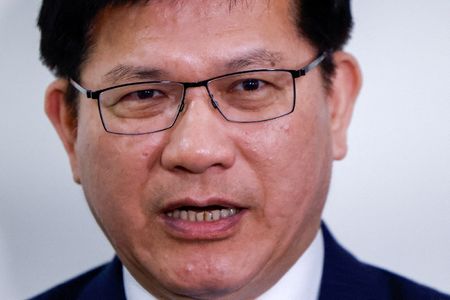
In a post on his Facebook page which did not directly reference Trump's remarks, Taiwanese Foreign Minister Lin Chia-lung said many Taiwanese had been "concerned" by the U.S. president's meeting with Xi.
"I want to report to everyone that my diplomatic team and I have continued to closely monitor the situation, and have maintained good communication with the United States," Lin said.
"Taiwan occupies a key geostrategic position and is a responsible and trustworthy partner of the international community. Looking ahead, we will continue to deepen cooperation with the United States and like-minded countries in the Indo-Pacific," he added.
Lin pointed to comments by U.S. Secretary of State Marco Rubio on Thursday that U.S. policy towards the island remains unchanged. Trump reiterated that stance in his comments to reporters on board his plane on Friday.
ARMS SALES
Last December the U.S. approved an $11 billion arms sales package for Taiwan, the largest ever, and a second one worth some $14 billion is awaiting Trump's approval, Reuters has previously reported.
China has never renounced the use of force to bring Taiwan under its control. The U.S. is bound by law to provide Taiwan, whose government rejects Beijing's sovereignty claims, with the means to defend itself.
Lin said Taiwan has always been a contributor to, and guardian of, peace and stability in the Taiwan Strait.
"The party that has truly continued to heighten regional risks is China, with its expanding military activities and authoritarian oppression in recent years," Lin said.
"China, which is attempting to change the international order and the status quo of regional peace and stability, is the main source of threat that is widely concerning the international community."
Xi told Trump on Thursday that mishandling the countries' disagreements over Taiwan could push China-U.S. relations to a "dangerous place".
(Reporting by Ben Blanchard and Yimou Lee; Editing by Jacqueline Wong, Stephen Coates, Kate Mayberry and Gareth Jones)