By Matt Spetalnick and Humeyra Pamuk
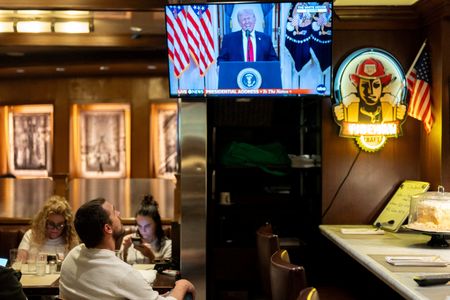
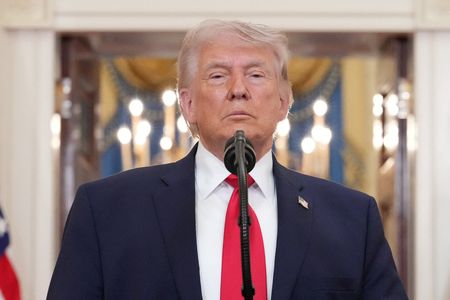
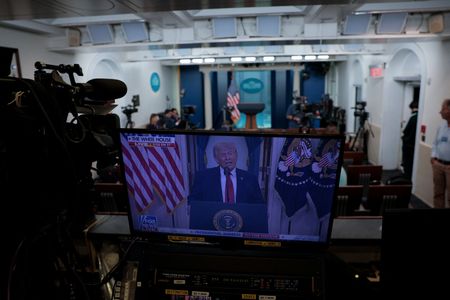
WASHINGTON, April 1 (Reuters) - President Donald Trump staunchly defended his handling of the month-old U.S.-Israeli war on Iran in a prime-time address on Wednesday, saying the U.S. military was nearing completion of its mission while also reinforcing his threats to bomb the Islamic Republic back to the Stone Age.
He delivered his 19-minute speech against a backdrop of high global oil prices and his own low approval ratings.
Here are some key takeaways:
LOOKING FOR AN EXIT - BUT NOT QUITE YET
Trump, facing a war-wary American public and sliding poll numbers, said the U.S. had destroyed Iran's navy and air force, crippled its ballistic missile and nuclear program and would continue to hit them “extremely hard” over the next two to three weeks.
But beyond that, even while saying the U.S. military was on track to complete its objectives “very fast,” he stopped short of offering a firm timeline for an end to hostilities.
And he suggested the war could escalate if Iranian leaders did not capitulate to U.S. terms during negotiations, with strikes on Iran's energy and oil infrastructure possible.
Trump’s use of his speech to reiterate threats and send mixed messages may do little to calm jittery financial markets and ease the concerns of an American public that has shown little support for the country’s biggest military operation since the 2003 invasion of Iraq.
The often conflicting signals that Trump has issued throughout the course of the conflict have only added to confusion, with the president one moment calling for a diplomatic settlement and in the next threatening to rain further destruction on Iran amid a continuing U.S. military buildup in the region.
THE STRAIT OF HORMUZ
Trump’s comments on Wednesday were not clear about whether U.S. military operations could end even before Iran reopened the Strait of Hormuz, the vital waterway on which it has a chokehold that has created the worst global energy shock in history.
He instead repeated his calls for countries that rely on Gulf oil to "take the lead" and assume the burden of reopening the waterway, not the U.S., which he said does not need energy supplies from the region.
Western allies, however, have resisted joining a war that he and Israeli Prime Minister Benjamin Netanyahu started without consulting them.
In his speech, however, Trump stopped short of saying, as he has in recent media interviews, that he is considering withdrawing from NATO over what he sees as its failure to support the U.S. in the Iran conflict.
The risk, analysts say, is that Iran would essentially be left with significant leverage over the strait, the passageway for a fifth of the world’s oil and natural gas shipments.
Washington’s Gulf allies may also resent a hasty U.S. exit, given that they could be left with a wounded, hostile neighbor.
MISSION ACCOMPLISHED?
Trump touted the U.S. military’s successes in the conflict but questions remain about whether he has truly achieved the main goal he laid out at the start of the war: Closing off Iran’s path to a nuclear weapon.
More than a month later, Iran still has a stockpile of highly enriched uranium that could be processed to bomb grade, but it is believed to be mostly buried underground by U.S.-Israeli bombing in June.
Trump, in a sudden reversal from his demands that Iran turn over the enriched uranium, told Reuters earlier on Wednesday that he no longer cared about the material because it was “so far underground” and U.S. satellites could keep an eye on the area. Iran has always denied seeking a nuclear bomb.
While threatening new air strikes if Iran tries to move the stockpile, he made no mention of sending special forces on a risky mission to seize it, which U.S. officials have said is among the options under consideration. However, any deployment of ground troops would likely anger most Americans.
Despite Trump’s claims of having destroyed Iran’s conventional military capabilities, it has demonstrated that its remaining missiles and drones can still be used to target Israel as well as U.S. Gulf allies and American military installations housed on their land.
And Trump’s earlier calls for the overthrow of Iran’s theocratic rulers have gone unfulfilled. U.S.-Israeli air strikes killed many of the top leaders, including Supreme Leader Ayatollah Ali Khamenei, but they have been replaced by even more hard-line successors, including Khamenei's son. U.S. intelligence has deemed the Iranian government largely intact.
DOMESTIC POLITICS
Trump’s speech, his first prime-time address since the war started on February 28, was originally seen as being aimed at easing Americans’ concerns about the interventionist tendencies of a president who campaigned for his second term on a promise to keep the U.S. out of “stupid” military interventions.
But Trump, whose advisers have pressed him to show the public that he considers kitchen-table issues a priority, gave only a nod to Americans’ anxieties and appeared to dismiss their economic pain as temporary and sure to ease once the war is over.
“Many Americans have been concerned to see the recent rise in gasoline prices here at home,” he said. “This short-term increase has been entirely the result of the Iranian regime launching deranged terror attacks against commercial oil tankers of neighboring countries that have nothing to do with the conflict."
While Trump’s MAGA movement has mostly stood with him, his grip on his political base could weaken if the economic impact, including high gas prices, persists with his Republican Party scrambling to keep control of Congress in November’s midterm elections.
Trump’s overall approval rating has fallen to 36%, the lowest since his return to the White House, a Reuters/Ipsos poll completed on Monday found.
After his TV appearance, stocks fell, the dollar strengthened and oil rose as Trump stopped short of providing a clear outline for when the war would end.
The market reaction reflects a basic problem with Trump's dissonant messaging: He wants to reassure Americans that the war will be over soon, while at the same time threatening Iran with new attacks and suggesting he may leave without opening the Strait of Hormuz.
FLAT PERFORMANCE?
Wednesday’s address offered Trump precious prime-time viewership and a chance to reset with voters. He made a dramatic entrance, walking through double doors in the White House residence to approach the podium.
But for the next 19 minutes, he spoke in a mostly subdued tone in a dimly lit room, sticking to well-worn talking points instead of clarifying his reasons for taking the U.S. to war.
It was a far cry from the usual public appearances of the former reality TV star who was in front of probably his biggest audience since February’s State of the Union address.
(Reporting By Matt Spetalnick and Humeyra Pamuk, additional reporting by Trevor Hunnicutt; Editing by Don Durfee and Thomas Derpinghaus)