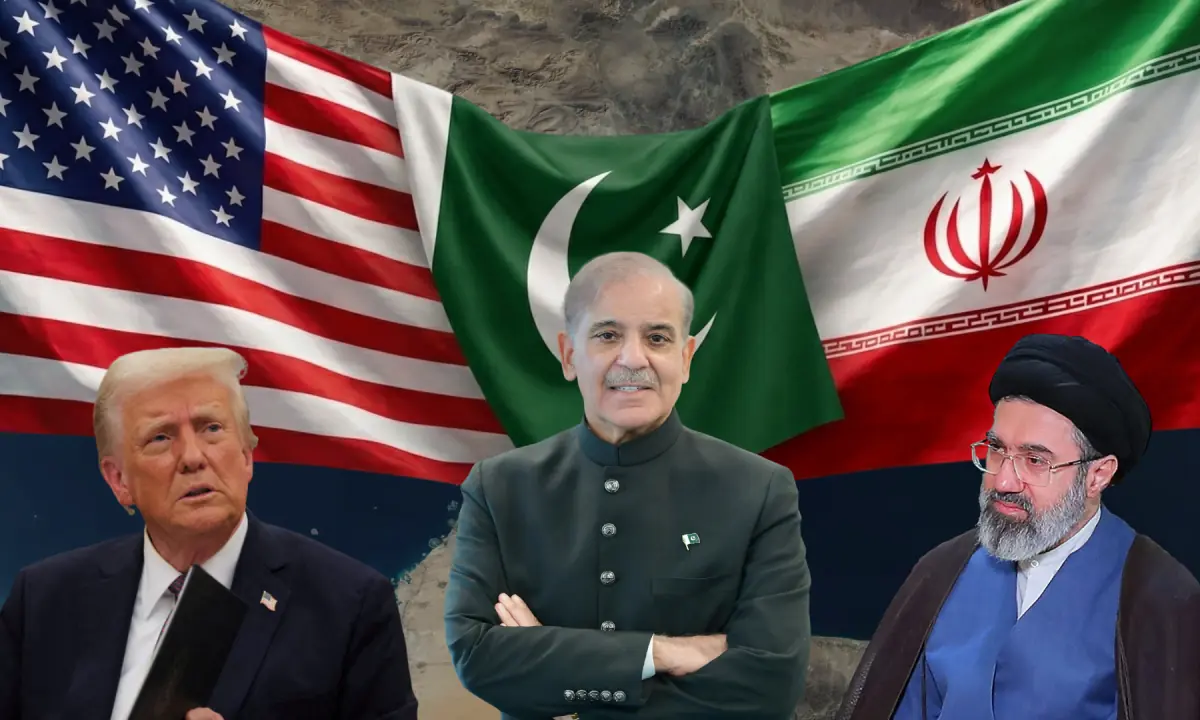
The current Iran crisis, triggered by the American Israeli attack on Iran, may prove to be one of the most consequential geopolitical turning points of the early twenty first century. What unfolded on 28 February 2026 was not merely another episode in the long history of Middle Eastern conflict. It represented the opening of a new strategic chapter that may reshape alliances, deterrence doctrines, and regional power balances across both the Middle East and South Asia. For Pakistan in particular, this unfolding crisis may present a historic opportunity, one that could shift the country from the periphery of regional politics to the very center of emerging geopolitical alignments.
The Spark That Ignited the Crisis
The war reportedly began with an unprecedented American Israeli aerial assault on Tehran on 28 February 2026. According to widely circulated accounts, the attack assassinated Iran’s Supreme Leader, Ayatollah Ali Khamenei, along with members of his family and several senior Iranian military and government officials. The uncalled for operation represented one of the most dramatic decapitation strikes in modern geopolitical history. For nearly half a century, relations between Iran and Israel had been defined by deep hostility. Since the Iranian Revolution of 1979, Iran’s ideological and strategic opposition to Israel had shaped much of the region’s security architecture. Iran’s unwavering support for the Palestinian cause, expressed through diplomatic advocacy, financial assistance, and military backing of resistance groups, placed Tehran squarely in confrontation with Israel and its principal ally, the United States.
Benjamin Netanyahu is on record for nearly three decades repeatedly urging the United States and Western powers to attack Iran, often warning that Tehran was only weeks or months away from acquiring nuclear weapons. For years, several American presidents were reluctant to follow that path, believing that diplomacy and containment could still prevent escalation. However, Donald Trump, with his impulsive and mercurial political style, ultimately moved toward confrontation with Iran. It is notable that during his presidency Trump was even described by some commentators and Jewish political figures as the “Jewish president of America,” reflecting the strong support he received from pro Israel lobbying circles including AIPAC. With a cabinet that included hawkish figures such as Marco Rubio and J.D. Vance, alongside close advisers like Jared Kushner, Trump’s Jewish son in law who maintained deep connections with Israeli leadership, the alignment between Washington and Tel Aviv reached an unprecedented level. For many observers, it therefore came as little surprise that under Trump’s presidency the United States eventually joined Israel in attacking Iran.
Some critics have also linked the timing of the war to the resurfacing of the Jeffrey Epstein scandal. Trump’s name reportedly appeared multiple times in documents related to the Epstein case, and public pressure for further investigation was growing. According to this interpretation, the escalation with Iran served as a geopolitical diversion that redirected domestic political attention away from the controversy surrounding the Epstein files. Whether this interpretation proves accurate or not, it illustrates the highly politicized environment in which the decision to attack Iran was ultimately made.
For decades, analysts had speculated about the possibility of a catastrophic confrontation between Iran and Israel, often described metaphorically as a geopolitical “Armageddon.” Many observers now believe that this long anticipated confrontation has finally begun to unfold.
The Prelude: The 2025 Escalation
The seeds of the present crisis were visible earlier. In June 2025, a dramatic twelve day escalation between Iran and Israel appeared to serve as a preview of the larger conflict to come. During that period, Israel reportedly conducted a stealth operation that eliminated several Iranian political figures and nuclear scientists. Among those killed was Ismail Haniyeh, the leader of Hamas, who was visiting Tehran at the time.
Despite the shock of the operation, Iran demonstrated remarkable resilience and resolve in its response. Rather than retreating strategically, Tehran adopted a posture that many analysts described as a “punch for punch” doctrine. Iran reportedly responded with direct and indirect strikes against both American and Israeli targets.
These responses included operations against military installations as well as symbolic demonstrations of strategic capability. Iran’s retaliatory posture suggested that it would not hesitate to respond to assassination campaigns or attacks on its nuclear infrastructure with equal intensity. The message was clear that Iran would not absorb strategic blows without answering them. Although the 2025 confrontation eventually subsided, it left all sides wounded and more deeply entrenched in their positions. Many observers described it as a “trailer” for the much larger war that could follow.
War Expands Across the Region
The events of 2026 appear to have confirmed those fears. Since the outbreak of the present war, both sides have claimed significant damage inflicted upon the other. Reports circulating in international and regional media suggest that multiple American military facilities across the Gulf region including installations in Kuwait, the United Arab Emirates, Bahrain, Qatar, Iraq, and Saudi Arabia have suffered damage. Critical infrastructure in several Gulf states has also reportedly been affected. Meanwhile, resistance groups across the region have become increasingly active, particularly in Iraq, further widening the theater of conflict. Yet perhaps the most striking development has been Iran’s domestic resilience. Despite years of economic sanctions, inflation, and internal unrest, the Iranian state appears to have rallied substantial public support in the face of external attack. Millions of citizens reportedly took to the streets in demonstrations of national solidarity. This mass mobilization surprised many observers who had previously believed that internal dissatisfaction might weaken Iran’s resolve during wartime. Instead, the crisis appears to have reinforced national cohesion. The war now increasingly resembles an existential struggle in which both sides perceive the stakes as survival itself.
Expanding Strategic Anxiety: Bennett’s Remarks
As the war intensifies, the rhetoric emerging from Israeli leadership has also raised alarm across the broader region. Former Israeli Prime Minister Naftali Bennett reportedly made a statement suggesting that Türkiye could become “the next Iran.” The remark also referenced nuclear armed Pakistan and Saudi Arabia in ways that many analysts interpreted as identifying Israel’s future strategic concerns or adversaries. It is also worth noting that current Israeli Prime Minister Benjamin Netanyahu has previously made statements describing Pakistan as a potentially dangerous country for Israel, reflecting longstanding concerns within Israeli strategic thinking about Pakistan’s nuclear capabilities and its support for the Palestinian cause.
Such rhetoric inevitably triggered anxiety across regional capitals. Türkiye remains a powerful NATO member with a large and capable military. Pakistan, meanwhile, is the only nuclear armed state in the Muslim world and commands significant strategic weight with its population of more than 250 million people. Many analysts considered the statement unusually provocative. At a moment when Israel was already engaged in a high intensity conflict with Iran, expanding rhetorical confrontation toward other major regional powers risked widening the strategic front even further. Yet for some observers, the remark was not entirely surprising. Israeli strategic discourse has occasionally framed both Iran and Pakistan as long term threats. Bennett’s statement therefore appeared to reflect deeper anxieties within Israeli security thinking.
The evolving situation also brings into focus broader geopolitical thinking. Russian President Vladimir Putin famously remarked in 2018 that “Why do we need a world if Russia is not in it?” That statement reflected the doctrine that some states view their survival as inseparable from the global balance of power. Stating also that Israel has refused to sign the Nuclear Non Proliferation Treaty for nuclear arms and has not allowed the International Atomic Energy Agency to inspect its nuclear sites. There has long been an argument that Israel possesses a nuclear arsenal, although officially it has neither confirmed nor denied it. Nevertheless, many around the world believe Israel possesses nuclear weapons capability. There have also been references to what is known as the Samson Option, the idea that if Israel were ever to face an existential threat it might choose to use overwhelming force, even nuclear weapons, rather than allow the destruction of the state.
The current crisis therefore changes the entire strategic environment of the region. America’s role remains central. Under the American security umbrella, Israel has often been supported, encouraged, and protected in various strategic confrontations. Critics argue that rather than strictly pursuing an “America First” doctrine, Washington has sometimes appeared to follow a policy that prioritizes Israeli security interests. This raises the possibility that, at best, the United States might remain neutral if a confrontation expanded toward Türkiye or Pakistan, and at worst it might actively support Israel in doing so.
Pakistan’s Strategic Position
The recent events in the Middle East, not far from Pakistan’s borders, must give Pakistan’s military establishment much to think about. The rapid collapse of the Syrian government under Bashar al Assad, followed by the swift rise of armed groups that advanced across large parts of the country and ultimately reached Damascus, demonstrated how quickly even seemingly powerful governments can unravel when regional and global forces align against them.
Similarly, the arrest of Venezuela’s President Nicolás Maduro by American forces in a surprise decapitation operation, the Israeli strike in Lebanon that killed Hezbollah leader Hassan Nasrallah, and the current events in Iran all raise serious strategic questions. Despite close ties between countries such as Venezuela, Syria, and Iran with major powers like Russia and China, those relationships did not ultimately prevent decisive military pressure from the United States or Israel. These developments illustrate a stark reality of international politics that when a country comes under attack by powerful adversaries it often finds itself largely on its own.
Amid this shifting landscape, Pakistan’s role is becoming increasingly relevant.
Pakistan’s military is widely regarded as one of the most disciplined and professional armed forces in the developing world. Yet beyond institutional discipline lies another factor that shapes Pakistan’s strategic behavior, the cultural and psychological temperament of its society.
The Pakistani national psyche, influenced by religious conviction and historical experience, tends to resist coercion and external pressure. This disposition has been repeatedly demonstrated in Pakistan’s confrontations with India. In several crises, Pakistan has shown a willingness to climb higher on the escalation ladder rather than retreat. In recent skirmishes with India where Pakistan reportedly downed seven Indian jets within the span of an hour as reported by Donald Trump himself, missile attacks inside Iran targeting terrorist groups in response to an earlier Iranian attack on Pakistani territory, and last month’s surgical strikes inside Afghanistan targeting militant groups all demonstrate the resolve, capability, and execution of the Pakistani armed forces to hold the upper hand on the escalation ladder.
The pattern has reinforced a perception among strategic analysts that Pakistan would not hesitate to employ decisive force if confronted with an existential threat. This psychological posture makes Pakistan an exceptionally dangerous adversary for any state contemplating direct confrontation. If tensions were ever to escalate dramatically between Pakistan and Israel, Pakistan’s leadership could potentially consider pre emptive strategic measures rather than waiting to absorb a first strike.
Pakistan’s conventional military strength, combined with its sophisticated nuclear arsenal and long range missile capabilities, provides a powerful deterrent framework. Any adversary contemplating conflict must therefore calculate the risks very carefully.
China: Pakistan’s Strategic Anchor
Another critical dimension of Pakistan’s strategic importance lies in its close relationship with China. The Pakistan China partnership is often described using a famous phrase repeated by leaders of both countries that their friendship is “higher than the Himalayas, deeper than the oceans, and sweeter than honey.” This relationship has evolved into one of the most significant strategic partnerships in Asia. At the heart of this cooperation lies the China Pakistan Economic Corridor, a flagship component of China’s Belt and Road Initiative launched by Chinese leadership. Through CPEC, China has invested tens of billions of dollars in infrastructure, energy, and connectivity projects across Pakistan.
Pakistan’s geographical position gives China direct access to the Arabian Sea through the port of Gwadar, significantly reducing Beijing’s dependence on vulnerable maritime routes through the Strait of Malacca. Strategically, Pakistan also serves as an important counterweight in China’s rivalry with India. Some analysts have even suggested that Chinese officials privately view Pakistan as playing a role similar to Israel in American strategic thinking, a trusted regional partner whose security and stability are deeply intertwined with their own.
Saudi Arabia and Emerging Security Cooperation
Another notable development has occurred in Saudi Arabia’s evolving relationship with Pakistan. Following Israeli attacks on Qatar infrastructure last year, the Saudi leadership reportedly moved quickly to initiate high level dialogue with Pakistan’s government under Prime Minister Shehbaz Sharif. Several meetings were held with Pakistan’s military leadership , especially the Field Marshall Asim Munir, about developing deeper security cooperation.
These discussions reportedly explored the possibility of a more formal mutual security arrangement between the two countries under which an attack on one state could be considered an attack on the other. Saudi Arabia has long relied on Pakistan for military cooperation, training, and advisory roles. The recent regional instability may accelerate that relationship further.
Toward a New Strategic Bloc
The ongoing crisis highlights a broader pattern in global geopolitics. When smaller or medium sized powers confront larger military coalitions, they often discover that they must rely primarily on their own capabilities.
Pakistan experienced a similar realization during tensions with India, just as Iran appears to be experiencing now.
Some analysts believe Pakistan could spearhead a broader strategic alignment among Muslim majority countries potentially involving dozens of states and Gulf partners. In theory such cooperation might even involve extended deterrence arrangements in which Pakistan’s strategic capabilities help protect allied states.
A Historic Moment for Pakistan
Only a short time ago Pakistan was widely perceived as politically unstable and economically fragile. Yet geopolitical crises often create unexpected opportunities. If Pakistan approaches this moment with strategic foresight and diplomatic clarity it could reposition itself at the center of regional politics. The Iran crisis may therefore represent not only a moment of danger but also a moment of transformation.
At such a moment Pakistan’s leadership, both civilian and military, must approach the situation with strategic clarity and long term vision. Diplomatically, Islamabad should intensify engagement with key regional powers, particularly Türkiye and Saudi Arabia. Türkiye possesses one of the most capable conventional militaries in the Muslim world, advanced drone technology, and a rapidly expanding independent defense industry. Saudi Arabia, meanwhile, remains the financial and political center of the Gulf region and is increasingly seeking diversified security partnerships beyond traditional Western frameworks. A trilateral strategic dialogue among Pakistan, Türkiye, and Saudi Arabia could therefore evolve into a powerful axis combining military capability, financial strength, and geopolitical reach.
From a military perspective Pakistan should continue strengthening its doctrine of credible minimum deterrence while expanding cooperation in advanced technologies such as missile defense, drone warfare, cyber capabilities, and space based surveillance. Joint exercises, intelligence sharing mechanisms, and integrated defense planning with trusted partners could gradually form the basis of a broader regional security architecture. Such cooperation would not necessarily be directed against any single country but would function as a stabilizing deterrent designed to prevent unilateral military coercion in the region.
At the same time Pakistan must pursue a balanced diplomatic strategy that combines deterrence with proactive conflict mediation. Islamabad has historically maintained working relations with multiple regional and global powers including China, Saudi Arabia, Türkiye, Iran, and Western states. Leveraging these relationships could allow Pakistan to position itself not only as a strategic power but also as a diplomatic bridge capable of facilitating dialogue in moments of crisis. In an increasingly polarized international system the ability to combine military credibility with diplomatic flexibility may prove to be Pakistan’s greatest geopolitical asset.
History often shows that great geopolitical transformations emerge from moments of crisis. The Iran conflict may prove to be one such moment. For Pakistan, the strategic choices made in the coming years will determine whether it remains a reactive state navigating regional turbulence or evolves into a proactive power shaping the security architecture of a vast region stretching from the Middle East to South Asia. If guided by strategic prudence, credible deterrence, and balanced diplomacy, Pakistan could transform this volatile period into an opportunity to strengthen regional stability, expand its diplomatic reach, and secure a more influential role in the emerging global order.