By Vivian Sequera and Mayela Armas
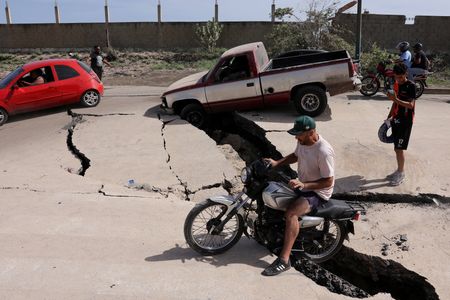
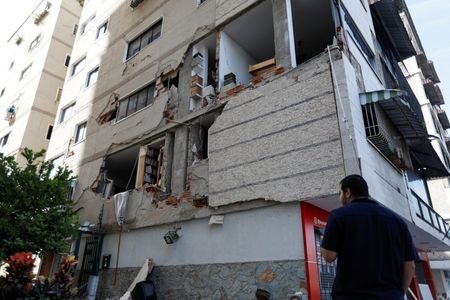
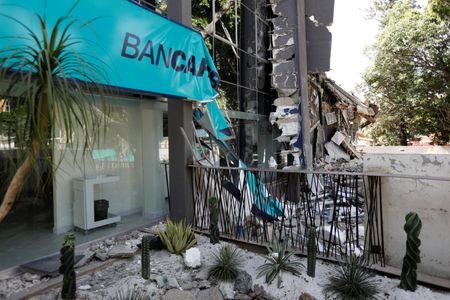
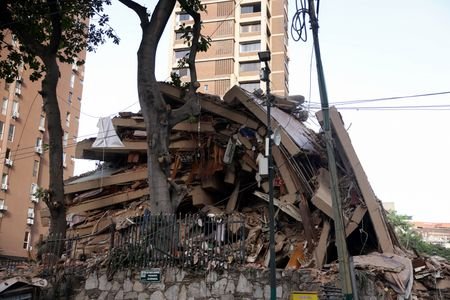
CARACAS, June 25 (Reuters) - Thousands of Venezuelans were feared dead on Thursday after two powerful earthquakes wreaked havoc in and around the capital Caracas, trapping people beneath the rubble of collapsed buildings and setting off powerful aftershocks.
A magnitude 7.2 earthquake hit about 160 km (100 miles) west of Caracas on Wednesday afternoon, followed less than a minute later by a magnitude 7.5 tremor, according to the U.S. Geological Survey.
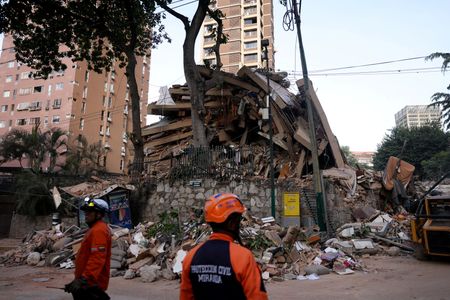
Emergency workers scrambled over the debris of collapsed buildings in Caracas as night fell, while distraught relatives sought help for loved ones feared trapped. Dazed survivors were taken away, some on stretchers.
"When we went downstairs, the scene was like a horror movie," said Maria Alejandra, a resident from a nearby building, who did not give her surname.
"We had to climb over the rubble and everything. The building superintendent with the baby and all the neighbors coming down. But from that building, I only saw that one family got out."
WEBSITE SHOWS MORE THAN 24,000 PEOPLE UNACCOUNTED FOR
Interim President Delcy Rodriguez said at least 164 people were confirmed dead and nearly 1,000 injured, and the government was working with business to deploy heavy machinery to accelerate efforts to help those still trapped.
The worst-affected area was La Guaira state, near Caracas and home to the city's airport. Witnesses' footage showed scenes of panic as ceilings came down in the airport and rubble from destroyed buildings along the seafront.
"Dozens of buildings have collapsed, and we are currently carrying out very intense rescue efforts to save as many lives as God allows us to save," Rodriguez said on state television just before 1 a.m. local time (0500 GMT) on Thursday.
"La Guaira state is a true tragedy, and has become a disaster zone."
Houses collapsed near the quake's epicenter in Morón, a small seaside town in the state of Carabobo, where there was no water or electricity. Three children were among at least eight killed in the area, municipal mayor Emily Riera told Reuters.
"It felt like all those houses were collapsing on top of us," said Geilin Morales, 29, who had just left her home with her husband and 6-year-old daughter when the quake destroyed it.
The U.S. Geological Survey, using predictive modeling to estimate the death toll, said it would most likely run into the thousands, with a substantial probability of exceeding 10,000.
A website set up to track missing people by leaders from the country's opposition, many of whom are outside Venezuela, listed more than 24,000 people as unaccounted for at 10.40 a.m. local time (1440 GMT).
Many Venezuelans were at home when the quakes struck during a public holiday.
"There was a very loud crash. Things fell in the house, jugs inside the refrigerator. I've never experienced anything like it," said Coro Martinez, 56, who lives in eastern Caracas.
PENTAGON TO DEPLOY ASSETS TO BADLY DAMAGED AIRPORT
Rodriguez said rescue crews from other countries would arrive soon and thanked leaders including U.S. President Donald Trump and Russian President Vladimir Putin.
She called for unity in Venezuela, where anti-government protests over annual inflation of more than 500% have become more frequent since Trump ordered the capture of President Nicolas Maduro in a violent raid in January.
Trump said there had been a "devastating" number of deaths. U.S. Secretary of State Marco Rubio said rescue teams were being deployed and the Pentagon would send assets to the damaged airport.
Other cities and towns close to Caracas affected by the quake, including El Junquito and La Guaira, remained without power on Thursday morning, increasing the challenges.
The U.N.'s Venezuela human rights mission urged the government to lift restrictions on social media, saying it was a "matter of life and death". Access became available in some areas of the country, where cell services are unreliable.
RESIDENTS RUSH INTO THE STREETS
Residents across Caracas, where infrastructure was already crumbling due to lack of investment, rushed to evacuate as buildings shook.
"As soon as it started, we began hearing people screaming," said Astrid Ramirez, a 41-year-old publicist in western Caracas. "Everyone was running down the stairs."
Maria Romero, an 80-year-old pensioner in southern Caracas, said police helped her out of her home. "This earthquake was horrible, even worse than the one in 1967," she said, referring to a magnitude 6.3 quake that the USGS said killed 240 people.
Venezuela lies in a seismically active zone where the Caribbean Plate meets the South American Plate.
An estimated 30,000 people were killed when a quake caused widespread destruction in Merida and Caracas in 1812, according to the USGS.
U.N. aid chief Tom Fletcher said it was coordinating the rapid deployment of international rescue teams, adding that "a massive collective effort" would be needed in a country where even before the quake, 8 million people needed humanitarian aid.
STOCK EXCHANGE TO BE USED IN RESCUE EFFORTS
At Caracas' Hospital de Clinicas, staff doubled up on the night shift to help treat the injured, a worker there said.
School classes were canceled for the rest of the week. The city's stock exchange was closed and will be used to help rescue efforts.
The Venezuelan Red Cross said its headquarters had been critically damaged but sent rescue teams to the worst-affected areas. The French embassy was also badly hit.
Near the epicenter, workers were restarting the Morón Petrochemical Complex, Venezuela's second-largest in operation, a local firefighter chief said, after damage was assessed.
Other oil infrastructure appeared to be unaffected.
Chevron, the main foreign partner of Venezuela's state-run oil company PDVSA, said all employees were accounted for and operations were continuing. UK oil firm Shell, which is evaluating developing gas fields in Venezuela, said all its employees were unhurt.
(Reporting by Vivian Sequera and Mayela Armas in Caracas; Additional reporting by Deisy Buitrago, Aida Pelaez-Fernandez and Reuters TV in Caracas, Tibisay Romero in Valencia, Venezuela, Keren Torres in Barquisimeto, Venezuela, Tathiana Ortiz in San Cristobal, Venezuela, Mariela Nava in Maracaibo, Venezuela, Marianna Parraga and Sheila Dang in Houston, Fabian Cambero in Santiago, Ana Isabel Martinez in Mexico City and Emma Farge in Geneva, Gram Slattery in Manama and John Irish in Paris; Writing by Kylie Madry, Julia Symmes Cobb and Philippa Fletcher; Editing by Daina Beth Solomon, Lincoln Feast, Raju Gopalakrishnan and Timothy Heritage)