By Trevor Hunnicutt and David Brunnstrom
WASHINGTON, March 19 (Reuters) - President Donald Trump on Thursday urged Japanese Prime Minister Sanae Takaichi to "step up" as he pressed allies for more support over the war with Iran and rising oil prices, while defending the secrecy of the campaign by invoking Japan’s surprise attack on Pearl Harbor.
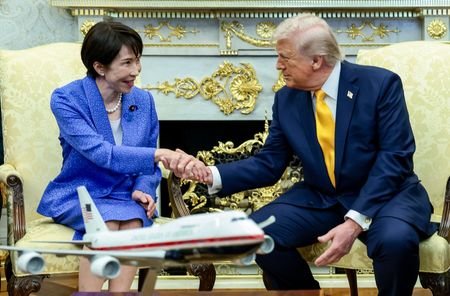
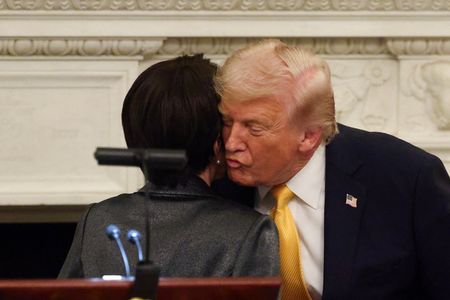
Trump, who greeted Takaichi with hugs at the White House, heaped praise on the leader of Washington's closest ally in East Asia during an Oval Office meeting where the expected topics of discussion included tense relations with China and the billions of dollars Tokyo is committing to U.S. investments favored by Trump.
But Trump defended an Iran operation that took U.S. allies by surprise and also used the meeting to renew pressure on U.S. allies from Asia to Europe. The Republican president has asked for more ships to clear mines and escort tankers through the Strait of Hormuz, largely closed by Iran in the conflict, despite saying the U.S. doesn't need any help.
"I expect Japan to step up because, you know, we have that kind of relationship and we step up for Japan," Trump said. "We don't need much. We don't need anything. I mean, honestly, we don't need anything from Japan or from anyone else. But I think it's appropriate that people step up."
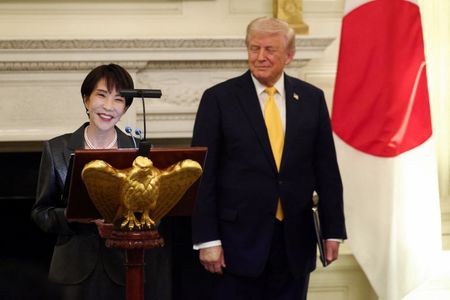
Speaking to reporters after the meeting, Takaichi said she had briefed Trump on what support Japan could and could not provide in the strait under its laws. She did not elaborate publicly.
TRUMP CITES PEARL HARBOR IN DEFENSE OF 'SURPRISE' ATTACK ON IRAN
Trump's pleas for help have received a lukewarm response from some allies caught off guard by Trump's audacious campaign in Iran, now in its third week.
Asked why he had not told allies about his war plans, the U.S. president cited Japan's December 7, 1941, attack on the U.S. naval base in Pearl Harbor, Hawaii, which drew Washington into World War Two.
"We wanted surprise," Trump told a Japanese journalist. "Who knows better about surprise than Japan? Why didn't you tell me about Pearl Harbor?"
Takaichi's eyes widened, her grin vanished and she shifted in her chair next to Trump after his comment.
Takaichi said she came prepared to discuss specific strategies to calm global energy markets. Ahead of the meeting, Japan joined leading nations in Europe in a joint statement, saying they would take steps to stabilize energy markets and were ready to join "appropriate efforts" to ensure safe passage through the strait.
But it was not clear that she was prepared to supply minesweeping vessels that could expose her pacifist nation to a bloody Middle East conflict.
"They are really stepping up to the plate," Trump said of Japan, "unlike NATO."
Takaichi called for de-escalation of the conflict, condemned Iran's attacks in the strait, said Iran must never be allowed to obtain a nuclear weapon and added she believed only Trump could achieve peace. She also said the global economy was about to take a hit due to the turmoil in the Middle East.
JAPAN RELIES ON CRUDE OIL FROM GULF
Takaichi's long-scheduled White House visit has been aimed at burnishing the decades-old security and economic partnership between Washington and its closest East Asian ally, but there have been concerns among Japanese officials that Trump would press her to do more than she can on Iran.
"Unfortunately for Tokyo, for Seoul, the reality is that I don't think they're in a position to just say no. I think it's going to have to be yes," said Zack Cooper, senior fellow at the American Enterprise Institute, a think tank.
Takaichi has sought to move Japan away from a pacifist constitution imposed by Washington after World War Two, but with the Iran war unpopular at home, she has so far not offered to assist in clearing the strait.
She told the Japanese parliament on Monday that Japan had received no official request from the United States on Iran but was checking the scope of possible action within the limits of its constitution.
Japan and the U.S. were also set to strike deals related to energy, critical minerals and defense. Speaking to reporters, Takaichi said the two sides agreed to joint development and production of missiles.
(Reporting by Trevor Hunnicutt and David Brunnstrom; Additional reporting by Tamiyuki Kihara, Tim Kelly, Nobuhiro Kubo, Tamiyuki Kihara and John Geddie in Tokyo and Michael Martina in Washington, editing by Colleen Jenkins, Deepa Babington, Rod Nickel and Chizu Nomiyama)