By Enas Alashray and Phil Stewart
CAIRO/WASHINGTON, April 4 (Reuters) - Iranian and U.S. forces were searching for a missing American pilot on Saturday from one of two warplanes downed over Iran and the Gulf, while President Donald Trump warned Tehran time was running out on his latest deadline for a deal to end the war.
The prospect of a U.S. service member alive and on the run in Iran raised the stakes for Washington as the conflict entered its sixth week with scant prospect of peace talks in sight and polls showing low public support.
With Iran's leadership defiant since the start of the war, its foreign minister left the door open in principle for peace talks with the U.S. via mediation from Pakistan, but gave no sign of Tehran's willingness to bow to Trump's demands.
"We are deeply grateful to Pakistan for its efforts and have never refused to go to Islamabad. What we care about are the terms of a conclusive and lasting END to the illegal war that is imposed on us," Foreign Minister Abbas Araqchi said on X.
MIXED SIGNALS
Trump has sent mixed messages since the conflict began with a U.S.-Israeli bombardment of Iran on February 28, switching between hinting at diplomatic progress to making threats to bomb the Islamic Republic "back to the Stone Ages".
On Saturday, he repeated his threats to intensify attacks on Iran if it failed to reach a deal or open the Strait of Hormuz strategic waterway.
"Remember when I gave Iran ten days to MAKE A DEAL or OPEN UP THE HORMUZ STRAIT. Time is running out - 48 hours before all Hell will reign (sic) down on them. Glory be to GOD!" he said in a post on Truth Social.
In an apparent move to heap further pressure on Tehran following Trump's ultimatum, a senior Israeli defence official said Israel was preparing to attack Iranian energy facilities, and was awaiting the green light from the U.S.
The timeframe for such attacks would be within the next week, the official said. Trump has previously threatened to hit Iranian power plants if his demands were not met.
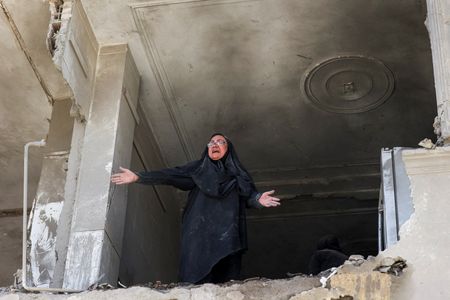
The war has killed thousands, sparked an energy crisis and threatened lasting damage to the world economy. Iran has virtually shut the Strait of Hormuz, which normally carries about a fifth of the world's oil and liquefied natural gas.
Iran has rained drones and missiles down on Israel, and also taken aim at Gulf countries allied to the U.S., which have so far held back from joining the war directly for fear of further escalation.
Iranian state TV said its military had launched drones at U.S. radar installations and a U.S.-linked aluminium plant in the United Arab Emirates and U.S. military headquarters in Kuwait in retaliation for deadly attacks on Iranian industrial centres.
Iran earlier attacked an Israel-affiliated vessel with a drone in the strait, setting the ship on fire, state media said, citing the commander of the Revolutionary Guards' navy.
IRAN TOUTS NEW AIR DEFENCE SYSTEMS
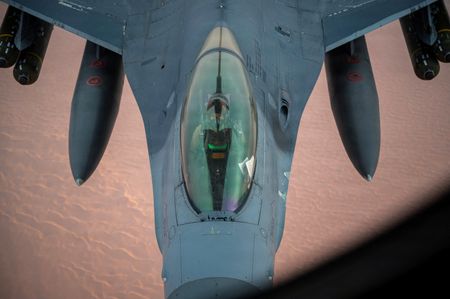
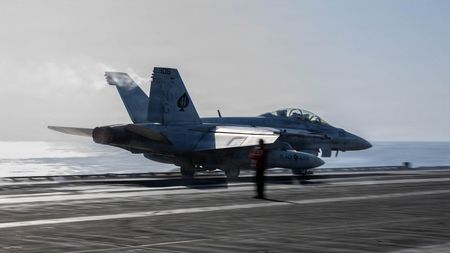
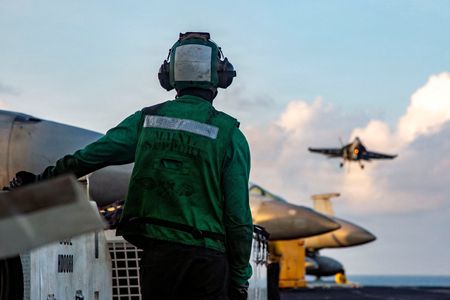
The downing of two U.S. warplanes shows the risks still facing U.S. and Israeli aircraft, despite assertions by Trump and his Defense Secretary Pete Hegseth that U.S. forces had total control of the skies over Iran.
Iranian fire brought down a two-seat U.S. F-15E jet, officials in both countries said on Friday, and a U.S. official said search-and-rescue efforts had recovered one of the crew.
Two Black Hawk helicopters engaged in the search for the missing crew member were hit by Iranian fire but made it out of Iranian airspace, the two U.S. officials told Reuters.
Iran's Islamic Revolutionary Guard Corps said it was combing a southwestern area near where the pilot's plane came down, while the regional governor promised a commendation for anyone who captured or killed "forces of the hostile enemy."
In a separate incident, an A-10 Warthog fighter aircraft was hit and crashed over Kuwait, with the pilot ejecting, the U.S. officials said.
Iranians, pummelled by air power since the U.S. and Israel began their attacks, celebrated their success.
The Khatam al-Anbiya joint military command said it used a new air-defence system on Friday, which targeted a U.S. fighter jet, three drones and two cruise missiles.
"The enemy should know that we rely on new air-defence systems built by the young, knowledgeable, and proud people of this country, unveiling them one after another in the field," a Khatam al-Anbiya spokesperson said, according to Iran's state media.
The Revolutionary Guards said they had targeted various areas in Israel in a wave of missiles and drones. Israeli media reported that two warheads from an Iranian cluster missile landed near Israel’s Kirya military headquarters in Tel Aviv.
Later on Saturday, the Israel Defence Forces said they had detected more missiles launched from Iran towards Israel.
PETROCHEMICAL ZONE STRUCK IN IRAN
Iranian state media reported air strikes at a petrochemical zone in southwestern Iran, with five people reported injured. They later said a fire there had been extinguished.
Israeli Prime Minister Benjamin Netanyahu said Israel had struck the plant, which an Israeli military spokesperson said produced materials for explosives and missiles.
Israel has been waging a parallel campaign against Iran-backed Hezbollah in Lebanon after the militant group fired at Israel in support of Iran.
Early on Saturday, Israel's military said it was striking the militants' infrastructure sites in Beirut. It later said an Israeli soldier had been killed in combat in southern Lebanon.
(Reporting by Phil Stewart in Washington, Enas Alashray and Hatem Maher in Cairo, Jerusalem bureau and Reuters bureaux worldwide; Writing by Clarence Fernandez, Matthias Williams and Alex Richardson; Editing by William Mallard, Sharon Singleton and Toby Chopra)