By Elizabeth Piper
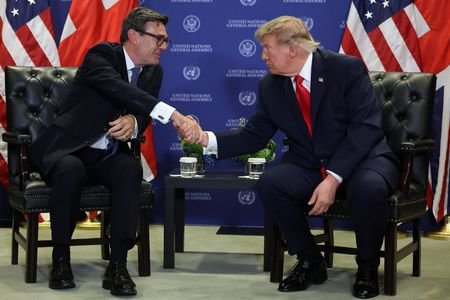
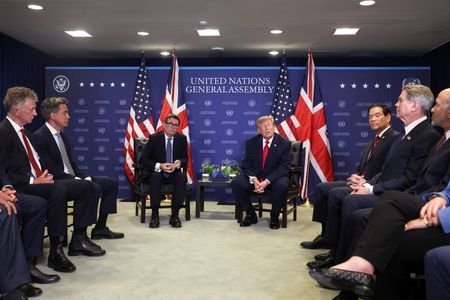
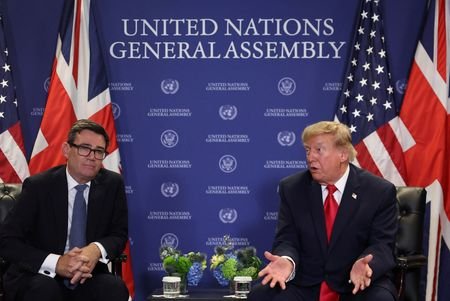
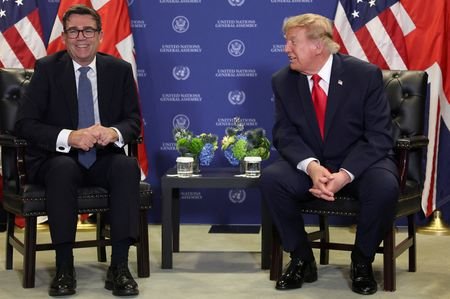
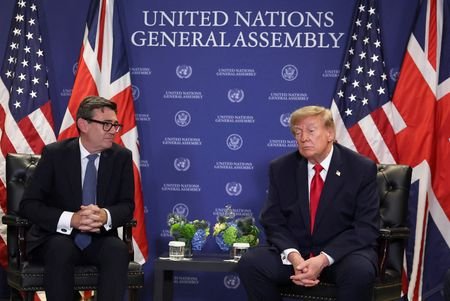
UNITED NATIONS, Sept 22 (Reuters) - US President Donald Trump hailed Andy Burnham on Tuesday as a "natural business person" at what the new British leader's team described as a smooth first face-to-face meeting.
After days of preparation for the Trump meeting, Burnham emerged relatively unscathed, with the US leader only taking issue with what he called a "terrible deal" to cede sovereignty of the Chagos Islands, home to a US-British air base.
Otherwise, Trump praised Burnham, saying Britain's seventh prime minister in a decade was someone with whom he could do business and a patriot who had put Britain on the up after replacing the former prime minister, Keir Starmer, in July.
"I think right now, based on my relationship with the prime minister, Andy, I think that ... we're doing very well," Trump said after they met on the sidelines of the United Nations General Assembly in New York for around 40 minutes.
"I think he's a natural business person. We've had a lot of discussions, even before this meeting we were talking with each other numerous times on the phone."
'ENCOURAGING MEETING'
Burnham, who travelled to New York on Monday to take part in the UN assembly, had said little beforehand about his expectations for the meeting with Trump, saying only that in their two phone calls he had found "a connection" with the US president.
Afterwards, he repeated that earlier conversations had established that connection "and that very much came through today".
"(I) can certainly work with him. It was a very encouraging meeting," Burnham told reporters, saying the two leaders had found "common ground" on dealing with cost-of-living pressures, ending the conflict in the Middle East and reindustrialising nations to spur economic growth, among other issues.
"He was very upbeat about the country's (Britain's) prospects, which, to be honest, was great to hear."
Before arriving in New York, Burnham had sought common ground with Trump on AI, a focus of his comments to the UN on Monday in which he described the technology as having the ability to bring "huge benefits" to the British and global economy.
Trump has said he wants to cherish AI rather than stifle its growth, dismissing fears about it as a hoax and "sick conspiracy". The US leader has said concerns can be addressed through the existing justice system without extra regulation — an issue that might cause some friction with Britain.
Yet, while the two leaders seemed to find common ground on a number of issues, there were some pitfalls.
Trump again criticised Britain's move, under Starmer, to cede sovereignty of the Chagos Islands while retaining control of Diego Garcia air base on a 99-year lease.
Trump called the agreement with Mauritius, now on hold, a "terrible" deal. "It's amazing how strategic it is, and I think the prime minister is going to be looking at it," he said.
Burnham later told reporters he had inherited the problem and would work to find a resolution between the different sides. "It was clear that we need to come to that agreement, but I'm confident we can find it working with our US partners," he said.
Burnham also showed a willingness to disagree with Trump if it is in his nation's interest, saying he would "stand firm in the face of any threats" to the right of Falkland Islanders to self-determination and to remain British.
In August, Trump said he was reviewing the United States' neutral position on the remote archipelago in the South Atlantic. Days later Argentine President Javier Milei — who will address the UN on Wednesday — said he would impose sanctions on oil companies drilling in the islands.
And the British leader navigated some other bilateral sticking points. Trump appeared unmoved over Britain's decision to block imports from Israeli settlements in the occupied West Bank, while its decision not to back the US over the Iran war was also skated over.
OPENS WAY FOR BURNHAM TO FOCUS ON AI
With the meeting done, Burnham turns his focus for UNGA to AI and his support for the technology, which he hopes will help Britain assume a leading role globally.
At an earlier business roundtable, Burnham said he would make the case for Britain in a speech later on Tuesday to help establish "a single set of global principles and standards" to unlock the potential of AI.
Describing Britain as being stuck in 10 years of political turbulence since voting to leave the European Union in 2016, Burnham told business leaders he wanted to usher in a period of stability and embrace AI, while being clear-eyed on the risks.
"So outside Downing Street, on my first day, I said I want to be the circuit breaker," he told the roundtable, including Tim Cook, executive chairman of Apple, and Citigroup CEO Jane Fraser.
"(To) bring forward a very clear path that everyone can understand, a 10-year plan for Britain ... so that nobody's in any doubt at all about what we're trying to do."
(Reporting by Elizabeth Piper; additional reporting by Andrew MacAskill and Alistair Smout; Editing by Kate Holton, Jonathan Spicer and Rosalba O'Brien)