By Nandita Bose, Andreas Rinke and Andrea Shalal
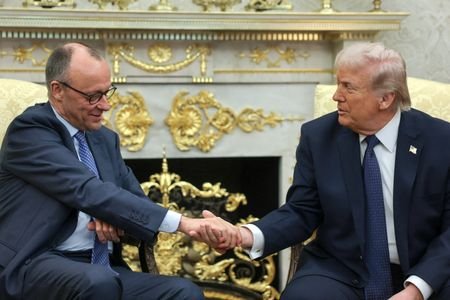
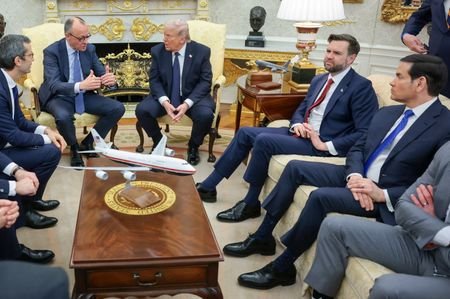
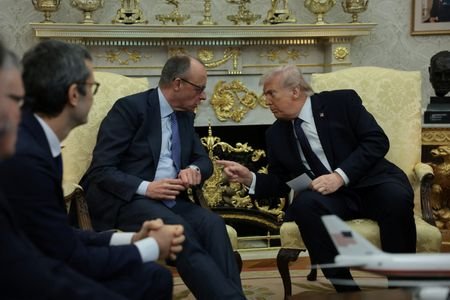
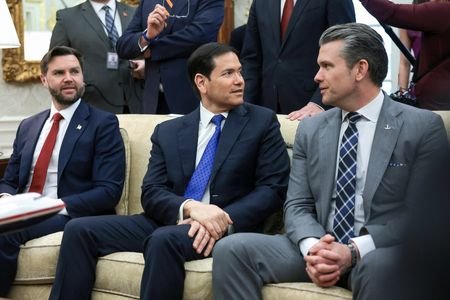
WASHINGTON, March 3 (Reuters) - U.S. President Donald Trump welcomed German Chancellor Friedrich Merz to the White House on Tuesday, thanking the German leader for his support of the widening U.S.-Israel war against Iran in talks that also touched on trade and Russia's war in Ukraine.
Trump, speaking in the Oval Office alongside Merz, told reporters that Germany had been "helping out" by allowing U.S. forces to access certain bases, and drew a sharp contrast to the actions of two other European countries: Britain and Spain.
Merz told Trump that Germany and the United States shared a desire to get rid of Iran's current regime, and said Berlin wanted to see a rapid end to the war. He later cast doubt on whether the U.S. and Israeli military strikes would spark political change in Iran, saying the plan posed some risks.
"This plan is not without risk, and we would also have to bear the consequences," Merz told reporters after meeting Trump.
The war in Iran is politically sensitive for Merz, who faces potential backlash at home over Germany's support for the U.S.-Israeli operation.
On Sunday, he had expressed no criticism of the U.S. airstrikes but stopped short of endorsing an operation which Trump's critics have said was undertaken without sufficient explanation and the required legal backing in international law.
Neither Israel nor the U.S. have asked Germany to get directly involved in the conflict, Merz said, adding he had explained to Trump that any such action would require formal German parliamentary approval.
"We are on the same page in terms of getting this terrible regime in Iran away, and we will talk about the day after," Merz said at the start of the talks, adding that he would also raise Russia's war in Ukraine and the need to finalize a U.S.-European Union trade deal following Trump's additional tariff threats.
Trump said the U.S. was not asking Germany to provide troops. "They're letting us land in certain areas, and we appreciate it, and they're just making it comfortable. We're not asking them to put boots on the ground."
The U.S. president said he had a good relationship with Germany and Merz in particular, calling him an "excellent leader". That marked a big change from Merz's fellow Christian Democrat and former Chancellor Angela Merkel, Trump said, adding that he had differences with Merkel over immigration and energy.
FOCUS ON UKRAINE
Merz, keen to maintain the positive relationship he has forged with Trump over the past year, presented the president with a framed replica of a trade agreement signed between the United States and Prussia in 1785, the first ever trade deal signed by the then-newly constituted United States.
Despite Trump's praise of the German leader, the meeting threatened to go off the rails when Trump said he would cut off all trade with Spain over its refusal to let U.S. forces use its bases for missions related to the Iran war.
Merz told reporters that he made clear to Trump during their closed-door meeting later that Spain was part of the EU and could not be excluded from trade deals.
He said he also underscored the need for continued support for Ukraine, which last week marked the fourth anniversary of Russia's full-scale invasion, and stressed that Ukraine should not have to accept further territorial concessions.
"We all want to see this war coming to an end as soon as possible. But Ukraine has to preserve its territory and their security interests," Merz said at the start of his third visit to the Oval Office.
He told reporters he thought Trump had understood the point after he showed him a map of the war-torn country.
Trump assured Merz that negotiating a deal to end the war between Russia and Ukraine remained "very high" on his priority list, and said he believed the U.S. had plenty of munitions to fight Iran and sell them to Europe for use in Ukraine.
Merz left Berlin for Washington as Germany and France announced plans to deepen cooperation on nuclear deterrence, another move by the European neighbors to adapt to changes in the transatlantic relationship amid ongoing threats from Russia and feared instability linked to the Iran conflict.
The two leaders also discussed China, with Merz just back from a visit there to meet with Chinese President Xi Jinping. Trump is due to visit China at the end of the month.
Merz, who met with industry executives before heading to the White House, arrived in Washington amid grave European concerns over the legality of the Iran strikes - which killed Iran's Supreme Leader Ayatollah Ali Khamenei and other Iranian leaders - under international law, and deep worries over Trump's threat to pile fresh tariffs on global goods.
Jeff Rathke, president of the American-German Institute, a Washington-based think tank, said Merz made his points succinctly but left without clear answers.
"I don’t think Trump gave an answer that would reassure Germany or other European allies about what the U.S. vision is for Iran’s future and the U.S. capacity to deliver that," he said.
(Reporting by Nandita Bose, Andreas Rinke and Andrea Shalal in Washington; additional reporting by Rachel More in Berlin; Editing by Ross Colvin, Daniel Wallis, Don Durfee and Alistair Bell)