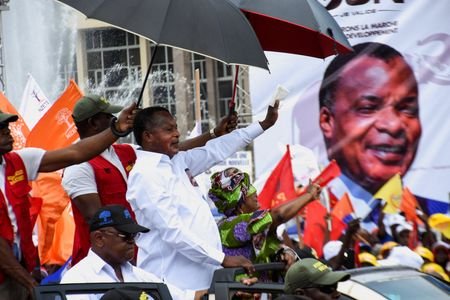
BRAZZAVILLE, March 15 (Reuters) - Congo Republic voted on Sunday in a presidential election likely to extend the rule of President Denis Sassou Nguesso, one of Africa's longest-serving leaders, with visibly weak turnout underscoring a lack of suspense over the poll's outcome.
Sassou faces a weak field of challengers, with two of the country’s best‑known opposition leaders in prison and others in exile. Several opposition parties boycotted the vote, saying the process lacked credibility.
More than 3.2 million Congolese were registered to vote, although analysts and civil society groups predicted turnout to fall below the nearly 68% recorded in 2021, when Sassou won his previous five-year mandate with 88.4% of the vote.
Polling stations in the capital, Brazzaville, had short lines or no lines at all, a Reuters witness said.
Polls were due to close at 6 p.m. local time (1700 GMT). Provisional electoral results are expected 48 to 72 hours after polls close.
INTERNET OUTAGE REPORTED
Sassou seized power in the oil‑producing nation in 1979 and has governed almost continuously since, except for a five-year hiatus in the 1990s.
He was running against six little-known candidates, none seen as serious contenders, with electoral bodies dominated by figures aligned with the ruling Congolese Labour Party.
"The opposition is fragmented and lacks a strong, emblematic figure," said Remadji Hoinathy of the Pretoria-based Institute for Security Studies. "There may be fatigue among voters, but that will not affect Sassou's chances."
The internet was down across the country on Sunday, internet monitoring group NetBlocks said, making it difficult to get a full picture of how election day was unfolding.
"We confirm that a nation-scale internet blackout is now in effect in the Republic of Congo, a measure likely to limit transparency during today's election," Alp Toker, director of NetBlocks, said in an email to Reuters, adding that connectivity was around 3% of ordinary levels.
That was "technically consistent" with an internet outage imposed during the presidential election in 2021, Toker said.
Congo's Prime Minister Anatole Collinet Makosso and Thierry Moungalla, the communications minister, did not respond to requests for comment about the outage.
VOTERS SEE SCANT HOPE FOR CHANGE
Rights groups say the political space has narrowed in Congo in recent years, citing arrests of activists and suspensions of political parties.
The economy, heavily dependent on oil, has stabilised in recent years after a long downturn. But 52% of Congo's 6.1 million people live in poverty, according to the World Bank.
Casting their ballots on Sunday, some Congolese said the country needed new direction, without saying explicitly whether they were backing Sassou or one of his opponents.
"Our children are here with their diplomas but they're not doing anything," Brazzaville resident Gigi Wandiabantou said.
"Whoever will be in charge, I'm really counting on them to help us mothers so we can receive something."
Some Congolese say they see little chance for change.
"It's an election whose outcome is known in advance," said Frédéric Nkou, an unemployed resident of Brazzaville. "I don't expect things to improve."
Ahead of Sunday's vote, Prime Minister Makosso dismissed accusations of pro-Sassou bias, arguing that Congo's oversight bodies would ensure a transparent and fair election.
Sassou has campaigned on continuity, pledging to accelerate development projects and expand access to education and professional training.
(Reporting by Clement Bonnerot and Ngouda Dione in Dakar and Congo Republic newsroom; Writing by Clement Bonnerot and Robbie Corey-Boulet; Editing by Andrei Khalip and Joe Bavier)