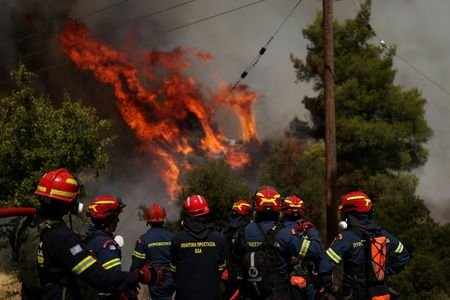
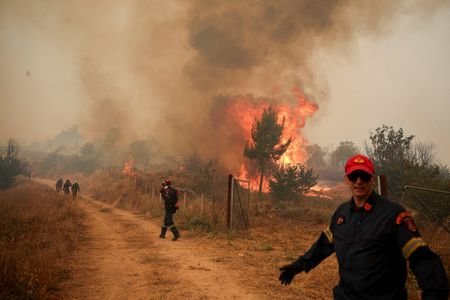
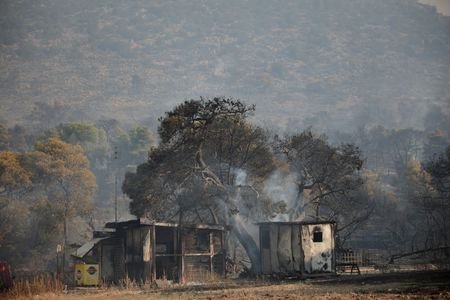
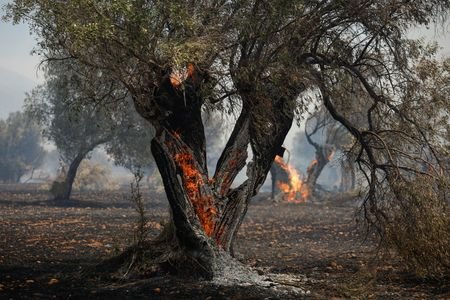
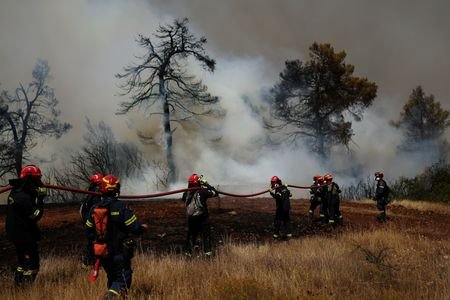
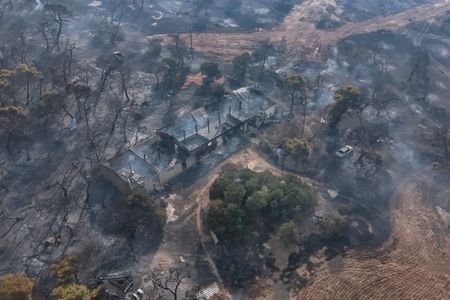
AGIOS KONSTANTINOS, Greece, Aug 2 (Reuters) - Two firefighting helicopters collided in Greece while helping to control a huge wildfire on Sunday that has destroyed more than 100 homes northwest of Athens, while people fled another blaze on the tourist island of Kefalonia.
Two people on one helicopter — a Greek and a Danish national — died, while the crew on the other, one person from Greece, one from Britain, survived, the fire service said. Investigations had started into what caused the collision, it added.
Europe has been ravaged by wildfires this summer after a period of record-breaking heatwaves and little rain – conditions that scientists say have been exacerbated by climate change.
Destructive blazes in France and Spain showed some signs of easing over the weekend, but several wildfires have broken out in Greece after a period of relative calm there.
The two helicopters collided in the area of Psatha in the Attica region, Greece's fire service said in a statement.
Video posted on the Forecast Weather Greece Facebook page appeared to show two helicopters closing to cross paths at low altitude, before the main rotor of the lower helicopter struck the underside of the other. The lower one then crashed in flames.
The second helicopter then dumped its load of water and flew away. Reuters has not verified the authenticity of the footage.
Investigations suggested the fire that started in the Greek region of Boeotia before spreading to Attica was caused by sparks from conductors on a private network transmitting electricity generated by wind turbines to the main power grid, the eKathimerini website reported.
Two Greek nationals were arrested on suspicion of negligence, while another suspect remains at large, the report said.
'FORCE OF NATURE'
Gale-force winds that had fuelled a fire around Porto Germeno on the Gulf of Corinth 60 km (40 miles) northwest of Athens subsided, but flames crossed a mountain to the south and reached the settlement of Veniza and a military firing range, igniting unexploded ordnance.
Emergency crews focused their efforts on preventing fire from advancing towards the coastal town of Megara, which has a population of around 30,000.
"There are moments when the force of nature and the intensity of weather conditions exceed all human planning and every operational capability,” Prime Minister Kyriakos Mitsotakis said in his regular Sunday message.
Greek authorities issued emergency alerts for evacuations for a number of settlements in western Attica, including an industrial estate near Megara.
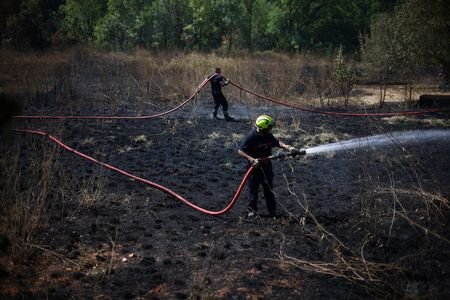
In the village of Agios Konstantinos, residents were doing their best to halt the spread of the blaze.
"The fire has been burning since last night, it is certain that they cannot have forces everywhere. We as residents are doing everything we can,” said Tasos Tzempelikos, 61, who along with his son was pouring water on the fire.
Overnight, several settlements on the Ionian island of Kefalonia were evacuated after a fire broke out in the Pastra area in the south.
FIRE IN FRANCE CHANGES COURSE
In France, a fire in the southwestern Var region switched direction after a change in the wind and surged into a forested area that was difficult to access, BFM TV reported.
A new fire also broke out alongside a highway near the historic southern city of Carcassonne, apparently caused by a blazing vehicle, BFM TV added.
Video on the channel showed huge plumes of billowing grey smoke and flames near the road. Authorities said they had closed the highway and evacuated a nearby animal park.
In Montfort-sur-Argens in Var, Georges Blanc, who had fled the fire earlier, returned home and was busy putting out hot embers to prevent a flare-up, while firefighters watered the wider area.
"With the combined efforts of the two Canadairs (firefighting planes) and the firefighters, I think you could say all the houses were saved ... And now, well, I'm coming back to check, because since I saw the flames, I thought the houses wouldn't have survived," he told Reuters.
In central Spain, wildfires that ripped through tens of thousands of hectares over the past week were mostly under control, though firefighters were dealing with reignitions in some areas.
In the western province of Caceres, a forest blaze erupted on Saturday, prompting the evacuation of around 800 people. Those residents were allowed to return on Sunday but remained confined to their homes as the fire was still active.
HUNGARY NUCLEAR PLANT FORCED TO SHUT
Other European countries are struggling with drought and receding water levels in major rivers, including the Rhine and the Danube, which recorded its lowest-ever water levels in Hungary, Serbia and Romania.
Hungary faces a critical five days, Prime Minister Peter Magyar said on Sunday, as the drying out of the Danube forced the country's sole nuclear power plant to shut for the first time in more than four decades, with a new heatwave looming.
Falls in water levels amid a lack of rain have also disrupted shipping and tourism in Hungary and triggered water-use restrictions in more than 100 cities and villages.
Danube levels in Serbia fell to their lowest since 1985, cutting the daily output of the country's biggest hydropower plant to only 20%, the energy minister said on Sunday.
(Reporting by Aleksandar Vasovic in Belgrade, Dominique Patton in Paris, Manon Cruz and Fatos Bytyci in Var, Gergely Szakacs in Budapest, Louisa Gouliamaki, Angelos Tsatsis, Vania Turner in Greece, Andrey Khalip in Madrid; Writing by Aleksandar Vasovic; Editing by Christina Fincher, Alex Richardson and Andrew Heavens)