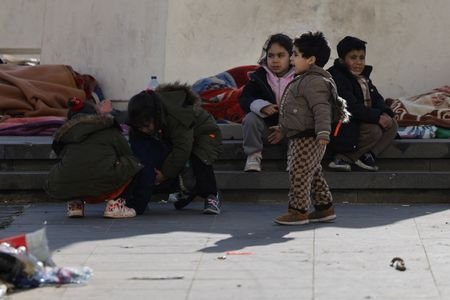
BEIRUT, March 6 (Reuters) - The number of displaced people in Lebanon is expected to rapidly increase after unprecedented Israeli evacuation orders covering large parts of the country, with about 100,000 already cramming shelters, a senior U.N. official said on Friday.
With hostilities raging between Israel and Hezbollah amid a spreading U.S.-led war on Iran, the Israeli military on Thursday ordered residents out of Beirut's southern suburbs, including districts controlled by the Iran-backed group, before intensifying its air strikes on the area.
Israel has also ordered people out of areas of the eastern Bekaa Valley, and a swathe of the south.
"What we saw in the last couple of days is, I would say ... unprecedented in terms of the scale here in Lebanon of the warnings, the displacement orders, and the reaction, the panic also, that this has all created," Imran Riza, the U.N. Humanitarian Coordinator in Lebanon, told Reuters.
He noted that over a million people were uprooted in Lebanon during a war between Hezbollah and Israel in 2024, 75-80% of whom did not go to collective shelters, and that this time the majority would probably not go to shelters either.
"There are about 100,000 people that are, as of this morning, in some 477 collective shelters. There are some 57 shelters that still have some space, but basically the capacity is being reached very, very quickly," Riza said.
SHORT OF FUNDING
"We had people moving all over the place and not knowing where to go to. So yes, I think we're going to have an increased number quite quickly," he said, citing the example of a Beirut shelter where the number of families rose to 150 on Friday from 90 earlier in the week.
Riza said there was good coordination between Lebanese authorities and international aid organisations but resources were short. Lebanon's 2026 aid appeal for $1.6 billion has been only 20% funded so far.
"We are much, much worse off in terms of actual funding and material preparedness than we were even in 2024, which was of itself a difficult time," he said.
The Lebanese health ministry has reported 123 people killed and another 683 wounded as a result of Israeli attacks this week. Its figures do not distinguish between civilians and combatants.
Riza said a number of health workers had been killed and injured, and urged respect for international humanitarian law.
"We need immediate de-escalation," he added.
(Reporting by Tom Perry; Editing by Toby Chopra)