By David Lawder and Humeyra Pamuk
WASHINGTON, Aug 24 (Reuters) - The U.S. on Monday unveiled an expansion of sanctions that it said would cut off Iran's economic lifeline but stopped short of the most punishing measures, instead putting the world on notice to cease doing business with the Islamic Republic.
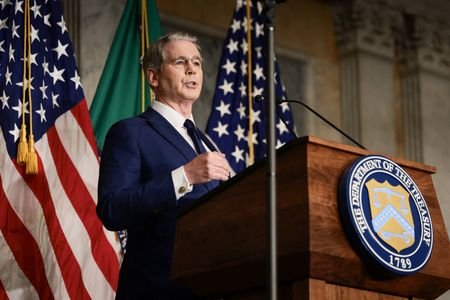
Treasury Secretary Scott Bessent said other countries would need to sever business ties with Iran or risk being forced out of the dollar-based financial system.
But he declined to identify the countries that would be targeted or reveal when those penalties would take effect, saying he would instead provide them time to comply with the new directive.
"We are giving everyone the opportunity to remedy bad behavior. Why would I want to blow up the global financial system?" Bessent said at a news conference.
The Treasury Department did announce new sanctions on 60 individuals, entities and vessels, but the list did not include any of the Chinese financial institutions suspected of facilitating Iran's oil trade.
Struggling to resolve an unpopular war that has pushed energy prices higher, Washington appears to be counting on further economic pressure even though Iran has spent decades under layers of U.S. and international sanctions that have battered its economy but have not deterred its leadership.
Though neither side has launched major strikes in weeks, the war shows little sign of reaching a diplomatic solution. In the meantime the U.S. is seeking new ways to end Iranian attacks on ships in the Gulf and, more recently via its allies, in the Red Sea.
Before the announcement, Iran threatened both a possible military response and further reduction in oil exports from the Gulf in response to any U.S. economic measures. Afterward, Iranian Economy Minister Ali Madanizadeh said, "We are fully prepared for the U.S. sanctions."
"Naturally, the enemies intend to launch an economic terrorist attack on us, but we also have our own tools and know how to play the game. Our defense is no longer so defensive; the enemies should wait for an attack," Madanizadeh told state television.
Brigadier General Hossein Mohebbi, a spokesperson for Iran's Islamic Revolutionary Guard Corps, vowed heavy blows to U.S. vital interests and energy chokepoints if Iran's infrastructure is threatened, Press TV reported.
Almost six months have passed since the U.S. and Israel launched strikes on Iran, sparking a conflict that has snarled shipping in the region, reduced the flow of oil and taken a toll on the U.S. and global economies. Thousands of people have died, most of them in Iran and Lebanon.
While the war has degraded much of Iran's conventional military capacity, inflicted economic pain and killed then-Supreme Leader Ayatollah Ali Khamenei, Iran has preserved enough missile and drone capability to attack its Gulf neighbors and threaten oil tankers in the Strait of Hormuz, bringing shipping in the key waterway to a near standstill. The exact state of Iran's nuclear program, which the Americans and Israelis aim to wipe out, remains unknown.
Oil prices fell more than $2 a barrel on Monday, though investors braced for the prospect of further supply disruptions from the Middle East.
'NO ONE' BEYOND REACH OF SANCTIONS
Madanizadeh, the economy minister, said neither China nor Russia had "accepted" the U.S. measures, and predicted other countries would resist them.
Bessent previously urged cooperation from China, the biggest buyer of Iranian oil for several years, although the U.S. blockade of Iran's ports, renewed in mid-July, has already cut Iranian oil flows to China.
Experts say Washington is wary of Chinese retaliation for any sanctions on its banks ahead of expected talks next month between U.S. President Donald Trump and Chinese President Xi Jinping, with any curbs on China's exports of critical minerals especially sensitive.
Asked about Chinese banks on Monday, Bessent said, "We want to make clear here today that no one is above the reach of U.S. sanctions."
The Chinese Foreign Ministry said sanctions and pressure tactics do not help and Beijing would do what was necessary to protect China's interests.
Bessent said the Treasury Department has mapped the networks, facilitators and financial channels that Iran uses to smuggle oil and evade sanctions. He said Washington would be working with U.S. partners to target any source of Iran's "illicit revenue."
The department said the Iranian government was using five sectors -- digital assets, technology, gold, aviation and shipping -- to prop up its economy and they were on notice for sanctions.
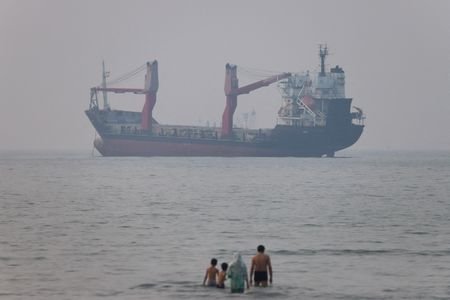
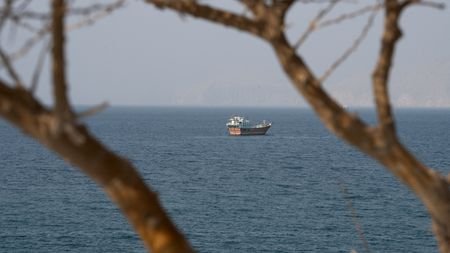
Earlier on Monday, Iran issued a new warning to shipping not to pass through the Strait of Hormuz without its permission, listing 45 ships it said had violated its rules and threatening retaliation for any ship-to-ship transfers with them.
(Additional reporting by Andrea Shalal, Michael Martina and Kanishka Singh in Washington, Menna Alaa El-Din, Yasmine Ghania and Eman Abouhassira in Cairo and Rick Noak in Islamabad; Writing by Daniel Trotta, Philippa Fletcher and Brad Brooks; Editing by Sharon Singleton, Scott Malone and Cynthia Osterman)