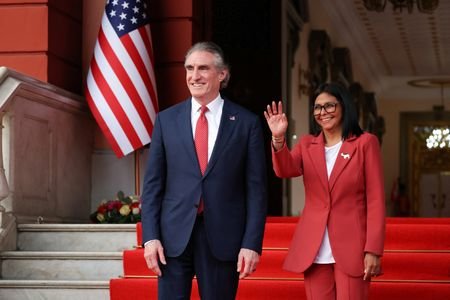
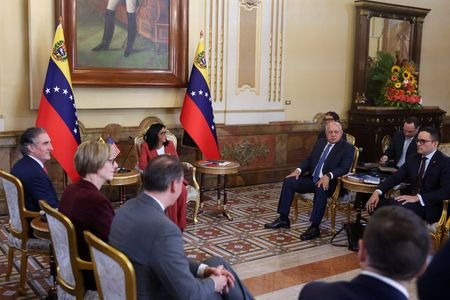
March 4 (Reuters) - Venezuela's interim President Delcy Rodriguez said on Wednesday a reform of the country's main mining law will be submitted in coming days to the country's legislature, after a meeting in Caracas with U.S. Secretary of the Interior Doug Burgum, where the two officials hailed cooperation on minerals and a shared desire to pave the way for investment.
Burgum, who also heads the U.S. Energy Dominance Council, arrived in the South American country earlier on Wednesday with more than two dozen U.S. mining and minerals companies, which he said could represent billions in investment and thousands of high-paying jobs for Venezuela.
The visit is part of a U.S. push to open Venezuela to American investment, especially in oil, gas and mining, as the Trump administration tries to exert more control over the country following a January U.S. raid that captured President Nicolas Maduro. It is the second visit by a U.S. cabinet secretary since the ouster of Maduro, who courted the likes of China and Russia as allies.
In public, Trump has heaped praise on Rodriguez for cooperating with the U.S. and hailed her again on Wednesday, saying she is "doing a great job" and that oil was beginning to flow from the country. Rodriguez thanked Trump in her joint remarks alongside Burgum at the Miraflores presidential palace after their meeting.
Despite the public support, behind the scenes, the Trump administration has been applying pressure to achieve its objectives. U.S. officials are threatening a legal case against Rodriguez that could include corruption and money laundering charges, Reuters reported Tuesday, citing four people familiar with the matter, and Washington is also pushing her to arrest or detain several former high-level party officials Washington may want extradited.
MINING LAW CHANGES EXPECTED
The mining law, expected to include provisions that would allow foreign companies to exploit gold, diamonds and rare earths, will be proposed in the coming days, Rodriguez said, adding she hopes it will be passed swiftly.
"We want the successful models of the hydrocarbons law to also be reflected in the mining sector," she said.
Rodriguez said the meeting built on previous work with U.S. Energy Secretary Chris Wright, who visited the country in February. She said the agenda focused on "metallic minerals, non‑metallic minerals, strategic and non‑strategic minerals". Energy topics would be covered in meetings on Thursday, she added.
Her brother Jorge Rodriguez is the head of the assembly and has already ushered through changes to oil regulations meant to stoke investment.
Burgum is expected to meet with oil and gas companies on Thursday to discuss expansion and investment, two sources earlier told Reuters.
"The opportunities for collaboration and synergy between our two great countries of Venezuela and the United States are unlimited," Burgum said. "I know Delcy (Rodriguez), like President Trump, wants to move to cut the red tape to allow that capital investment to flow."
RARE EARTHS UNCONFIRMED
Venezuela's current mining legislation dates to 1999.
The South American country owes billions of dollars to industrial conglomerates, oil and mining companies after deep waves of nationalizations two decades ago, including to Crystallex, Gold Reserve and Rusoro Mining.
Exploration has not yet taken place in Venezuela to confirm reserves of rare earths, a grouping of 17 minor metals used to make magnets that turn power into motion. Rare earths are a subset of critical minerals, many of which are produced globally by China.
A report from the Venezuelan government in 2018 on mineral deposits used key mining industry terms like reserve and resource interchangeably, making it difficult to ascertain what the true measurements are. An official map published in 2021 showed reserves of antimony, copper, nickel, coltan, molybdenum, magnesium, silver, zinc, titanium, tungsten and uranium, but did not list volumes.
As part of bilateral agreements, Iranian companies in past years have explored for mining resources in the country, but the work did not lead to investments.
(Reporting by Marianna Parraga and Reuters; editing by David Gaffen)