By Ariba Shahid and Mubasher Bukhari
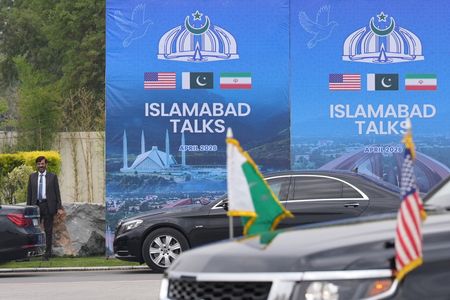
ISLAMABAD, April 14 (Reuters) - Negotiating teams from the U.S. and Iran could return to Pakistan later this week to resume negotiations to end the war in the Gulf, Pakistani and Iranian officials said on Tuesday, days after the first peace talks ended without a breakthrough.
There was no immediate confirmation from U.S. officials about the plans, which the Iranian and Pakistani officials discussed on condition of anonymity.
A source who has been involved in the talks said a proposal had been sent to Washington and Tehran for the delegations to return to Islamabad to resume discussions. No date had yet been decided but both countries could return as early as the end of this week.
An official at the Iranian embassy in Islamabad said: "The coming rounds of talks can come sometime later this week or earlier next week. But nothing is finalised as of now."
Earlier, a senior Iranian source told Reuters: "No firm date has been set, with the delegations keeping Friday through Sunday open."
A senior Pakistani official said Islamabad had reached out to Iran "and we got a positive response that they will be open to a second round of talks".
The official and a second Pakistani source said Islamabad was communicating with both sides about the timing of the next round, and the meeting would be likely to take place over the coming weekend.
Last weekend's meeting in Pakistan's capital to resolve the conflict between the U.S. and Iran, held four days after the announcement of a ceasefire, reached no breakthrough. It was the first direct encounter between U.S. and Iranian officials in more than a decade, and the most senior engagement since Iran's 1979 Islamic Revolution.
Pakistan's foreign ministry, military and prime minister's office did not respond to a Reuters request for comment. The White House also did not immediately respond to a request for comment.
U.S. Vice President JD Vance and Iranian Parliamentary Speaker Mohammad Baqer Qalibaf led their respective delegations in the last round of talks.
Issues under contention include the Strait of Hormuz, a major transit point for global energy supplies that Iran has effectively blocked but the U.S. has vowed to reopen, as well as Iran's nuclear programme and international sanctions on Tehran.
Vance told reporters after the talks ended: "We leave here with a very simple proposal, a method of understanding that is our final and best offer."
"We'll see if the Iranians accept it."
(Reporting by Ariba Shahid and Asif Shahzad in Islamabad, Mubasher Bukhari in Lahore; Writing by Saad Sayeed and Shilpa Jamkhandikar; Editing by Himani Sarkar, Sharon Singleton, Peter Graff)