By Enas Alashray, Elwely Elwelly, Tala Ramadan and Kanishka Singh
CAIRO/DUBAI/WASHINGTON, July 14 (Reuters) - President Donald Trump on Tuesday reimposed a naval blockade of all Iranian ports and threatened to hit power plants and bridges next week unless Tehran resumes negotiations, in the latest U.S. escalation of the conflict.
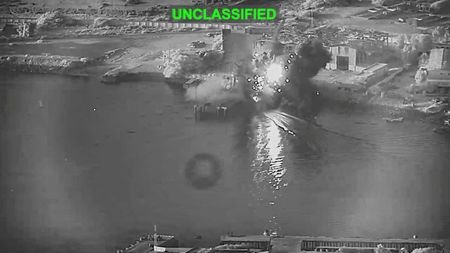
The U.S. also began a fresh round of strikes "to continue degrading Iranian capabilities used to attack commercial shipping in the Strait of Hormuz," the U.S. military said.
Tehran says it has again closed the strait after hostilities between Iran and the U.S. reignited last week, fraying an already fragile truce reached in June after several months of fighting that has killed thousands.
"I'll save the energy targets for last, but ultimately we'll hit energy targets," Trump told Fox News in an interview that aired Tuesday night on 'Special Report with Bret Baier'.
"Next week comes the power plants, next week comes the bridges," Trump said, "unless they get to the table and negotiate."
U.S. negotiators had been in touch with their Iranian counterparts to tell them "you better make a deal", he added.
Iran's army said early on Wednesday that it had launched drone attacks against U.S. positions at Jordan's Azraq base. There was no immediate comment from the Pentagon.
Iran's Islamic Revolutionary Guard Corps said they targeted weapons and storage facilities in Bahrain and Kuwait. Reuters could not immediately verify the reports.
The flare-up over the last few days has heightened doubts that a memorandum of understanding signed last month would lead to a permanent halt in the war, which has engulfed Iran's neighbors and disrupted global energy supplies.
American projectiles hit a location around Bandar Abbas, an Iranian city on the strait, the governor's office told state media late on Tuesday, while Iran's state news agency IRNA said that U.S. projectiles hit an area near Sirik in southern Iran.
"If the U.S. thinks that by tightening its measures against us, its military actions and its economic blockade, we will return to negotiations, it is making a mistake," Iran's Deputy Foreign Minister Kazem Gharibabadi said in an earlier interview with state television.
Before the war began in February, about a fifth of global oil and gas shipments passed through the Strait of Hormuz each day.
Trump on Monday floated the idea of a 20% fee on shipping through the strait, which drew sharp criticism from the U.N. shipping agency and others.
On Tuesday, he scrapped the idea and said, without providing details, that he would instead seek investment deals with Gulf states.
The naval blockade against vessels transiting to and from Iranian ports and coastal areas came back into effect at 2000 GMT (1600 EDT), after being lifted in June.
Trump said the strait was open to all shipping traffic except that of Iran. There are currently more than 20 U.S. Navy warships and hundreds of military aircraft operating across the region, the U.S. military said.
The conflict has proved unpopular in the U.S., where gasoline prices have risen and congressional elections are looming in November.
The price of benchmark Brent crude oil is up 15% over the last seven days to $85 a barrel, highest since mid-June.
COST OF WAR
The war has killed thousands, primarily in Iran and Lebanon, since it began in February with joint U.S.-Israeli strikes on Iran, and has widened to include other Gulf nations as Iran retaliated against its neighbors.
While the global economy has largely weathered the energy shock fairly well, the International Monetary Fund warned last month that extending the war beyond mid-July posed big risks, especially since countries have largely used up their strategic oil reserves to cushion the effect on consumers.
Half of those surveyed in a Reuters poll said they believed the war had not been worth its costs.
Iran said earlier on Tuesday that it attacked a U.S. Army base in Jordan with ballistic missiles, while Bahrain, which hosts a U.S. naval base, reported fending off an Iranian aerial attack and other Gulf states also came under fire.
The governor's office of Iran's Qeshm Island, on the Strait of Hormuz, said it was struck by a U.S. projectile at around 7 p.m. on Tuesday, Iranian state media reported.
Washington has asserted repeatedly that Iran must never have a nuclear weapon -- something Tehran denies seeking -- while Iran wants the end to sanctions and for other nations to recognize its control over the strait.
Trump said certain countries, without naming them, had told him they wanted to invest in the U.S. instead of being charged a transit fee.
It was not immediately clear what Gulf states had agreed to, if anything, and he did not mention any specific investment commitments.
(Additional reporting by Reuters bureaux; Writing by Costas Pitas and David Brunnstrom; Editing by Sanjeev Miglani, Don Durfee and David Gaffen)