(Corrects in paragraphs 6 to say 'research institute', not NGO)
By Louise Rasmussen
COPENHAGEN, March 18 (Reuters) - The wealth tax on which Danish Prime Minister Mette Frederiksen is campaigning ahead of a March 24 election may appear modest: a 0.5% levy set at such a high threshold that barely 20,000 Danes - one in 300 residents - will pay it.
But if the intent was to trigger a divisive, nationwide debate about equality and wealth in the small northern European country that could help the social democrat emerge as leader of a new left-leaning alliance, it may be doing its job.
According to political analyst Noa Redington, the proposal reflects a broader pivot by Frederiksen and her Social Democratic Party, which has lost left-leaning voters after going into coalition with the centre-right and introducing tough asylum reforms.
"'We still remember that we come from the left, that in our heart, we are red'," he said of the signal sent out by a tax aimed at raising some $1 billion to fund school reforms allowing for smaller class sizes.
EUROPE'S LATEST RIFT OVER EQUALITY AND GROWTH
Variants of taxes on the assets of the rich have in recent months been championed by left-leaning politicians in France, Italy, Britain, Switzerland, New York and elsewhere as they seek to address anger at inequality and to rally their voter bases.
Quentin Parrinello, of the EU Tax Observatory research institute, said tax justice was becoming a growing issue.
"You have an increasing number of countries that are faced with difficult choices... And there's a question that lingers at the end: who needs to foot the bill?"
While it is too early to say how the wealth tax plan will shape Tuesday's general election, a Voxmeter survey on March 17 showed Frederiksen and potential left-wing allies have recently gained support and could even make it over the line to secure a majority.
An Epinion survey for the Danish Trade Union Confederation showed Danes split down the middle on the levy, while a Mols-Bjerre Consultants survey for daily Borsen showed 42% in favour, primarily supported by those intending to vote for leftist parties.
OPPOSITION FROM BUSINESS
Danish captains of industry, from shipping group Maersk's chair Robert Maersk Uggla to LEGO CEO Niels Christiansen, are resolutely opposed, warning it could push job- and growth-creating entrepreneurs abroad.
"I think there is a good chance Denmark will become poorer," Martin Thorborg, CEO of Danish accounting software firm Visma Dinero, told Reuters of the consequences of a tax he would expect to have to pay.
"If we make Denmark poorer, there may well be less inequality, but this will affect the weak in our society more than the rich," he said.
Other countries have tougher wealth taxes. In Norway, for example, individuals pay 1% on net wealth between 1.76 million and 20.7 million crowns ($182,000-$2.1 million) and, since 2022, 1.1% above that. About 12% of the population paid it in 2023.
To be sure, if the 0.5% tax was implemented on Danish fortunes above 25 million crowns ($3.86 million), it would come on top of Denmark's inheritance tax, an exit tax and Europe's highest top marginal income tax rate at 60.5%.
Yet, that has not stopped Denmark's richest 1% garnering a growing share of the country's wealth - up from 26.4% in 2020 to 29.8% in 2023 and 2024, according to Statistics Denmark.
Indeed, on a broader metric, more than half of all Danish household wealth is concentrated within the top 10% of households, making Denmark the third least-equal country in the OECD club of advanced economies after the United States and the Netherlands.
LESSONS FROM NORWAY'S LEVY
Denmark's Social Democrats abolished an existing wealth tax in 1997, and in 2022, under Frederiksen, the party voted against a progressive wealth tax proposal.
Critics, including members of Frederiksen's outgoing grand coalition formed in 2022, still say it is the wrong approach.
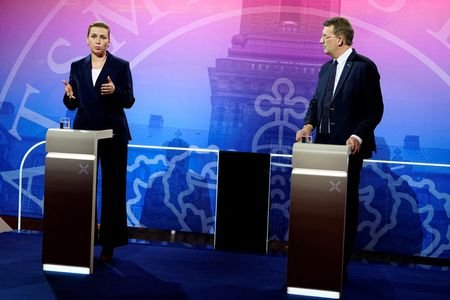
"If we are to do more - and we must, in order to take care of some of the most vulnerable members of society - then the solution is not to make Denmark poorer," Defence Minister Troels Lund Poulsen, leader of the right-leaning Liberal Party, said in a debate with Frederiksen on Sunday.
Parrinello, of the EU Tax Observatory, argued that wealth taxes encouraged ordinary citizens to pay their own taxes if they restored trust in the tax system and showed that the rich were paying a fair share.
"Is democracy about one person, one vote, or is it about one dollar, one vote, and those with more dollars have more rights and more rights to pay less tax than us?" he said.
U.S. economist Joseph Stiglitz, a Nobel Prize laureate, on Tuesday threw his weight behind the proposal, urging European governments to follow suit.
"Does anybody think that if you tax Bill Gates by 0.5% he will stop working? Or Jeff Bezos? No - they are going to go on doing exactly what they are doing."
The experience of Norway - with a wealth tax dating back to 1892 - offers fodder for both sides of the argument.
Data from conservative think-tank Civita show 261 residents with assets above 10 million crowns left Norway in 2022 and 254 in 2023. But despite the exodus, revenue from the wealth tax has gradually risen to a not-trivial 0.6% of national output.
(Reporting by Louise Rasmussen, Soren Jeppesen and Stine Jacobsen in Copenhagen, and Francesco Canepa in Frankfurt, editing by Terje Solsvik, Mark John and Alex Richardson)