By Maria Tsvetkova
NEW YORK, Dec 23 (Reuters) - Russia’s full-scale invasion of Ukraine opened a potential goldmine for Vladimir Arsenyev.
The 75-year-old scientist heads a Moscow firm that makes components for a communications device used by tank crews.
As Russian tanks rumbled through Ukraine in 2022, his business was awash with defence orders.
But the orders he landed turned out to be a poisoned chalice, he recounted in a series of interviews with Reuters, the first time he has spoken publicly about his struggles. He had to ramp up production at breakneck speed and deliver to tight deadlines at prices set by the Russian defence ministry.
Failure was no option. Invoking the spectre of Soviet dictator Josef Stalin, Russia’s government has threatened defence manufacturers with jail time if they don’t meet contractual obligations.
By spring 2023, Arsenyev’s factory was behind schedule on production, and senior executives were feuding, interviews with two key players and court documents show.
Sergei Mosiyenko, a minority shareholder, said he could see the company was going to miss deadlines, so he blew the whistle. “The defence ministry is the customer,” he told Reuters. “They are always right.”
Officials Arsenyev turned to for help ignored him, the factory boss said.
With the company edging toward bankruptcy, Arsenyev walked into Moscow’s Red Square on July 26, 2024. Outside the Kremlin, near the mausoleum of Soviet state founder Vladimir Lenin, he poured gasoline over his body and set himself alight.
He spent weeks in hospital with severe burns, he said.
Speaking to Reuters from the hospital, Arsenyev disputed that the contracts were in trouble, saying people who were trying to undermine him had sent unfounded complaints to the authorities.
“How is it that a company that is getting growing orders and fulfils those orders is dying?” he asked. “That probably means there’s a problem.”
The Kremlin and Russia’s defence ministry did not respond to detailed questions about Arsenyev’s case or their handling of defence contracts more broadly.
DEFENCE INDUSTRY UNDER PRESSURE
The difficulties at Arsenyev’s firm, Volna Central Scientific Research Institute, lay bare the pressures on Russian defence companies, which have faced years of demands to ramp up production.
Arsenyev’s struggles are not unique, a Reuters review of Moscow court rulings found.
At least 34 people have faced criminal charges for disrupting state defence orders since the start of the Ukraine war, according to documents posted on the Moscow courts of general jurisdiction website. They include at least 11 company bosses and two senior executives.
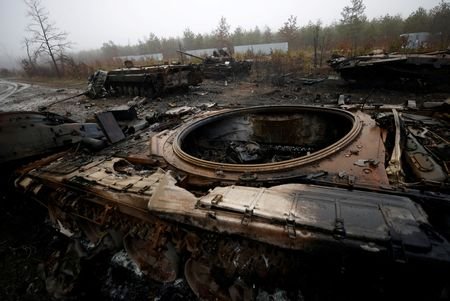
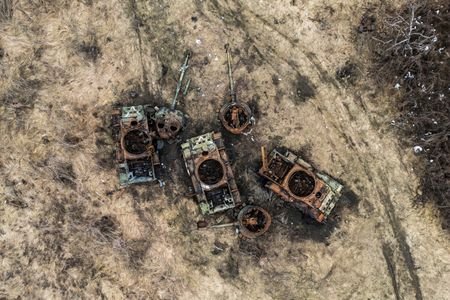
Since Russian President Vladimir Putin ordered troops into Ukraine in February 2022, the country’s manufacturers have increased output of artillery shells, missiles, tanks and drones, outstripping what Kyiv can produce or source from Western allies. But the sector is also plagued by inefficiency and corruption, resulting in spiralling costs, production delays and unmet quotas, according to Mathieu Boulegue, consulting fellow at London’s Chatham House think tank, and a number of other Western security analysts.
The Kremlin’s response – centralising decisions with the defence ministry and state defence conglomerate Rostec, and imposing rigid rules on contractors – is hurting the ability of companies to innovate and modernise, Boulegue told Reuters.
This likely won’t affect Russia’s ability to remain a threat to Ukraine and the West in the short term, Boulegue wrote in a July paper, but it “will make it harder for Russia to sustain competition with its adversaries”.
Responding to questions from Reuters, Rostec dismissed as “propaganda myths” any assertions by the news agency related to a “degradation” of the Russian defence industry.
“Everything is fine with the Russian defence industry,” Rostec said in a statement on its Telegram account. “Our Western colleagues can only dream of the rate of growth that Rostec is showing.”
Ultimately, the military did not receive the communication devices it needed on time, according to the firm that assembles them, Luch Factory, which is co-owned through a chain of companies by Rostec.
That was in part because Arsenyev’s firm did not supply components when it was supposed to, Luch said in its 2023 annual report, an accusation Arsenyev denies. It was not clear from the report how big the orders were or how long they were delayed. Luch’s director, Andrei Pestryaev, declined to provide details.
A dispute with the government over the price of Volna’s components left the firm short of funds, Arsenyev said.
Its accounts were then frozen for failing to pay taxes, according to Arsenyev and SPARK, a database created by Russia’s Interfax news agency that aggregates information from corporate and state records. Wages went unpaid, leading to lawsuits.
“We suddenly found ourselves close to bankruptcy,” Arsenyev said.
Bailiffs called in to recover debts in September 2024 were unable to find assets they could seize, their website shows.
To meet the military’s needs, Luch had to design and produce its own version of Volna’s components, Pestryaev told Reuters.
As of January, there was a deficit of Luch’s devices, a military equipment trader who supplies them to front-line Russian units said on condition of anonymity. Reuters could not determine if that was still the case. Pestryaev declined to comment.
Rostec did not answer questions about the case or the handling of defence contracts. The military also did not comment.
INVOKING STALIN
The tone of how the Kremlin deals with manufacturers was set by Dmitry Medvedev, a former Russian president who deputises for Putin as chair of the Military-Industrial Commission, the body overseeing the defence industry.
At a March 2023 meeting with industry leaders, he read out a World War Two telegram from Stalin stating a manufacturer that failed to deliver weapons on time would be “smashed like criminals”.
“Colleagues, I want you to hear what I’m saying and remember the words of the generalissimo,” Medvedev told the room full of managers, according to a video posted on his Telegram account.
Medvedev did not respond to questions about his remarks sent via the Kremlin.
Underpinning Medvedev’s threat is a 2017 law making it a criminal offence - punishable by up to 10 years in jail - to harm a defence contract in pursuit of personal gain. Just one prosecution was recorded on the Moscow courts website before the war started.
In September 2022, the law was amended to widen the list of missteps that can be prosecuted. It now includes refusal to sign a defence contract or inability to fulfil one, without, in certain circumstances, having to prove defendants were seeking personal gain.
The following January, Putin urged state prosecutors to “strengthen scrutiny” of the timely fulfilment of defence orders.
At least five of the 35 defendants identified by Reuters were sentenced to jail terms of up to six years, and 15 others were detained pending trial.
They include Sergei Kryuchkov, ex-boss of a Russian construction company that was awarded contracts to build a logistics centre for the Federal Agency for State Reserves (Rosrezerv), which manages strategic reserves of food, fuel and equipment for deployment during wars and national emergencies.
His lawyer told a Moscow court in January 2024 that restrictions on his liberty were “creating serious problems” for the firm’s ability to fulfil 12 defence contracts, court documents show.
Kryuchkov was placed under house arrest in August 2023 and sentenced in July to five and a half years in jail on charges of having harmed defence contracts by using money advanced to his company to lease vehicles not mentioned in the agreements, the records show. They include at least three BMW sports utility vehicles.
Kryuchkov argued the cars were for work purposes and said his firm, GES-Montazh, was meeting its contractual obligations. He appealed against his conviction, but the outcome is classified.
The documents do not disclose why he was dismissed last year. His lawyer and GES-Montazh did not respond to questions about the case. Neither did Rosrezerv or the prosecutor-general’s office.
Putin’s former ombudsman for business, Boris Titov, was reported by Russia’s RBC newspaper in April 2023 to have requested that instructions be issued to prosecutors to “exercise particular vigilance” when applying the law, saying a significant portion of cases were for missed deadlines, which can be unavoidable.
The ombudsman’s office told Reuters such guidance was subsequently issued by the prosecutor-general’s office, and since then, it has stopped receiving complaints about the law. The prosecutor-general’s office did not comment.
HELMET RADIOS
A few months into Russia’s invasion, its tank crews faced a shortage of radio sets, according to Andrei Morozov, a Russian soldier in eastern Ukraine.
“They’ve run out. There’s no re-supply,” Morozov wrote in an August 2022 blog post.
At the time, Ukrainian forces were destroying many Russian tanks, which had to be replaced along with equipment like the radios crews use to communicate.
Morozov committed suicide in February 2024, according to a Russian lawmaker citing correspondence he said he received from the defence ministry. A suicide note published on his blog said his unit was suffering equipment shortages, which Reuters was unable to independently confirm. The military and defence ministry did not comment.
The communication systems Morozov wrote about connect headsets and microphones built into soldiers’ helmets to a tank’s radio set via a switching device. Volna was then the only firm making electronics modules for the switching devices, according to court records related to its disputes with Luch and documents posted on the Russian state procurement website.
Before the Ukraine war, Volna produced no more than 5,000 modules per year, the court records show. But after Russia’s invasion, many more were needed. In September 2022, Volna signed contracts to deliver more than 50,000 modules to Luch over the following year.
Increasing production tenfold was a huge undertaking, the documents show. The company had to hire staff and revamp production processes.
Volna received advances worth about 80% of some contracts, the records show. But by April 2023, Volna had fallen behind on its production plan, according to documents related to a separate dispute between the company and its chief engineer at the time, Andrei Buchinsky.
An unidentified person at Volna reprimanded Buchinsky for being late with an amended plan, which he argued in a lawsuit was unjustified. The court sided with Volna, saying Buchinsky provided a plan on time but did not submit it in the requested format. Buchinsky declined to comment on the ruling.
Between March and May 2023, Mosiyenko, the minority shareholder, wrote letters to Rostec and the Federal Security Service (FSB), successor to the Soviet KGB, saying the contracts were in trouble.
“As a shareholder, I cannot do nothing,” Mosiyenko told Reuters. “Otherwise, I will be held criminally accountable.”
Mosiyenko’s complaints triggered investigations. He showed Reuters an extract from a letter he said he received from the defence ministry saying military prosecutors were looking into alleged irregularities with fulfiling the contracts. He did not share the whole letter, citing laws protecting military secrets.
Reuters was unable to establish the status of these probes but found no evidence Arsenyev or any of his employees faced criminal charges. The prosecutor-general’s office, Rostec and the FSB did not respond to questions about the case sent via email.
According to Arsenyev, inspections by various authorities disrupted work on the orders, but they were delivered on time.
In September 2023, the defence ministry dropped a bombshell: it told Arsenyev it was cutting by nearly half the amount Luch would pay for Volna’s modules, the documents related to disputes between the companies show.
Luch is now seeking to recover over 65 million roubles ($824,900) in advances paid to Volna, the documents show. That is 7 million roubles more than Volna's total revenue in 2020, the last year for which the firm published accounts.
The ministry told Arsenyev it recalculated the price after Volna automated more of its production process, reducing costs, the documents show.
A defence ministry official who handled the Volna contracts, speaking on condition of anonymity, said Volna failed to communicate with the ministry to resolve the dispute, which Arsenyev denies.
Volna suspended production for six weeks and challenged the decision in court, Arsenyev said.
A judge who ruled in a lawsuit brought by Luch concluded the ministry’s decision to reduce what would be paid for the modules hurt Russia’s supply pipeline in Ukraine.
It led to the “non-fulfilment (disruption) of the 2024 state defence procurement programme for the supply of products that are in particular demand for the SVO,” the judge wrote, using an acronym for Russia’s military operation in Ukraine.
The judge ruled in Volna’s favour, but over a dozen related suits remain unresolved.
After his Red Square protest, Arsenyev said he kept working from hospital to resolve the factory’s financial and legal problems, with little success. His company is still afloat, but it has had to downsize, and its orders are much smaller.
Now back at work, he spends much of his time attending court hearings.
The only sign that officials or prosecutors noticed his desperate act of self-immolation: In October 2024, a court fined him an undisclosed amount for staging an unauthorised demonstration in a sensitive location.
($1 = 78.7955 roubles)
(Additional reporting by Christian Lowe, Anton Zverev and Polina Nikolskaya in London; Writing by Christian Lowe; Editing by Alexandra Zavis)