By Anthony Deutsch
AMSTERDAM, April 3 (Reuters) - Leading Russian state oil and gas companies Rosneft and Gazprom supported wartime camps where more than 2,000 Ukrainian children were taken, facilitating transportation and providing funds, Yale University research has alleged, prompting calls from some U.S. lawmakers to reinstate sanctions on the two firms.
The findings, released by Yale last week, provide the first "definitive public proof of these companies' critical involvement in Russia's systematic campaign of child deportation and indoctrination," the Yale School of Public Health's Humanitarian Research Lab (Yale HRL) publication said.
With the support of the two energy giants, approximately 2,158 children were taken to the camps in Russian-occupied Ukraine and Russia between 2022–2025, it said, including for pro-Russian education.
Yale's conclusions were based on analysis of public statements by individuals, verified social media posts, corporate websites and records, it said. Reuters could not independently confirm the report's findings.
Russia's foreign ministry and Ukrainian authorities did not respond to requests for comment.
In response to a Reuters request for comment on details of the report, Gazprom said: "Gazprom owns several health resorts in Russia and Russian children spend summer vacations there."
Russia has consistently denied it forcibly took Ukrainian children, saying it removed them from danger on humanitarian grounds. It has dismissed earlier Yale reports as anti-Russian propaganda.
Lawyers representing Rosneft said in a letter to Reuters that Yale's report failed to find any evidence of participation in illegal activity by the company.
"In essence, the report purports to attribute participation in war crimes to Rosneft without any evidence. Rosneft categorically denies directing, controlling, or participating in any of the alleged conduct," it said.
ROLE OF THE UNIONS
At least 1,072 children from Russia-occupied Ukraine received vouchers from Gazprom subsidiaries and trade union organizations to attend pro-Russia camps in 2022 and 2023, Yale's report said.
Rosneft's Interregional Trade Union sponsored 100 children from Ukraine to attend three camps in 2022, it said. Rosneft's trade union did not respond to a request for comment.
Rosneft's lawyers said that the union was a separate legal entity, independently registered under Russian law.
They also said Yale did not provide any evidence that Rosneft "directed, controlled, authorised or even knew" of the union's alleged conduct.
Rosneft's website says it "pays special attention to strengthening the system of partnership relations" with trade unions and their subsidiaries.
Michael McFaul, a professor of international affairs at Stanford who served as U.S. ambassador to Russia from 2012-2014, dismissed the idea that Rosneft's union was independent.
"Rosneft is an arm of the Russian government ... Tragically, Putin's dictatorship no longer allows independent trade unions," said McFaul, who served as Senior Director for Russian and Eurasian Affairs on the National Security Council from 2009 to 2012.
UNITED STATES EASES SANCTIONS
Earlier in March, the United States announced a temporary lifting of sanctions on the sale of Russian-origin crude oil and petroleum products to counter surging prices that followed the war in Iran.
The White House did not respond to a request for comment.
A bipartisan group of 12 members of U.S. Congress cited Yale's findings in an appeal to reimpose sanctions on Gazprom and Rosneft, which were also lifted under the waiver.
A letter drafted by Ohio Representative Greg Landsman and shared with Reuters said that "the recent revelation of their direct involvement in Russia's abduction of over 35,000 children from Ukraine is cause for significant alarm."
The letter, which was to be sent to Secretary of State Marco Rubio and Treasury Secretary Scott Bessent on Friday, called for 35 additional entities identified by Yale to be sanctioned, adding that the 30-day sanctions waiver for Russian oil sales will result in approximately $12 billion of revenue for the two Russian companies.
RUSSIA REJECTS ICC'S ALLEGATIONS
Under international law, the forced deportation and transfer of children from occupied territory to the territory of an occupying power or to that of any other country is a war crime, regardless of the motive, and Ukraine has classified it as a crime against humanity.
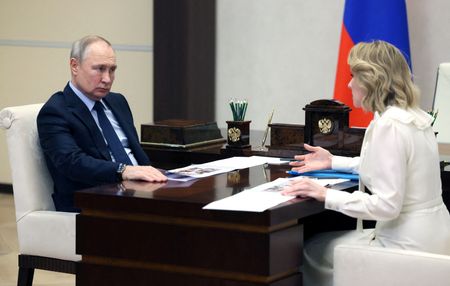
Russian President Vladimir Putin and his commissioner for children's rights, Maria Lvova-Belova, have been accused of the war crime of deportation for the illegal transfer of Ukrainian children.
The International Criminal Court issued an arrest warrant for Putin and Lvova-Belova for their alleged roles in atrocities during the war that began with Russia's 2022 invasion of Ukraine.
The Office of the Prosecutor at the ICC did not respond directly to the assertions raised in the Yale report.
In comments sent to Reuters it said that it continued to receive reports about child deportations and was entitled to enlarge cases to include new suspects "should the evidence meet the required standards."
Russia has rejected the court's allegations.
"As far as the ICC's accusations are concerned, we don't understand what we are accused of," Lvova-Belova told a news conference in April, 2023. "Give us the facts and we will look into it. So far, it all looks like a farce without specifics and is incomprehensible."
Yale's latest findings came after it said in September that Russia had expanded a network of camps for military training, drone manufacturing and other forced re-education of Ukrainian children to at least 210 facilities.
Children from Ukraine were taken to at least six camps in Russia and Russia-occupied Crimea, including three camps owned by Gazprom subsidiaries as recently as 2025, Yale said.
The Kremlin did not respond to a request for comment on that report.
(Reporting by Anthony Deutsch; Editing by Mike Collett-White)