By Tim Cocks
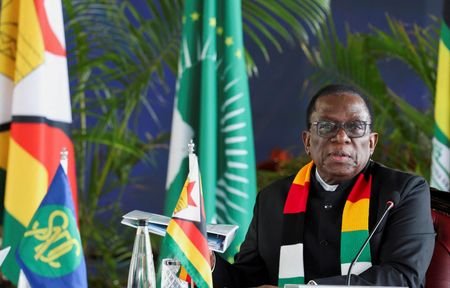
JOHANNESBURG, June 18 (Reuters) - Emmerson Mnangagwa's political skills may have earned him the nickname "The Crocodile", but it still took half a century of working under Robert Mugabe before he got the chance to take Zimbabwe's top job.
Perhaps that's why, nearly a decade later, Zimbabwe's second post-independence leader seems reluctant to allow his time in office to expire.
Zimbabwe's parliament voted in legislation on Thursday that would change the constitution to extend presidential terms from five years to seven.
That would allow Mnangagwa, 83, to remain in power until 2030, three years beyond when his current term expires. His presidency began with a coup in November 2017.
Supporters of the extension in Mnangagwa's ZANU-PF party argue it will boost stability, cut election costs and enable longer-term economic planning.
Their campaign has faced uncharacteristically vocal opposition from the public and some independence war veterans, who turned on their erstwhile ally, accusing him of a power grab.
Other proposed changes include parliament electing the president rather than a direct popular vote. They all need to go to the Senate for a second vote before being ratified.
NO MAJOR CHANGE FROM MUGABE
Shortly after taking power, Mnangagwa rebranded himself as a reformer, promising cuts to government spending and privatising state firms that were burning a hole in government finances.
He has since presided over a period of economic instability and chaos almost as pronounced as that which marred his deposed predecessor's time -- although the government has finally got inflation under control. It fell to single digits in January for the first time in nearly three decades.
That was only after a long period of robust price increases that continued into 2023, a year in which Zimbabwean inflation was amongst the highest in the world, at 243%.
Mnangagwa's government, like Mugabe's, has blamed Western sanctions for Zimbabwe's prolonged economic woes, and not policy failures.
Whatever goodwill Mnangagwa's promises brought him was also dispelled by a military crackdown on protests against the 2018 election results. At least six people died in confrontations that recalled the iron fist that the state used to crush dissent in Mugabe's days.
Authorities have defended curbs on the opposition as necessary for order, and accused critics of trying to destabilise the country.
The Crocodile had long been considered the most likely successor to Mugabe, particularly after his promotion to vice president in 2014. Then, in 2017, Mugabe dismissed him for alleged "disloyalty" — a move widely seen as clearing the path to the leadership for Mugabe's deeply unpopular wife, Grace.
That miscalculation ultimately proved Mugabe's undoing: the military seized power and placed the bitter, tearful post-independence leader under house arrest until he resigned.
A HISTORY OF GUERRILLA ACTIVISM
Mnangagwa was born on September 15, 1942, in Zvishavane, then part of Southern Rhodesia, to a farming family. His father opposed British-backed white minority rule, a cause Mnangagwa embraced as a young man.
His activism led to his expulsion from college in 1960 and, five years later, a death sentence for blowing up a train. The sentence was reduced to 10 years because he was under 21, an experience that shaped his long-standing opposition to capital punishment, which he abolished in Zimbabwe in 2024.
In the 1970s, he became an assistant to Robert Mugabe, operating from their liberation movement's base in neighbouring Mozambique.
He was part of the leadership that negotiated the end of white minority rule, paving the way for Zimbabwe's independence and ZANU-PF's landslide victory in the 1980 election. The party has remained in power ever since.
Mnangagwa served for decades in Mugabe's government, including as justice and defence minister. As overseer of state intelligence, he faced criticism over his alleged role in the Gukurahundi massacres of the 1980s, in which thousands of civilians, largely from the Ndebele ethnic group, were killed.
He has acknowledged the atrocities took place but denies responsibility, saying he was too junior at the time to be a decision-maker.
(Reporting by Tim Cocks; Editing by Andrew Heavens)

