By Laurie Chen and Claire Fu
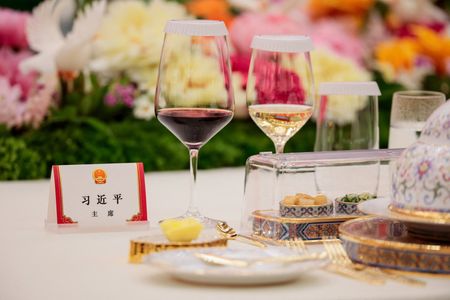
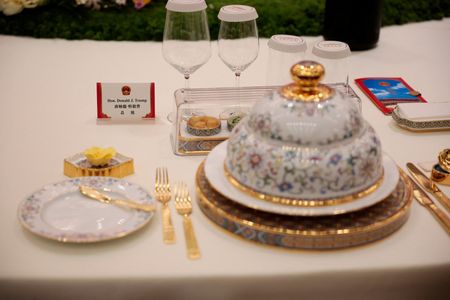
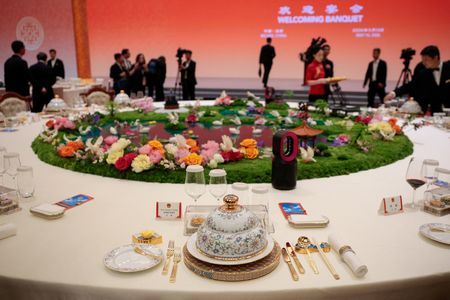
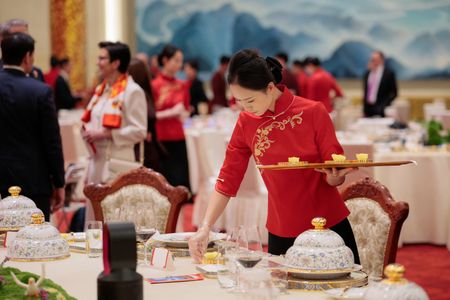
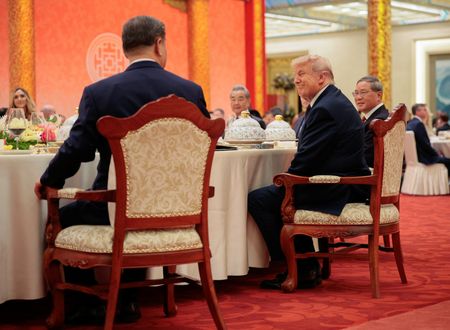
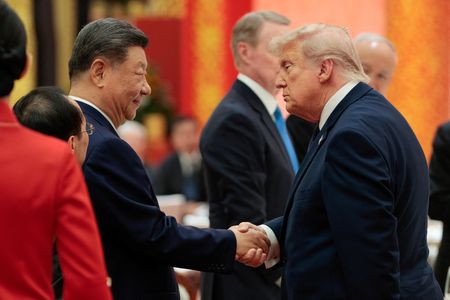
BEIJING/SINGAPORE, May 14 (Reuters) - When Presidents Donald Trump and Xi Jinping sat down to a lavish state banquet in Beijing on Thursday, the menu itself read like a work of diplomacy.
Chinese state dinners traditionally draw on Huaiyang cuisine, from the region surrounding Shanghai, known for its mild, subtle flavours, refined knife-work and emphasis on seasonal dishes.
To cap a meeting in which both sides expressed a willingness to reset relations, menu planners appeared to add a note of culinary flexibility - including Beijing roast duck, China's national dish, and beef ribs, in an apparent nod to Trump's preference for a well-done steak.
They also went heavy on dessert options for American guests: tiramisu, fruits and ice cream and a "trumpet-shell shaped pastry."
For decades, China has used the powerful symbolism of food during landmark official events and when receiving distinguished foreign visitors. In China's modern history, famines and political turmoil that caused decades of widespread rationing turned food into a potent status symbol in Chinese culture.
FOOD AS DIPLOMATIC SYMBOL
Food has also featured in unexpected viral moments when foreign officials visited China in recent years. In 2023, former U.S. Treasury Secretary Janet Yellen joked about eating "magic mushrooms" at a Yunnan cuisine restaurant in Beijing, while in 2011 then-U.S. Vice President Joe Biden ate at a humble Beijing eatery famed for its fried liver.
China has even named dishes after visiting figures, including a chicken recipe created for Henry Kissinger during his secret 1971 trip, and banquet menus are often later replicated by local restaurants.
"One of the key strengths of Huaiyang cuisine is its broad appeal. Its flavours are widely acceptable and accessible to most people ... including international guests," said Shi Qiang, executive chef at Gui Hua Lou, an upscale Huaiyang cuisine restaurant in Shanghai.
One of the eight major regional cuisines of China, Huaiyang cuisine has long played a starring role at major diplomatic events.
It was served at the 1949 "founding banquet" when the People's Republic was established, at China's 50th anniversary commemoration banquet in 1999, as well as a 2002 banquet hosted by then-President Jiang Zemin for the visiting U.S. President George W. Bush.
Signature dishes include tender, springy "lion's head" pork meatballs, Yangzhou fried rice, "squirrel fish" deep-fried in a sweet-and-sour sauce, and "wensi tofu" - a block of tofu sliced into thousands of fine strands.
The cuisine features ingredients native to the Yangtze river basin like freshwater fish, eel and bamboo shoots, as well as minimal seasoning to highlight their freshness.
"It's great for banquets because it's lighter than the food of Shandong in China's north, not spicy like the foods of the southwest (like Sichuanese), and more approachable and less reliant on exotic ingredients than Cantonese, the big cuisine of the south," said Shanghai-based food writer Christopher St. Cavish.
"In the most basic description, it's 'safe'. It's the equivalent of serving chicken at a banquet in Washington, DC. No one is going to get offended or find it too hot to eat or too exotic to try."
(Reporting by Laurie Chen in Beijing and Claire Fu in Singapore; Editing by Lincoln Feast and Ros Russell)