By Jana Winter and Andrew Goudsward
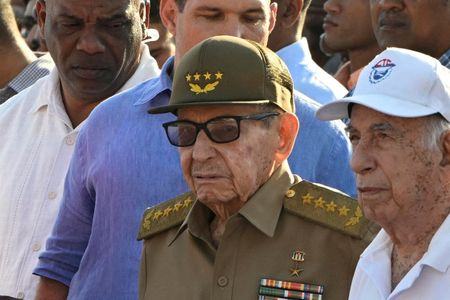
May 15 (Reuters) - The Trump administration plans to announce criminal charges against former Cuban president Raul Castro next Wednesday, according to a U.S. Justice Department official, in a move that would escalate the pressure campaign against the island's communist government.
The official, who spoke on condition of anonymity, said federal prosecutors expect to unseal an indictment against Castro, 94, in Miami on May 20, based on a 1996 incident in which Cuban jets shot down planes operated by a group of Cuban exiles.
The prosecutors' office in Miami will host an event that day to honor victims of the incident, according to an invitation seen by Reuters. The office did not immediately respond to a request for comment.
The indictment would need to first be approved by a grand jury. The planned announcement was first reported by the Miami Herald.
Castro is the brother of the late Fidel Castro, the revolutionary and longtime foil of the United States who led the island's communist government for decades. Raul Castro stepped down as Cuba's president in 2018 and handed over leadership of its communist party in 2021.
He was defense minister during the 1996 incident. The Cuban government has argued the strike was a legitimate response to the planes intruding on Cuban airspace.
The U.S. condemned the attack and imposed sanctions, but did not pursue criminal charges against either Castro brother. The Justice Department charged three Cuban military officers in 2003 but they were never extradited.
PRESSURE ON HAVANA
The development comes amid heightened tensions between Washington and Havana. The Trump administration has described Cuba's current communist-run government as corrupt and incompetent and is pushing for a regime change.
President Donald Trump has heaped pressure on the island, effectively imposing a blockade by threatening sanctions on countries supplying it with fuel, igniting power outages and delivering blows to its economy.
CIA chief John Ratcliffe delivered a message from Trump during a rare visit to Havana on Thursday that the U.S. would engage with the government on economic and security issues "only if it makes fundamental changes."
The criminal case against Castro recalls the earlier drug-trafficking indictment of former Venezuelan President Nicolas Maduro, which the Trump administration cited as justification for the January raid that captured Maduro and brought him to the U.S. to face charges. He has pleaded not guilty.
Trump in March threatened that Cuba "is next" after Venezuela.
The top federal prosecutor in Miami, Jason Reding Quiñones, is a Trump ally who is also overseeing an investigation of former CIA Director John Brennan, a longtime Trump adversary, along with a wider effort to examine whether prior investigations of Trump amounted to a conspiracy.
(Reporting by Jana Winter, Dan Rosenzweig-Ziff and Andrew Goudsward; Editing by Andy Sullivan, Sanjeev Miglani and Bill Berkrot)