By Nailia Bagirova
SHUSHA, Azerbaijan, July 16 (Reuters) - Azerbaijan and Armenia are at "real peace" and rebuilding trade links after decades of conflict, a senior Azerbaijani official told Reuters, but Baku is insisting on changes to Armenia's constitution before a final deal can be signed.
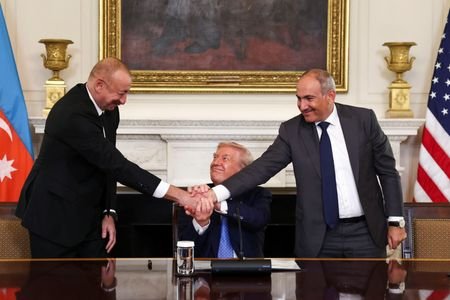
The South Caucasus neighbours had been at intermittent war since the late 1980s, mostly over the mountainous region of Nagorno-Karabakh, before reaching a preliminary U.S.-brokered peace agreement last August.
For Azerbaijan, a sticking point to signing a formal deal is the preamble of Armenia's constitution, which contains a reference to another Soviet-era document calling for the reunification of Armenia and Nagorno-Karabakh, then an autonomous region in Soviet Azerbaijan.
The territory had de facto independence and was governed by an ethnically Armenian administration for three decades before Azerbaijan took it in a lightning offensive in 2023. Most of its 100,000 population fled to Armenia.
A lasting peace could reopen trade and transport links across the South Caucasus, strengthening connections between Asia and Europe while reshaping the regional influence of Russia, Turkey and Iran.
In an interview with Reuters on the sidelines of a forum in the city of Shusha this week, Hikmet Hajiyev, assistant to Azerbaijan's president and head of the president's foreign policy department, praised the countries' progress towards peace, including growing direct contacts and bilateral trade.
"We are living in conditions of real peace. For Azerbaijan and Armenia, peace is not just something written on paper or contained in a declaration — it is a reality," he said in an interview, pointing to increased supplies of Azerbaijani oil products to Armenia.
Despite the progress, he said Baku maintained its stance on Armenia's constitution.
"The form of constitutional changes is Armenia's internal matter," said Hajiyev. "What is important for Azerbaijan is that the provisions we regard as territorial claims against our country are formally removed, whether through the adoption of a new constitution or another legal mechanism."
"Once that issue is resolved, we believe there will be no obstacles to signing the final peace agreement," he said.
"POSITIVE SIGNALS" ON PLANNED TRANSIT CORRIDOR
Armenian Prime Minister Nikol Pashinyan has said he wants to hold a referendum to change the constitution and that a draft of the new charter will be published by the end of this year.
But his Civil Contract party lacks the constitutional majority in parliament needed to call the referendum and it is unclear whether the opposition, dominated by pro-Russian groups, will join him.
Hajiyev said publication of the draft alone would not be sufficient to sign a peace deal.
He also said Azerbaijan had received "serious and positive signals" from the United States that construction work on a planned Washington-backed transport corridor in the region could begin this autumn.
Dubbed the "Trump Route for International Peace and Prosperity (TRIPP)", the proposed 43-km (27-mile) corridor would cut across Armenia and give Azerbaijan direct access to its exclave of Nakhchivan and to its close ally Turkey.
The route would better connect Asia to Europe at a time when Washington wants to diversify energy and trade flows away from Russia because of the war in Ukraine.
"Our position is that this (TRIPP) should be implemented as soon as possible," Hajiyev said.
He said infrastructure extending to Azerbaijan's southwestern Zangilan region would be largely completed by the end of 2026, after which it could be connected to planned infrastructure in Armenia and Turkey.
(Reporting by Nailia Bagirova; Writing by Lucy Papachristou, Editing by Timothy Heritage)