Chaos in Europe: Why the Continent's Young People Are on the Streets
Oct 19, 2026 ·
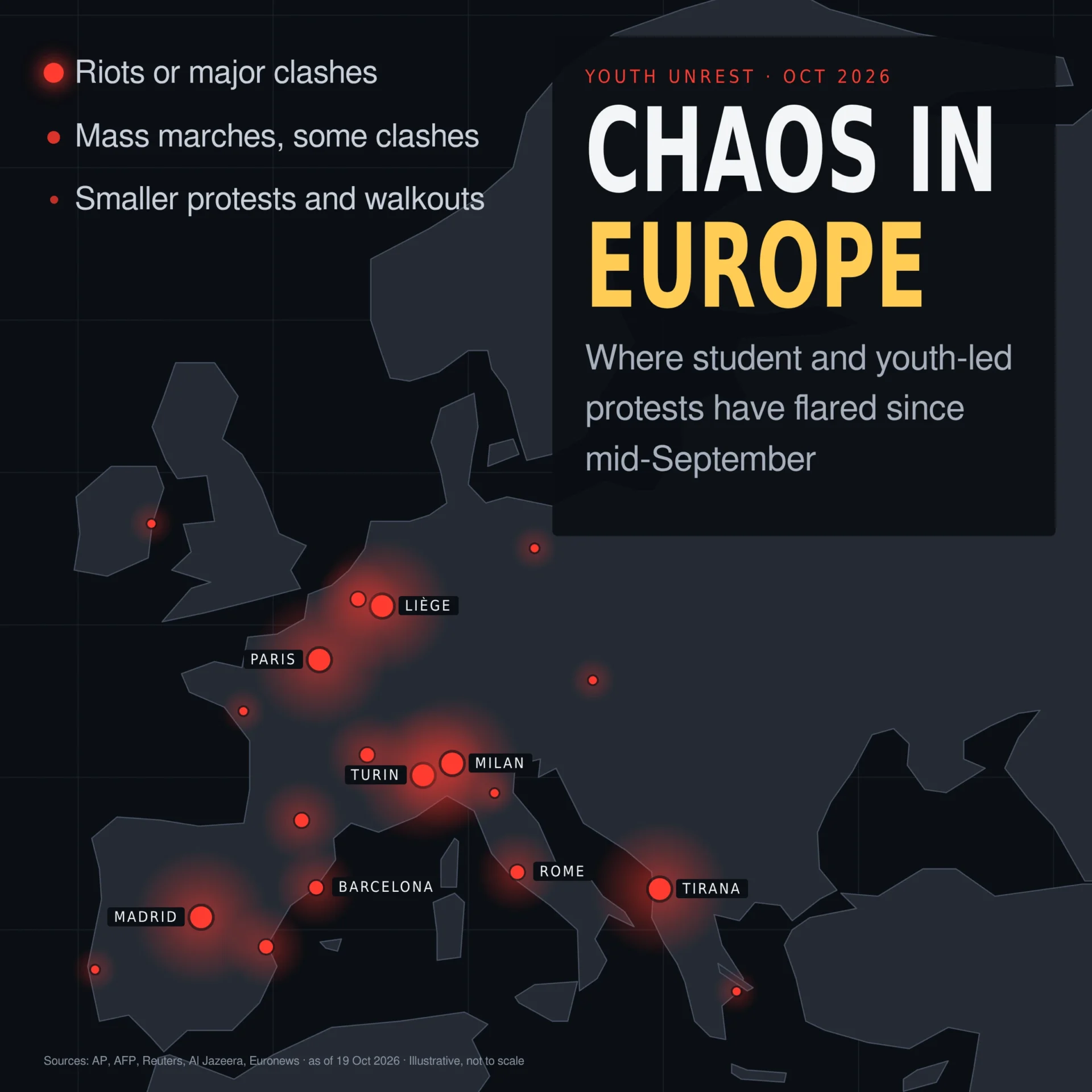
In five weeks, a handful of blocked French high schools has grown into a youth protest wave touching at least eight European countries. France, Belgium, Italy, Spain and Albania have seen the largest crowds and the worst clashes; Ireland, Germany, Austria, Portugal and Greece have seen smaller student actions. The anger is real and mostly about everyday things — crumbling schools, missing teachers, rent and the cost of living. So is the violence at the edges, and so is the political fight over who gets to speak for the young.
Accompanying graphic: “Chaos in Europe” hotspot map (see separate image).
Background: how it started
The current wave did not come from nowhere. In 2025, youth-led “Gen Z” protests spread from Nepal and Indonesia to Morocco and Madagascar, and in Europe they were strongest in Serbia and Slovakia (European Democracy Hub). In December 2025, protests over a draft budget brought down Bulgaria’s government — the first European government to fall to a youth-driven movement (Seeking Alpha).
Three separate fuses were then lit in autumn 2026:
- France — schools. In mid-September, students began blocking their lycées (high schools for ages 15–18) in the Paris suburbs and elsewhere, over classes of 32–36 pupils, teachers who are absent and never replaced, and run-down buildings. By 28 September about 180 schools were affected nationwide (Drawpie). The first day of national action, 29 September, coincided with union strikes against Prime Minister Sébastien Lecornu’s budget (Kuwait Times/AFP).
- Spain — housing. The televised eviction of 87-year-old Maricarmen Abascal in Madrid turned years of anger over rents into mass protest. Average rents have nearly doubled in a decade. When parliament rejected the government’s emergency housing decrees on 2 October, Pedro Sánchez called a snap election for 29 November, and tenants’ unions began pushing for a general strike (AP, Oman Observer).
- Albania — corruption. The “Flamingo Revolution” began months ago as daily rallies against a luxury resort in a protected coastal area, linked to an investment firm founded by Jared Kushner. A September investigative report widened it into an anti-corruption movement demanding Prime Minister Edi Rama’s resignation (OCCRP, Euronews).
In October these streams began to merge. Students in one country chanted slogans borrowed from another, and social media and Telegram channels spread call-outs across borders.
The situation now
France remains the centre of gravity, but Albania is currently the most volatile and Spain carries the biggest political stakes. Most marches in every country have been peaceful; the violence has been concentrated in a few cities and, often, after dark.
| Country | Main grievance | Scale and latest | Government response |
| France | School conditions, class sizes, teacher shortages; widening to cost of living | ~450,000 marched on 6 Oct (organisers); 6,500+ detained, mostly minors; a 17-year-old lost a hand to a police grenade in Saint-Étienne; Yellow Vests joined on 17 Oct (France 24, Organiser) | Five “priority workstreams”; consultation in every lycée; plan promised by end of October; stun grenades suspended; 10 police brutality inquiries (L’Étudiant, Kuwait Times/AFP) |
| Albania | Corruption, Kushner-linked resort, university conditions and fees | Riots of 8+ hours in Tirana on 14 Oct; fires at the Education Ministry; protests in a fifth day on 17 Oct and spreading to smaller cities (AP, Al Jazeera) | Rama offers dialogue with “genuine students”, refuses to resign, blames opponents; EU urges a proportionate police response |
| Spain | Housing and rents | Tens of thousands in 50+ cities; tent camp in Madrid; clashes in Valencia and Barcelona (Reuters, Euronews) | Snap election on 29 Nov; general strike called, date not yet set |
| Italy | School funding and buildings, 30% cap on some foreign pupils per class, military spending | “No Meloni Day” on 16 Oct in Rome, Milan, Turin, Bologna; 15 officers hurt in Turin; rail stations blocked (Il Post, Euronews) | Condemnation of violence; investigators checking whether masked rioters were outsiders |
| Belgium | Education costs, school conditions | Riots in Liège on 7 Oct closed the main station; marches in Brussels on 17 Oct (Wikipedia) | Police dispersals; no national package yet |
| Ireland, Germany, Austria, Greece, Portugal | Fees, student housing, schools; strikes in Portugal | Smaller walkouts, assemblies and marches (Freedom Press, IBTimes) | Largely local |
Analysis: what is really going on
The common thread is a generational squeeze, not a single ideology. Demands differ by country, but they converge on the cost of a decent start in life: a working school, an affordable room, a job that pays the rent. Analysts point to a structural cause underneath — ageing populations and stretched public finances make it hard to keep funding the welfare state at the old level (Ground News summary). France, for instance, is trying to cut its deficit from 5.4% of GDP in 2026 to 5% in 2027, which limits what it can offer students (La Gazette France/AFP).
The movements are leaderless, and that cuts both ways. Like the Gen Z protests in Asia and Africa, they organise through TikTok, Discord and Telegram rather than parties or unions. That lets them spread fast across borders. It also means no one can negotiate on their behalf, no one can call off a riot, and demands can become “very heterogeneous”, as one French governing-party MP put it (Sud Radio/AFP).
Points that are genuinely contested:
- Police conduct. Amnesty International has called the French response disproportionate, and the EU has urged restraint in Albania. Governments reply that officers face fireworks, bricks and arson, and that most injuries are accidents rather than policy (France 24, La Gazette France).
- Who is doing the violence. Leaders in France, Albania and Italy all distinguish “genuine students” from masked groups who loot or attack property. Protesters say this framing is used to discredit the whole movement. Both can be partly true; evidence so far is local and incomplete.
- Political capture. French intelligence reportedly linked parts of the movement to France Unbowed (LFI), and Lecornu accuses the party of trying to create disorder before the 2027 election. LFI says the government is dodging the students’ demands. In Albania, Rama blames the opposition, which openly backs the protests. Opposition parties everywhere are clearly trying to ride the wave; whether they started it is far less clear.
- Foreign policy and identity issues. In Italy, banners against rearmament and the war in Gaza sat alongside school demands, while the government defends its cap on some foreign pupils per class as a measure to help integration and learning. Mixed agendas make the movements broader but easier to dismiss.
Honest prediction
My best guess: the street phase peaks within weeks, but the anger becomes a lasting political force rather than a revolution. No European government except possibly Albania’s looks at real risk of falling. Here is how I see it, with rough odds that are judgement, not data.
- Most likely (about 55%) — slow burn and partial wins. France unveils its school plan before the 12 November education-budget debate; it offers repairs, timetable changes and some teacher hiring, but not the money students want. Turnout falls over the November holidays and winter, with flare-ups around key dates. Italy and Belgium follow the French tempo. Spain’s energy shifts from the street to the 29 November ballot box.
- Plausible (about 30%) — a sharper escalation. A death or serious injury at a protest, or a viral video of police violence, could unite students, unions and the Yellow Vests into a general-strike moment, as happened briefly in France in 2018–19 and in Greece in 2008. Spain’s general strike and Albania’s daily clashes are the likeliest sparks.
- Less likely (about 15%) — a government falls. Albania is the exception to watch: the movement is older, explicitly aimed at removing Rama, and backed by the opposition, though Rama won a fourth term last year and faces no election until 2029. In France, a censure vote over the budget is possible but would be driven by parliament, not the street.
The longer-term effect matters more than the riots. A generation that feels shut out of housing and decent public services tends to vote for anti-establishment parties of the left and the right. Expect youth turnout and anger to shape Spain’s November vote and France’s 2027 presidential race. Whichever governments convert part of these demands into visible change — a repaired school, a rent cap, a hired teacher — will cool the streets fastest. Those that rely mainly on policing are likely to see the protests return.
Sources
- Al Jazeera — Albania’s PM dismisses calls to resign
- AP — Riots erupt in Albania’s capital
- OCCRP — Violent student protests surge in Tirana
- France 24 — Hundreds arrested on biggest day of French student protests
- Kuwait Times/AFP — French students plan fresh protests despite PM’s pledge
- L’Étudiant — Government launches five priority workstreams
- La Gazette France/AFP — Lecornu condemns violence, rejects “police repression” claim
- Drawpie — France student protests explained
- Reuters — Tens of thousands protest across Spain over housing
- Oman Observer — Spain’s PM calls snap election
- Il Post — Students protest across Italy, 16 October
- Euronews — Clashes on “No Meloni Day”
- Freedom Press — Gen Z on the barricades
- European Democracy Hub — The 2025 surge in protests continues in 2026
- Al Jazeera — Young protesters across Europe share grievances
Note: several outlets above have a clear editorial slant (left or right); facts in this article were cross-checked against wire services (AP, AFP, Reuters) where possible.