By Simon Lewis
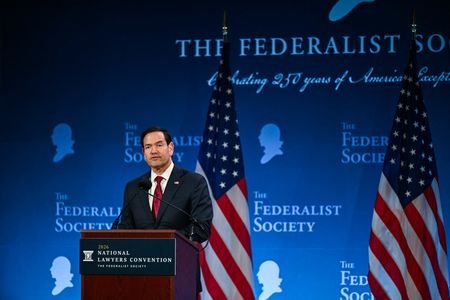
WASHINGTON, Nov 13 (Reuters) - Secretary of State Marco Rubio attacked the International Criminal Court in a speech to a conservative legal group on Friday, arguing for a muscular foreign policy and against international law restraining US actions.
Rubio's speech to the Federalist Society in Washington, his first prepared remarks since Republicans were routed in the midterm elections on November 3, heightens speculation over whether he will leave his roles as national security adviser and top US diplomat to run for president in 2028.
Rubio, who has at times sought to provide an intellectual justification for President Donald Trump's "America First" foreign policy, has firmly denied reports he will soon embark on a presidential campaign, but the Federalist Society is an occasional stop for Republican hopefuls.
He has dismissed criticisms that the Trump administration has broken international law by such actions as seizing Venezuelan then-President Nicolas Maduro and striking boats in the Caribbean and Eastern Pacific that it says were carrying drugs.
In his speech, Rubio said the goal of the US-Israeli war against Iran was to prevent Tehran from ever developing a nuclear weapon, which he said was particularly urgent because the Islamic Republic's "radical Shia clerics" had an "expansionist mentality."
He contrasted this with the government of North Korea's Kim Jong Un, whom Trump has met three times. "I'm not excusing the terrible things that have happened there," Rubio said of North Korea. "I'm just saying he (Kim) is not expansionist. He's not trying to invade Japan or, you know, China or whatever."
The US, Rubio said, would not “submit to the sterile vision of radical judges or soulless global bureaucrats,” repeating his assertion that the court would try to prosecute US officials or service members that he used to justify sanctions against the ICC announced last month.
“Americans have never agreed to submit to the ICC's authority, but that court and its allies in the global bureaucracy have appointed themselves judge and jury and executioner of the international order,” Rubio said.
The Trump administration has long been hostile to the Netherlands-based court, founded in 2002 to prosecute war crimes, crimes against humanity and genocide, and has previously imposed sanctions on its prosecutors and judges. The ICC has received strong backing from most member states, which include all EU countries and all members of the NATO alliance apart from the United States and Turkey.
Washington has denounced the court over arrest warrants issued for Israeli officials including Prime Minister Benjamin Netanyahu, and an investigation into actions of US soldiers in Afghanistan, which the ICC says is "deprioritized."
The US sanctions, designed to stifle the ICC’s ability to operate, will take effect in April unless supporters of the Netherlands-based court can reach an agreement with the US to avert them.
Rubio suggested that if the court tried to enforce its rulings against Americans, Washington would respond with force. Quoting the Roman general Pompey, Rubio said the US response would be: "Stop quoting laws to men with swords.”
(Reporting by Simon Lewis; Editing by William Mallard)