By Francesco Guarascio and Ben Blanchard
HANOI/TAIPEI Nov 18 (Reuters) - In staging its most significant deployment of military aircraft across East Asia in possibly more than a decade this week, Russia is displaying its enduring reach and likely sending a potent message ahead of this week's US-China-Russia meeting.
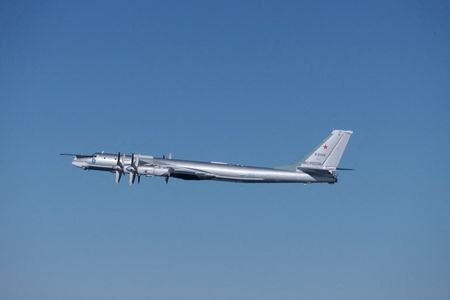
Two Tu-95 strategic bombers, known to NATO as "Bears", flanked by two long-range tankers, remained on the tarmac of Danang airport on Wednesday, after Russian military aircraft alarmed the air forces of both Taiwan and Japan on Tuesday as they flew south from Russia's Far East.
The flights took place just ahead of Russian President Vladimir Putin's arrival in the southern Chinese city of Shenzhen for this week's APEC Summit and just as leaders, including US President Donald Trump, gathered in Manila for an ASEAN meeting.
"The deployment is clearly intended to remind regional states that, despite ongoing war in Ukraine, Moscow can still project power into Southeast Asia," said Ian Storey, a security scholar at Singapore's ISEAS-Yusof Ishak Institute.
The last known deployment of Russian strategic airpower to Vietnam was in 2014, Storey said, when Hanoi offered Russian warships and aircraft preferential access to Moscow's Cold War-era base at Cam Ranh Bay and the airfield at Danang — both sites developed by US forces at the height of the Vietnam War.
Back then, Russia deployed tanker aircraft to Danang to support Tu-95 flights near the major US air and naval bases on the Pacific island of Guam, Storey said. He added he was not aware of later instances and that deployments may have been suspended after the then-administration of US President Barack Obama complained to Hanoi.
The Tu-95s, some of which are nuclear capable, are sometimes deployed for intelligence gathering and surveillance, military attaches say.
Last year, Moscow asked to revive the arrangement, but Hanoi was initially hesitant, said Nguyen The Phuong, an expert on Vietnam security at Australia’s University of New South Wales.
Phuong said this week's deployment was ostensibly for refuelling and signalled a change in approach that could herald further deployments.
Vietnam's foreign ministry, Russia's defence ministry and its embassy in Hanoi did not respond to requests for comment. The US State Department also did not respond to a request for comment on the flight of the aircraft near Japan and Taiwan.
Chieh Chung, a researcher from Taiwan's defence ministry think-tank, the Institute for National Defense and Security Research, said this was not the first time Russian military aircraft had been spotted near Taiwan, pointing to previous incidents in 1986 and 2010, both involving Tu-95s.
"Russia chose to make this politically charged flight before Thursday's US-China-Russia leaders summit," he said.
Chieh added he could not rule out that the aim was to project an image of tight China-Russia cooperation ahead of that summit.
China and Russia have close political and military ties and Moscow has repeatedly backed Beijing's territorial claims over Taiwan. China's air force and navy already operate around Taiwan daily.
Huang Chih-wei, vice chief of Taiwan's General Staff, told reporters in Taipei on Wednesday that the Russian flights "posed a threat to the peaceful and stable status quo in the Asia-Pacific region."
'SIGNAL TO CHINA'
Phuong said Hanoi could also have been motivated by the prospect of military procurement benefits.
Russia is by far Vietnam's main arms supplier.
Hanoi has publicly sought to diversify its suppliers since 2022, when Russia launched its full-scale invasion of Ukraine. But Vietnam remains dependent on Russian parts and technical support, while talks on additional supplies have continued.
Phuong said that by allowing the new Russian deployment, Hanoi could also be sending a signal to neighbouring China after Beijing's announcement in late September that it was helping build a new military airfield in Laos to train its air force.
Vietnam has not publicly criticised China's move but is monitoring activity there to ensure the training facility is not turned into a military base, Phuong said.
Hanoi and Beijing are also at odds over contested areas of the South China Sea, and Vietnam has often viewed its strong relations with Moscow as a strategic counterweight.
The green light for the Russian bombers may be intended to "signal to China that its military ties to Russia remain strong," Storey said.
(Reporting by Francesco Guarascio and Ben Blanchard; Additional reporting by Yimou Lee in Taipei; Writing by Greg Torode; Editing by Kate Mayberry)