
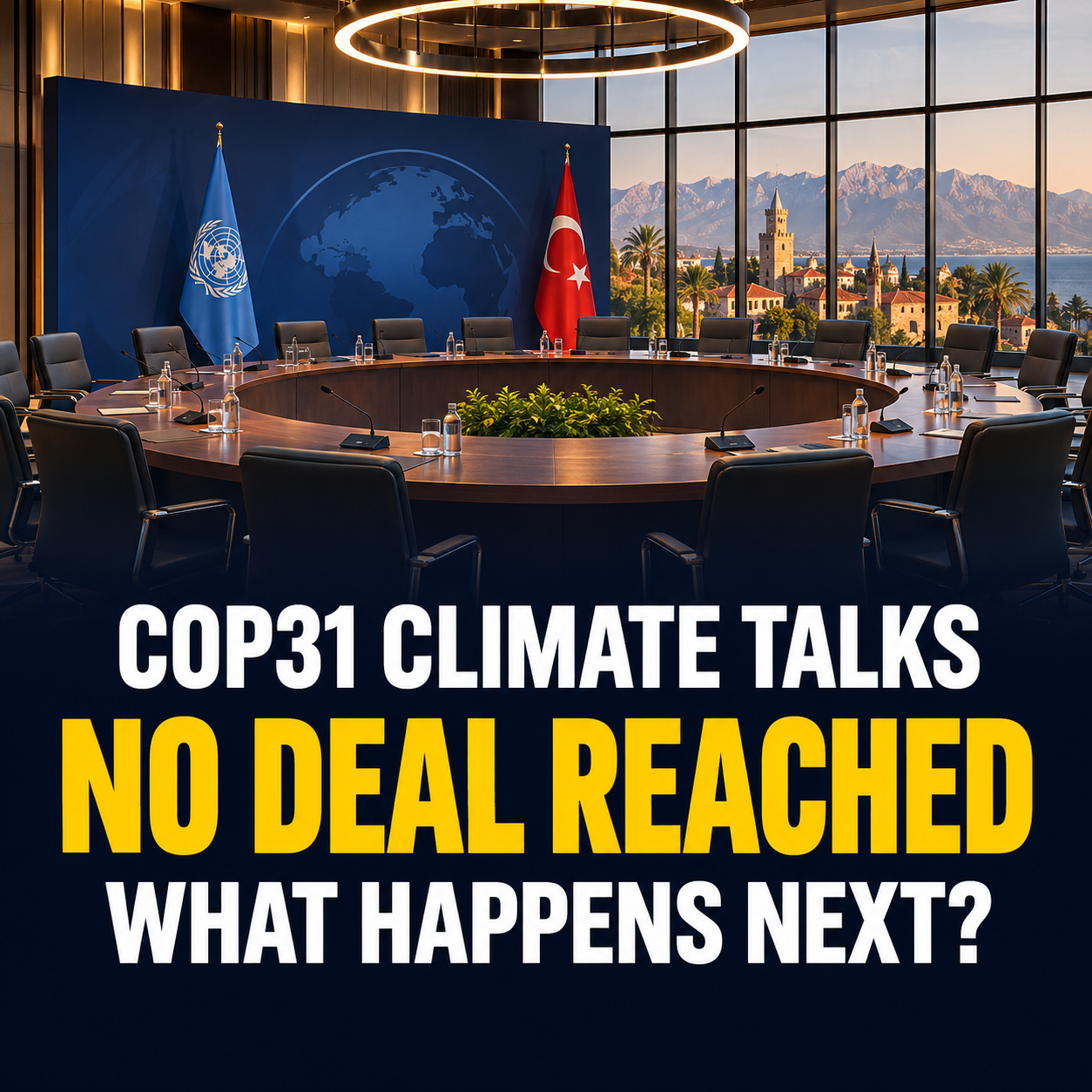
The summit in Antalya closed without an overarching agreement but existing climate commitments remain in force and work continues on other initiatives
The COP31 climate summit ended in Antalya, Türkiye, on Sunday, 22 November, without agreement on its overarching political outcome, after governments failed to resolve differences over fossil fuels and climate finance.
The breakdown leaves countries facing renewed questions about how to turn shared climate goals into action. It does not cancel the Paris Agreement or the commitments governments have already made, and officials pointed to progress on separate negotiations and voluntary initiatives.
Why the final agreement failed
Reuters reported that the European Union and other countries rejected the final proposal put forward by the Turkish and Australian summit leadership. Opponents said the draft failed to address the transition away from fossil fuels, while developing countries raised concerns about financial support for adapting to climate change.
Negotiations continued beyond the planned Friday finish before closing on Sunday. The absence of consensus prevented adoption of the presidency's proposed overarching decision, known as the Antalya Pact.
The dispute concerned the direction and strength of the collective message. Countries seeking explicit language on reducing reliance on fossil fuels would not accept a text they considered too weak, while major producers resisted that wording.
What the outcome does and does not change
The UK government's account of the summit says the Paris Agreement remains in place and countries remain responsible for delivering their existing commitments. It also says the failure to agree the Antalya Pact does not change Britain's domestic climate commitments.
That distinction matters when assessing the outcome. The failure to secure a new collective statement is a diplomatic setback, but it does not mean every negotiation at the conference failed or that national climate policies have automatically been reversed.
Where officials reported progress
UN climate chief Simon Stiell acknowledged the disappointment over the presidency-led decisions while pointing to work under the summit's Action Agenda. His closing remarks highlighted electrification, agriculture, food systems and resilience for cities and infrastructure.
The UK also listed initiatives on methane, forests and oceans, and support for communities exposed to climate impacts. These developments give governments and partners work to continue even without the broader political agreement.
Those commitments should be judged by what follows: whether funding is delivered, programmes are implemented and emissions are reduced. Announcing an initiative and demonstrating its effect are separate stages.
What happens next
The UK says discussions will continue ahead of COP32 in Ethiopia. Governments will face pressure to explain how they intend to address the disagreements left unresolved in Antalya while carrying out commitments that already exist.
For countries seeking help with climate impacts, the practical questions concern access to finance and support for adaptation. For the UK, the government's stated position is that domestic climate work continues despite the summit's outcome. Neither task depends solely on agreement at one annual meeting.
Impact and conclusion
COP31's failure to agree an overarching deal exposes the difficulty of reconciling fossil fuel dependence with demands for faster climate action. The immediate consequence is an unresolved political dispute, rather than the removal of existing obligations. The next test is whether governments can deliver the measures already promised and rebuild enough trust to negotiate a stronger outcome at COP32.
Sources
Reuters 22 November report on the collapse of the final agreement
United Nations 22 November summary of the COP31 outcome
UNFCCC closing remarks by Executive Secretary Simon Stiell
UK Government COP31 outcomes and next steps