
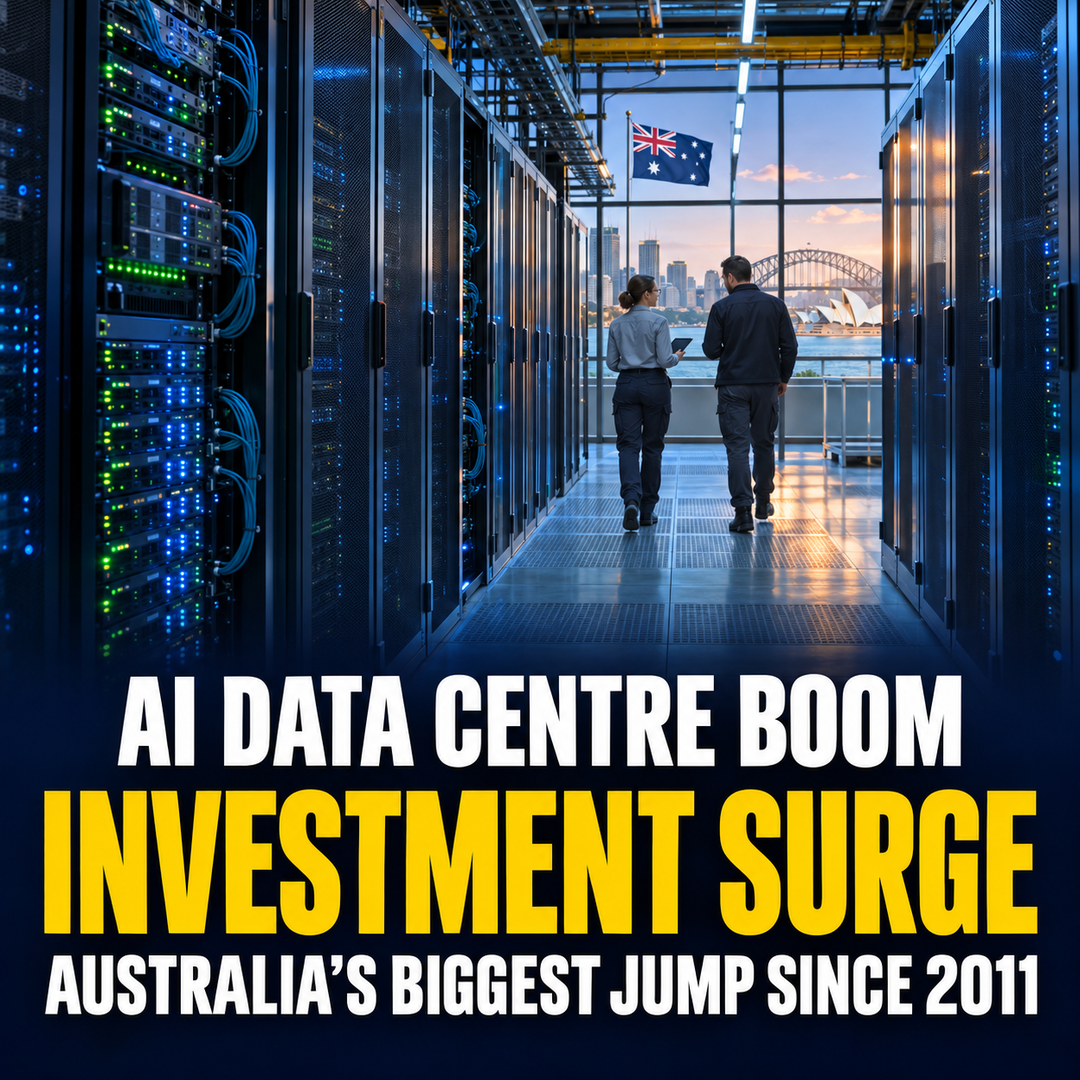
The AI data centre boom is becoming a story about major physical investment as well as software. Australian figures released on Thursday, 26 November, show private new capital expenditure rose 12.2% in the September quarter, with data centre equipment a central driver. [1, 2]
The Australian Bureau of Statistics said it was the largest quarterly increase since September 2011, during the mining investment boom. Capital expenditure was 18.6% higher than a year earlier. [1]
What the investment figures measure
Capital expenditure covers spending on assets such as buildings and equipment. The ABS release surveys selected private industries. Its headline growth rate describes their total new capital expenditure, rather than a separate measure of AI spending or growth in the whole economy. [2]
The quarterly comparisons are seasonally adjusted and expressed in volume terms. Keeping that definition attached to the figures helps readers compare investment activity without confusing it with a simple rise in cash spending. [2]
Why servers are driving the surge
The ABS identified large purchases of server racks and processing equipment as a key force behind the increase. Investment across the information media and telecommunications industry rose 86.7%. That industry figure covers more than AI alone. [1]
Across the surveyed industries, spending on equipment, plant and machinery rose 23.1%, while buildings and structures increased 1.7%. The contrast shows how much of the quarterly movement came through equipment rather than construction alone. [2]
The global question: how to power the expansion
Australia’s figures illustrate the infrastructure behind the wider AI investment race. The International Energy Agency’s October report, Powering Artificial Intelligence, examines how expanding data centres interact with electricity systems, prices, emissions and water use. [3]
The implication is that attracting digital investment requires more than announcing new computing capacity. As an assessment of the policy challenge, electricity connections, reliable supply and local resource needs deserve attention alongside the technology itself. The IEA frames affordability, sustainability and energy security as central planning goals. [3]
What to watch next
The ABS also reported planned capital expenditure of A$223.7 billion for 2026–27, 11.8% above the preceding estimate. These expectations are measured at current prices and describe intended expenditure; they are not completed investment. [2]
Impact and conclusion
The figures show that the data centre expansion is already changing demand for business equipment. The longer-term opportunity is productive digital infrastructure that supports useful services. Its success will depend on whether projects are delivered, whether energy systems can support them and whether the benefits justify the resources committed. A strong investment quarter is an important signal; lasting economic value still has to be demonstrated.
Sources and references
[1] Australian Bureau of Statistics. Data centre investment continues to drive new capital expenditure. 26 November 2026. Source link
[2] Australian Bureau of Statistics. Private New Capital Expenditure and Expected Expenditure, Australia, September 2026. 26 November 2026. Source link
[3] International Energy Agency. Powering Artificial Intelligence: Strategies for integrating data centres into electricity systems. 14 October 2026. Source link