By Emmanuel Bruce
ACCRA, June 19 (Reuters) - African and Caribbean nations on Friday demanded formal apologies from countries that benefited from transatlantic slavery, as well as debt relief and financial compensation, part of an increasingly forceful push for reparations.
The demands were part of a 19-point reparations plan endorsed at the end of a three-day conference in Ghana, whose U.N. resolution recognising transatlantic slavery as the "gravest crime against humanity" was approved in March despite resistance from Europe and the United States, countries which have a legacy in the sprawling human trafficking system that saw millions forcibly taken from their homelands.
The plan was adopted by the African Union and the Caribbean Community (CARICOM) Commission on Reparatory Justice. It does not mention which specific countries should apologise.
It calls for the establishment of a Global Reparations Fund, comprehensive debt relief and cancellation for affected countries and reforms to international financial institutions to ensure fairer representation for nations in the Global South.
It also calls for the restitution of looted cultural property and ancestral remains, climate justice financing and steps to address the specific brutalities inflicted on African women and girls during slavery.
And it urges African countries to grant the right of return and citizenship pathways for diaspora Africans while committing to preserving the coastal forts and castles as memorials.
The U.N. resolution in March was passed with 123 votes in favour, but the United States, Israel and 52 other countries —including European Union members and Britain — either opposed or abstained.
Both the EU and the U.S. voiced concerns the resolution could imply a hierarchy among crimes against humanity, treating some as more serious than others.
RESPONSIBILITY, NOT GUILT
At least 12.5 million Africans were kidnapped and forcibly transported by European ships between the 15th and 19th centuries. Advocates say action is needed to confront enduring legacies, including racism and economic inequality.
CARICOM had previously developed its own reparations framework, while the African Union was working on a separate plan. The conference in Ghana allowed the two bodies to merge their efforts into a single document to be presented at the next U.N. General Assembly.
Addressing the conference, several leaders struck a conciliatory tone.
“None of us gathered in this hall today can be held personally responsible for the atrocities of the transatlantic slave trade,” Ghana’s President John Dramani Mahama told delegates. “History does not ask us to inherit guilt, but it asks us to inherit responsibility.”
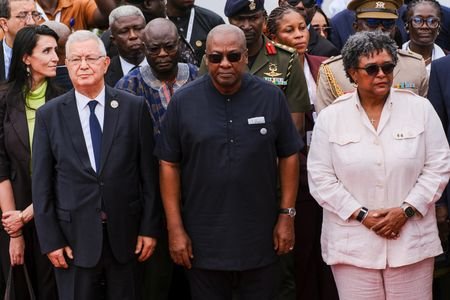
Heads of state from Namibia, Liberia, Senegal, Barbados and Sao Tome and Principe attended, as did the vice president of Equatorial Guinea.
Speaking virtually from the Elysee Palace, French President Emmanuel Macron said enslaved people “were torn from their homelands, deported, dehumanised, and treated as goods.”
He also said reparations should not be seen " as an end point, or a cheque written to bring the story to a close.”
Last month, French lawmakers voted to formally repeal slavery-era laws that defined the legal status of enslaved people as "movable property" and justified abuse and corporal punishment, though they stopped short of including demands for reparations.
(Reporting by Emmanuel Bruce; Editing by Robbie Corey-Boulet and Aurora Ellis)

