By John Davison
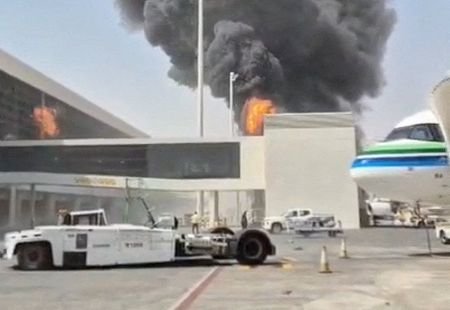
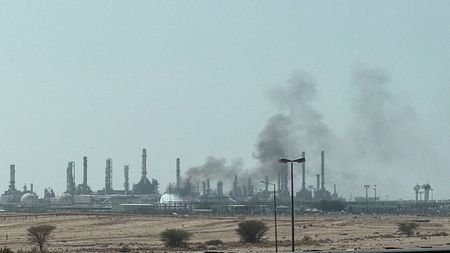
LONDON, Oct 15 (Reuters) - Houthi militants who control northwestern Yemen have in the past week attacked Riyadh international airport and hit the headquarters of Saudi Aramco, the world's largest oil company, in air assaults that have laid bare Saudi Arabia's vulnerability to threats from its enemy next door.
The attacks are shattering the illusion of Saudi Arabia as a safe international investment hub as it tries to attract foreign money and diversify away from oil.
This nightmare scenario for a key US ally in the Gulf has been years in the making, weapons and regional experts say.
They attribute Saudi Arabia's vulnerability to a ragtag group of Yemeni fighters to a perfect storm of factors that include Tehran helping the Houthis reach near self-sufficiency in producing and deploying advanced weapons, and the impact of the US war on Iran that has depleted stocks of interceptors.
TRAINING TO SELF-SUFFICIENCY BY IRAN
Iran has been giving weapons, money and training to the Houthis, known formally as Ansar Allah, for more than a decade, although Tehran has officially denied arming the Houthis in violation of a UN arms embargo.
While Iran has come under its own financial and military strains due to war and sanctions, the Houthis have learned – with Iranian help – how to assemble their own weapons, including drones and missiles, the experts interviewed by Reuters said.
Iran's Revolutionary Guards and members of Iran's other ally, Lebanese Hezbollah, initially gave the Houthis knowledge of missile systems and their operation, said Andreas Krieg, senior security studies lecturer at King's College London.
"Former Yemeni military engineers and a growing generation of locally trained specialists have helped institutionalise these capabilities," he said.
"Tehran has not simply supplied the Houthis with weapons. It has helped create an indigenous military-industrial learning process that becomes progressively harder to dismantle, even if direct Iranian supply routes are disrupted."
Iranian analysts said that the Houthis have in this way become one of the most cost-effective and valuable military proxies of Iran.
"The Revolutionary Guards were forward-looking. They looked at what happened if the Houthis couldn't receive equipment or weapons directly (from Iran), or if these were seized by US-allied forces," said Hamid Nikou, a former political advisor to Iran's Islamic Revolutionary Guard Corps.
Nikou said this strategy included teaching the Houthis how to assemble dual-use parts to make drones and even ballistic missiles.
"Iran has basically taught the Houthis how to fish," Nikou said.
The Saudi-led military coalition fighting against the Houthis in Yemen says it has intercepted a number of missiles fired by the Houthis at Saudi cities, and that it has destroyed 127 Houthi weapons storage facilities and launch platforms.
Coalition spokesperson Turki al-Maliki told a press conference the Houthis had acquired advanced military technology with the help of "regional actors," including ballistic missiles, drones and explosive-laden fast boats.
DIVERSIFYING WEAPONS IMPORTS AND TECHNOLOGY
A key strength of the Houthis in building their own weapons is that they don't rely solely on Iranian-made equipment or imports coming from Iran.
The Conflict Armament Research organization said in a report this week that the Houthis were attempting to make advanced medium-range ballistic missiles using parts shipped from China, after Yemen's internationally recognised government seized one such shipment.
"China has emerged as a particularly important commercial source, while Iran continues to provide specialised military technology, technical expertise and components that are difficult to obtain commercially," Krieg said.
The Houthis have also experimented with artificial intelligence in efforts to improve their weapons' effectiveness.
Anthropic said last month that "a cell of threat actors based in northern Yemen" had used its Claude AI assistant to help develop software for a guided rocket, a planned ballistic missile with a range of more than 2,000 km (1,240 miles) and a missile variant incorporating a hypersonic glide vehicle.
WAR FATIGUE, DEPLETED MUNITIONS
While the Houthis have improved their weapons production, US allies in the region have seen their air defences stretched since the war that began when the US and Israel attacked Iran in late February.
The United States has used large amounts of the missile interceptors it deploys in the region to protect its bases and its allies, which include Israel and Gulf countries, leaving some vulnerable, Saudi Arabia in particular.
"Saudi Arabia, in terms of the sophistication of the military and the development of an integrated air defence network, is not really yet at the level of either Israel or Ukraine, and it just has a very tough job to do," said Farzan Sabet, a Middle East expert at the Geneva Graduate Institute.
Saudi Arabia's sheer size makes defence against air attacks harder than defending Israel or a US base, he said.
WAR EXPERIENCE
The Houthis have learned from the increased levels of violence in the region in recent years, Sabet said.
A Yemeni civil war, in which the Houthis battled Saudi-backed forces from 2014, settled into a shaky ceasefire in 2022. But after Israel’s assault on Gaza in 2023, which followed deadly Hamas-led attacks on Israel, the Houthis began firing rockets at Israel and targeting shipping through the Red Sea.
The fallout from the US-Iran war this year reignited the Yemeni civil war, by which time the Houthis had developed new capabilities.
"They haven't been sitting still," Sabet said. "They were basically diversifying their supply chains... and as they gain operational experience, they're able to make those weapons more sophisticated."
(Reporting and writing by John Davison; Editing by Alex Richardson)