By Kate Holton and Michael Holden
LONDON, April 29 (Reuters) - King Charles' courting of President Donald Trump on his state visit will not repair the recent fraying of U.S.-British relations but underscores how London is playing a longer game in trying to preserve the historic alliance.
Britain has routinely deployed the royal family to charm the mercurial U.S. president, hosting him for a lavish state visit last September and dispatching King Charles and Queen Camilla to Washington this week for the 250th anniversary of the U.S. Declaration of Independence from British rule.
Trump has repeatedly mocked and criticised British Prime Minister Keir Starmer in recent weeks over his refusal to back the Iran war, but diplomats and commentators said Charles' task was not so much to smooth political ties as to remind the American public and their politicians of the depth and longevity of the relationship.
Nigel Sheinwald, Britain's ambassador to Washington between 2007 and 2012, said the king had used a rare and well-received address to Congress to highlight the web of bilateral ties across culture, security, defence and technology.
"(He will) hope that some of it will have an enduring impact on his audiences, which are much wider than the administration and will go on much longer than the administration", Sheinwald told Reuters.
WORST RELATIONS SINCE SUEZ
The 77-year-old monarch's four-day visit comes against the backdrop of the worst relations between the two countries since the Suez Crisis in 1956, and amid broader strains between the Trump administration and its European allies.
Trump earlier this year threatened to seize Greenland - which is part of the kingdom of Denmark - and more recently has harshly criticised NATO allies for not sending their navies to help open the Strait of Hormuz, which Iran has effectively shut.
In Tuesday's address to Congress, the highlight of his visit which ends on Thursday, Charles praised the U.S.-UK alliance while delivering several subtle rebukes to Trump, warning against the perils of becoming ever more inward-looking and promoting the need for peace and compassion in public life.
"The king is a masterful diplomat," said one senior government official.
In Australia, where Charles is also head of state, a column in the Sydney Morning Herald praised the "persuasive and incredibly sly" address for telling Trump what his many critics think he needed to hear.
But Mark Lyall Grant, Britain's former national security adviser and a career diplomat, said that while the events involving Trump were important, the broader mission of the king and queen was to address the American people on a trip that also includes stops in New York and Virginia.
"Just as there have been difficult relations at the political level in the past, the king symbolises the British state, and this visit therefore reminds the people of America, in particular, of what that relationship is and what it means to both countries," he said.
Britain has long vaunted its close ties with the U.S. but the increasingly visible strains during Trump's second presidency - almost a decade after the UK voted to leave the European Union - have sparked a bout of introspection about how it should navigate a much more volatile world.
NOT SPECIAL ANYMORE
Christian Turner, Britain's current ambassador to Washington, told a recent private event he did not like the term "special relationship" that was coined by wartime leader Winston Churchill because it harked back to the past.
The Foreign Office said the comments, reported by the Financial Times, were not government policy.
Critics of the government have also argued that while Trump's tone may sometimes be offensive, he is not wrong to say that Britain, like other European nations, must spend more on defence if it wants to be taken seriously by global partners.
Diplomats and commentators said the deployment of royal "soft power" would not provide cover for Starmer's centre-left Labour government for long, but that it would help keep channels open while the prime minister works to get back onto a better footing with the right-wing U.S. president.
"It's a perfect opportunity to keep the diplomatic channels open and to keep those conversations flowing," royal commentator Afua Hagan said.
Starmer will be hoping that Charles' visit will have worked the same magic for bilateral ties as the late Queen Elizabeth did in the immediate aftermath of the Suez crisis.
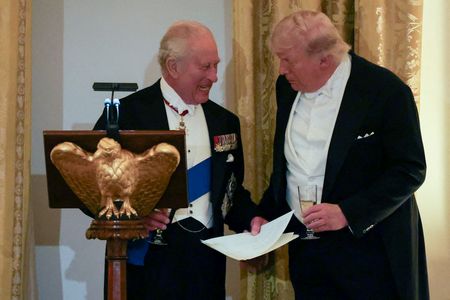
"When my mother visited in 1957, not the least of her tasks was to help put the "special" back into our relationship after a crisis in the Middle East," Charles said at Tuesday's state dinner at the White House.
"Nearly seventy years on, it is hard to imagine anything like that happening today," he joked.
(Additional reporting by Elizabeth PiperEditing by Gareth Jones)