By Miranda Murray
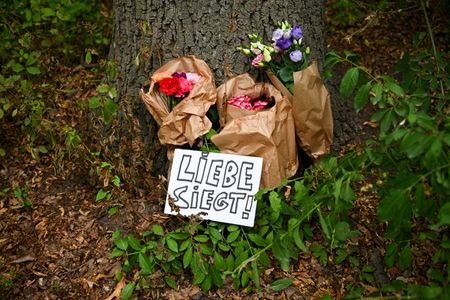
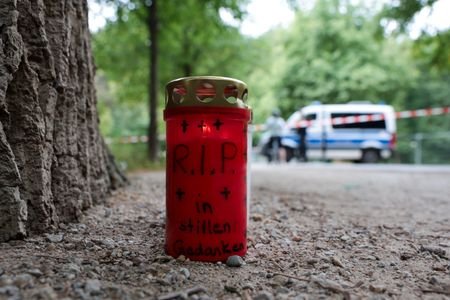
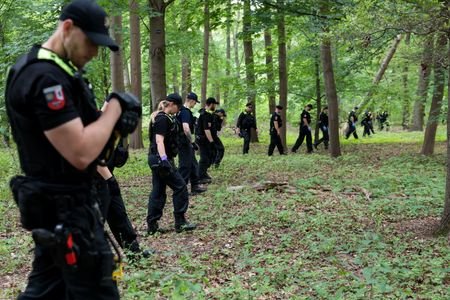
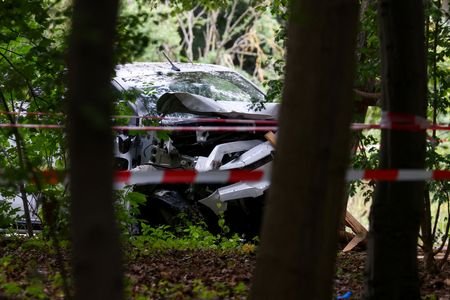
BERLIN, July 26 (Reuters) - Members of Berlin's LGBTQ community and others voiced grief, anger and solidarity on Sunday after a vehicle rammed into crowds at the city's annual Christopher Street Day Pride celebrations, killing one person and injuring more than a dozen.
Organisers of the parade cancelled several related events after Saturday night's attack, including a breakfast market at a popular food hall and a post-parade clean-up.
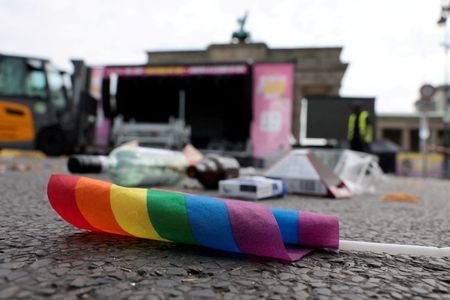
Instead, thousands of people gathered for a community vigil at 2 p.m. (1200 GMT) in Pariser Platz, the square surrounding the Brandenburg Gate, just a few hundred metres from where the attack took place.
The event hit maximum capacity about 30 minutes after beginning, despite on and off rain, with police limiting attendance due to security precautions, according to organisers.
Attendees held a moment of silence for the victims and waved pride flags, with one holding an oversized sign reading "From grief, to anger to resistance!"
German Chancellor Friedrich Merz and Justice Minister Stefanie Hubig attended a memorial service at the medieval St Mary's Church.
Alfonso Pantisano, the Berlin state government's LGBTQ affairs commissioner, said he was at Brandenburg Gate when everything changed in a matter of moments.
"To you, my dear community: I know that many of you are afraid right now. I won't sugarcoat it - I am, too. But you are not alone in this fear, in your grief, and in your anger," Pantisano wrote on Instagram.
BERLIN HAS LONG HISTORY AS LGBTQ HUB
Up to 1 million people participate in Berlin's CSD parade each year, according to city authorities.
The march through Berlin's green heart, the Tiergarten park, brings together groups and supporters campaigning for the rights and inclusion of gay, lesbian, bisexual, transgender and intersex people.
The event — first held in 1979 — takes its name from Christopher Street in New York's Greenwich Village, commemorating the 1969 Stonewall uprising against police raids and harassment.
Berlin has long occupied a central place in the history of gay rights and culture, starting in the late 19th century, when sexologist Magnus Hirschfeld founded what is regarded as the world's first gay rights organisation in 1897.
The city became an international hub of gay and lesbian life during the liberal Weimar era, but the flourishing cultural scene that emerged was largely destroyed under Nazi rule.
Despite continued discrimination after World War Two and during Germany's division, gay communities gradually re-emerged in Berlin through bars, social organisations and political activism.
"I hope that many people realise how important it is that we stay strongly together, now more than ever," German rapper Ikkimel, who was part of the stage show for the first day of CSD, wrote on Instagram.
"Please please please stay strong. I will always stand up for us."
(Reporting by Miranda Murray, Lena Toepfler and Martin Schlicht; Editing by Helen Popper and Peter Graff)