By Francesco Canepa and Leigh Thomas
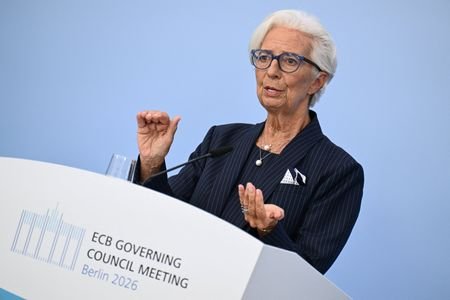
FRANKFURT, Oct 29 (Reuters) - Christine Lagarde's decision to step down early as European Central Bank president ends an eventful seven years at an institution she was never expected to lead.
The former French finance minister and head of the International Monetary Fund arrived in Frankfurt in 2019 as the first ECB chief with no formal economics training or central banking experience — prompting some market participants to label her a "credibility risk."
In fact, she knew so little about the institution that Lagarde, 70, later said she had accepted the job thinking the presidency was a five-year mandate, rather than eight.
Yet after a tenure dominated by a pandemic, two energy shocks and the worst inflation spike in the euro zone's history, Lagarde leaves with a record that defied the sceptics.
"Her seven years at the ECB have been, on the whole, pretty good," said Willem Buiter, an economist and former Bank of England official, noting that the ECB managed to bring inflation back down faster than peers in Britain and the United States.
Her exit, however, threatens to be as political as her arrival.
By walking away before her eight-year term ends, Lagarde gives European Union leaders a chance to pick her successor before a French election next spring that opinion polls suggest far-right candidate Marine Le Pen will win, replacing President Emmanuel Macron.
For an institution that fiercely guards its independence from political meddling, the timing has drawn sharp criticism from central bank watchers.
"This is debasing the institution and just following the purely political calculus of the French president," said Paul De Grauwe, a professor at the London School of Economics.
Lagarde and Macron have not addressed such criticism directly. Lagarde has said she would not be a candidate for the French presidency but would advocate for pro-European values in her home country "in whichever capacity" she deemed most efficient.
'BETTER WITH BUTTER'
Throughout her career, Lagarde has stood apart from more technocratic colleagues through a mix of charm, consensus-building and folksy pragmatism.
Favouring plain-speaking homilies over dense economic theory, the then-IMF chief famously declared that "everything is better with butter" when discussing growth and told governments to "fix the roof while the sun is shining".
Unorthodoxy was a hallmark of Lagarde's career, and the subject of her upcoming autobiography "Lady First".
A former corporate lawyer who spent years in Chicago, she entered French politics in 2005 as an outsider. Early missteps earned her the domestic moniker "Madame Lagaffe," but she soon became one of then-President Nicolas Sarkozy's sharpest operators, steering French banks through the 2008 crash.
She led the IMF through Europe's debt crisis, navigating a messy Greek rescue that imposed harsh austerity, and sparked outrage in Athens when she bluntly urged suffering citizens to "pay their taxes".
Her appetite for high-stakes bets showed again in 2018 with a record $57-billion lifeline for Argentina to back then-President Mauricio Macri. The gamble unravelled, failing to halt a currency collapse or avert a deep recession, and left the IMF bound to its most troubled debtor.
THE SPREADS CRISIS AND THE TRIBAL CLIQUE
Her occasional unfamiliarity with the nuances of central banking still peeked through.
In March 2020, as the pandemic rattled sovereign debt markets, Lagarde told a press conference the ECB was "not here to close spreads" between Italian and German borrowing costs.
The comment triggered an immediate selloff in bond markets and forced her to swiftly walk it back.
Under Lagarde's watch, the ECB swiftly rolled out emergency bond-buying that stabilised markets as COVID-19 spread. It launched its fastest series of interest-rate hikes to bring inflation under control following Russia's 2022 invasion of Ukraine, although it later acknowledged it had been slow to recognise the full impact of spiking energy prices.
As ECB president, she once described economists as a "tribal clique" — a provocative jab at the profession's establishment, though she later softened the blow by saying she hoped to join the tribe.
A 'MORE POLITICAL' ECB PRESIDENT
Lagarde used her political skills to repair rifts. Unlike her predecessor Mario Draghi, whose top-down style embittered some hawkish northern European peers, she worked to build consensus among the euro zone's 21 national central bank chiefs.
Her willingness to wade into politics remained evident: in January, Lagarde walked out of a World Economic Forum dinner in Davos during a speech by US Commerce Secretary Howard Lutnick that criticised Europe, an episode that underscored fraught transatlantic relations.
Whoever succeeds her when she leaves the ECB on February 7 will face fresh challenges including strains in French bond markets ahead of next year's election and a Middle East conflict that threatens a new bout of inflation.
Ultimately, Lagarde's legacy may be a paradox: an outsider who showed that political diplomacy could steer a central bank through historic shocks, but whose early departure served as a final reminder of her political instincts.
"She was put there for a reason: being more political than her predecessor and, on that mission, I think she largely succeeded," Frederik Ducrozet, head of strategy and macro research at Pictet Wealth Management, said.
(Additional reporting by Balazs Koranyi; Editing by Catherine Evans)