By Gopal Sharma, Sahana Bajracharya and Navesh Chitrakar
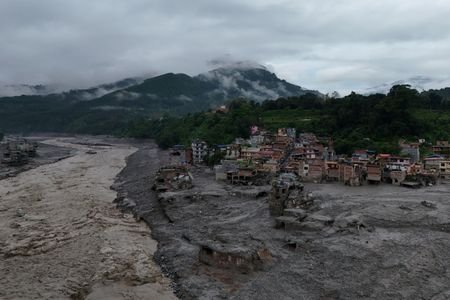
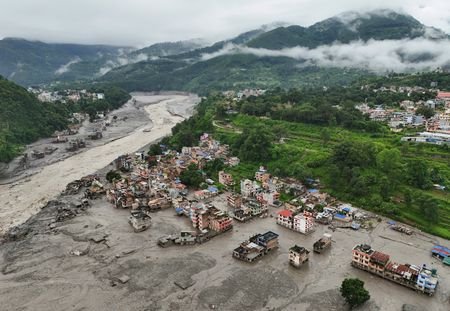
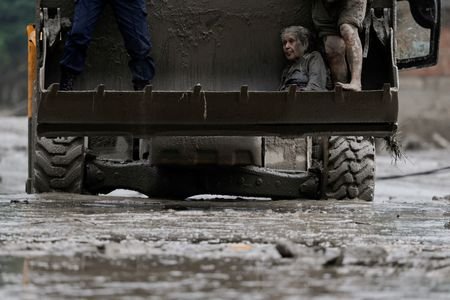
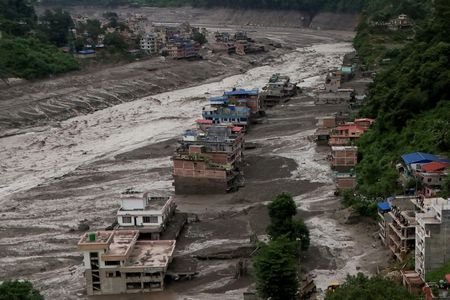
TRISHULI, Nepal, Aug 27 (Reuters) - Rescuers searched for survivors in the debris-strewn valleys and hillsides of Nepal on Thursday as more than 1,000 people were missing in the Himalayan country and neighbouring China after a wall of ice, mud and rock collapsed into a mountain river, triggering a catastrophic flash flood.
Authorities in Nepal used helicopters to search for survivors and drop emergency supplies to thousands cut off in towns and valleys after Wednesday's disaster swept a road thronged by trekkers and pilgrims that links Kathmandu with Lhasa in Tibet.
Police said they expected the death toll to rise beyond 270, with dozens of bodies swept down into the plains from where they were being recovered.
Nepal's Home Minister Sudhan Gurung said the focus remained on finding survivors as rescue teams located 100 missing Indian visitors, mostly pilgrims, and 25 Chinese workers in the worst-hit region around Trishuli. More than 650 foreigners were still unaccounted for while Nepali authorities were yet to determine the number of locals missing.
"It was a huge gush of mud coming straight towards us," said Keshav Prasad Baral, a 68-year-old survivor being treated in a Nepali hospital.
"As it got closer, it kept rising higher and higher. When I saw it enter our home, I tried to grab my wife's hand and take her to the terrace. But she was swept away by the mud."
A helicopter ferried him to safety four hours later. "My wife is still somewhere beneath the mud," he added. "She's gone."
The tally of missing in Tibet's Gyirong county was 558, Chinese state broadcaster CCTV said on Thursday, including 260 foreign nationals. China said the death toll stayed at three.
The missing foreigners across both regions belonged to more than two dozen countries, including 288 more from India, 63 from the United States, 51 from Malaysia, 34 from Australia, 33 from Britain and 25 from Canada.
BODIES RECOVERED FROM THE PLAINS
China is in close communication with Nepal on search and rescue efforts, with nearly 100 Chinese nationals in the affected area across the border in Nepal, the Chinese foreign ministry said.
China's Premier Li Qiang, the country's number two official, arrived at the disaster-stricken site in Gyirong on Thursday afternoon, state-run Xinhua news agency said.
The surprise visit, which had not been announced in advance, signalled Beijing is treating the disaster as a matter of the highest national priority.
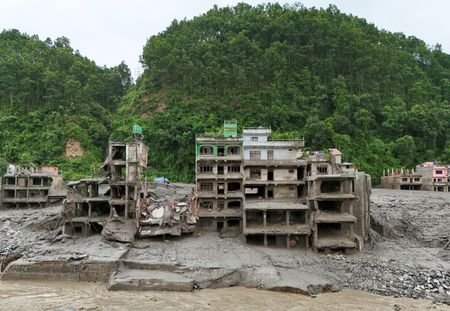
Verified videos showed crushing masses of water and debris sweeping away dozens of people at a border crossing in Gyirong, with homes, roads and power projects washed away in Nepal as the flows travelled downstream.
Ganesh Aryal, the administrator of Chitwan district, said authorities had recovered 103 bodies from the river system in his district which is about 100 km (62 miles) away in the plains from the worst-hit region of Trishuli.
With local hospitals unable to accommodate all the bodies, district authorities were setting up tents and also making arrangements for families that were expected to arrive to claim their dead relatives, he said.
Bodies that cannot be identified would be sent for DNA tests, he added.
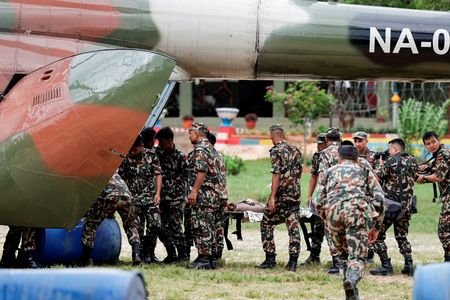
In the hardest-hit districts, helicopters were dropping tents, food and other emergency supplies provided by neighbouring India, said Raja Ram Basnet, a spokesperson for Nepal's army.
More than 5,000 army and police rescue personnel joined the rescue effort that retrieved 125 people on Thursday, including 20 foreigners, he said.
Nepal's Prime Minister Balendra Shah left by road to assess the flood situation in one of the worst affected districts of Nuwakot, his office said on social media.
The disaster is a major challenge for Shah's five-month-old government but officials said the country had systems and officials who have experience in handling such tragedies, including the 2015 earthquake that killed nearly 9,000 people.
MORE RISK FROM DAMMED LAKE
Early reports from Nepali officials suggested an earthquake in the area could have caused the lower part of a glacier to collapse and trigger the floods.
The U.S. Geological Survey said an earthquake with magnitude initially reported as 4.4 was in fact seismic energy generated by the collapse of glacial rock and ice, followed by debris flow.
Chinese authorities have identified risks from a still-dammed lake in Gyirong, upstream from the mudslide and flood-stricken Tibet-Nepal border crossing that could complicate rescue efforts, particularly as rains are forecast, CCTV said.
On Thursday morning, the dammed lake was estimated at 2 million cubic meters in volume and it was already overflowing, state media said citing the Chinese water resources ministry.
Another 3 million cubic meters of water is expected to enter the lake over the next three days, posing a high risk of a breach, it added.
Last July, the rapid drainage of a lake atop the Purepa glacier in Tibet unleashed deadly flooding in Nepal.
Many of this week's victims were pilgrims headed to Kailash Mansarovar, a high-altitude site in Tibet revered by Hindus and Buddhists, among others.
Mount Kailash, which Hindus believe to be the abode of Lord Shiva and lies on the banks of Lake Mansarovar, is also held sacred by many.
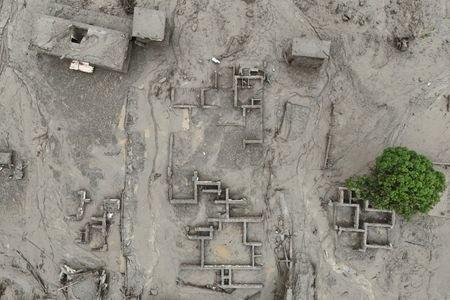
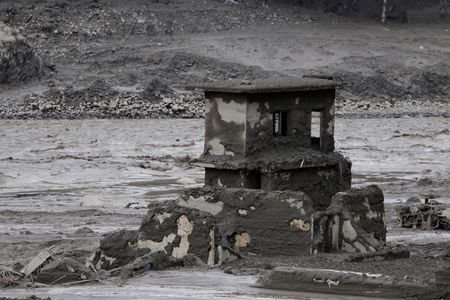
"There are no human-made things, no human settlement left. Everything is just flat," Sagar Pandey, the chief executive of a Himalayan tourism operator, told Reuters after flying over the zone in a helicopter. "So anyone in the hotel, the restaurant, or the car, I believe that everybody is gone."
RELATIVES DESPERATE FOR INFORMATION
Around the world, relatives of those missing were desperate for information about their whereabouts.
Vasanthi Muniandy, whose sister Vennila was part of a Hindu pilgrimage group from Malaysia, said she had last heard from her after Vennila had crossed into Tibet from Nepal.
"I am totally broken. My sister is very important to me," said Vasanthi. "I really want her to come back. I don’t have anyone but her. I just want her to come back home. I want her to be safe."
Security footage captured on the Chinese side of the border showed many people fleeing from a torrent of rock, mud and water that destroyed buildings and vehicles.
The Gyirong border port has a key role in the flagship Belt and Road network linking China to South Asia, with logistics parks, yards, and parking lots built in the past decade as part of extensive development efforts.
Countries and organisations rushed or pledged help, with India, the United States, Canada and the United Nations saying they were providing assistance and closely monitoring the situation, with U.N. teams sending supplies and personnel to support affected communities.
(Reporting by Gopal Sharma, Sahana Bajracharya, Aftab Ahmed, Saurabh Sharma, Liz Lee, Yukun Zhang, Xiuhao Chen, Shi Bu, Sakshi Dayal, Kanjyik Ghosh, Shilpa Jamkhandikar, Hritam Mukherjee, Ashley Tang and Christine Chen; Writing by Lincoln Feast and YP Rajesh; Editing by Stephen Coates, Clarence Fernandez and Saad Sayeed)