By Brad Heath, Jason Lange and David Morgan
WASHINGTON, Nov 4 (Reuters) - Democrats and Republicans squared up on Wednesday for what could be two years of deadlock in Washington, with the resurgent Democrats vowing to use their resounding midterm election victory to rein in President Donald Trump, who signaled he was ready to continue flexing the executive branch's considerable powers.
A wave of anger over Trump's policies, particularly the US-Iran war's role in pushing the cost of living higher, helped Democrats take the Senate, where they flipped seats in deeply Republican states for a majority of at least 54-44, and the House of Representatives, where they gained at least 25 seats.
It will be the first time that Trump, a Republican who also held the White House from 2017 to 2021, has had to contend with a Democratic-controlled Congress.
"The American people have connected that corruption into the adverse impact of the policies that have taken place over the last two years," House Democratic Leader Hakeem Jeffries told MS NOW on Wednesday, promising to "make sure that wrongdoers are being held accountable."
Jeffries, a New York lawmaker who is on track to become the first Black speaker of the House, said Democrats would "work hard" on making life more affordable, while urging Trump to end his unpopular eight-month-old war against Iran before the next Congress is seated.
Trump, meanwhile, posted an image on social media of one of his signature red "Make America Great Again" baseball caps with the usual slogan replaced with the word "VETO", a reminder that Democrats will be limited in their ability to legislate without his support.
Top Senate Republican John Thune, a veteran lawmaker not generally regarded as a firebrand, signaled that his caucus was not yet ready to look to a future beyond Trump.
"Senate Republicans will not stand idly by as the far-left, socialist wing of the Democrat Party attempts to unwind everything we've done," Thune, of South Dakota, said in a statement. "Thankfully, we still have President Trump in the White House, and we'll work with him to stop the worst impulses of Democrat extremism."
TEXAS, SOUTH CAROLINA, KANSAS FLIP
Trump had cast the midterm elections as a referendum on the first half of his second four-year stint in the White House, repeatedly urging his Republican base to "pretend I'm on the ballot," a message that Democratic Party leaders were happy to amplify.
The result: voters in conservative strongholds who had propelled the president to his second term in office just two years ago swung dramatically toward Democrats, fueled by deep frustration over the unpopular war with Iran, anxiety over the high cost of living and anger at Trump's stewardship of the country.
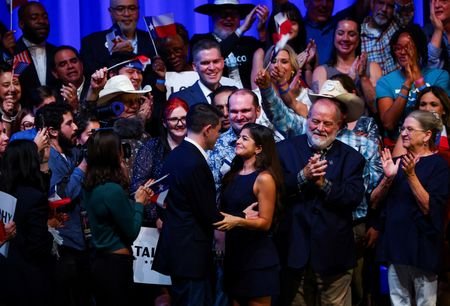
In Texas, the biggest Republican-led state before Tuesday, Democrats ended a decades-long losing streak in seismic fashion, winning their first Senate seat there since 1998 and ousting three-term Governor Greg Abbott.
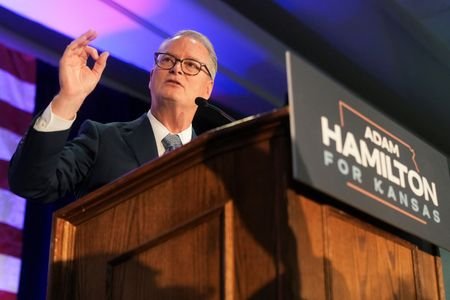
Kansas elected its first Democratic senator since the Great Depression nearly a century ago, and in South Carolina, a state that Trump carried by nearly 18 points in 2024, Democrats turned aside his hand-picked Senate candidate.
Senate races in Alaska and Mississippi remained uncalled as of Wednesday morning, leaving open the possibility that the Democrats' majority could grow by another two seats to 56-44.
Once seated in January, Democrats are expected to use their power to investigate Trump's administration, family and allies and demand concessions on major legislation. The Democratic Senate can block Trump's nominees, including any US Supreme Court justices should a vacancy arise.
However, until then, Republicans hold the reins and will have at least one must-pass piece of legislation ahead – a measure to fund the federal government past December – that they could use to enact conservative priorities during the so-called lame-duck period.
Trump, who is barred by the US Constitution from seeking a third term, has exercised an iron grip on his party for most of the last decade. He congratulated Democrats for doing "a good job," in uncharacteristically conciliatory media interviews overnight.
He acknowledged the war with Iran had played a role in his party's losses but stood by his decision. He also said he would work with Democrats on issues such as immigration, though he threatened to veto any "insane" bills they passed.
DEMOCRATIC WAVE
Democrats focused their campaign on corruption and affordability, blaming Trump's expensive tariffs on imports, some of which were ruled to be an illegal tax by the courts, and the war with Iran for driving up costs while highlighting the billions of dollars the Trump family has made since he returned to the White House.
Republicans, led by Trump, attacked Democrats for defending transgender people's rights and similar social issues, portraying them as radical and extreme. But voters made it clear they were far more concerned with pocketbook issues.
The Democratic wave flooded huge swaths of the country. Republicans lost ground in all but a handful of the approximately 2,100 counties where most votes had been counted, according to tallies compiled by Reuters and USA Today.
Democrats made gains in the richest counties and the poorest; in counties where more people have college degrees and where fewer do. Democrats' advances were particularly sharp in heavily Latino counties, including the border counties of Texas that shifted toward Trump in 2024 and the agricultural towns of the Kansas prairie.
Democrats flipped more than two dozen House seats currently held by Republicans, locking in a majority. Democrats won all the closely contested House races that have been decided so far, and they won about a dozen races in districts that Trump won by double digits two years ago.
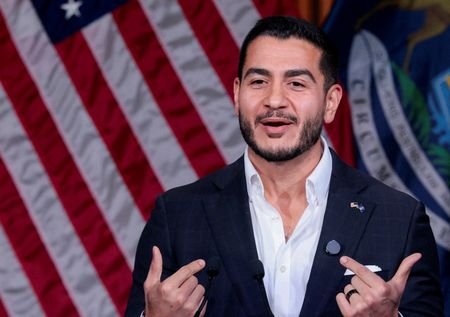
Abdul El-Sayed, a Democrat from the party's rising left wing, won Michigan's open Senate seat, becoming the first Muslim elected to the chamber. He defeated Mike Rogers, a former congressman and FBI agent, who entered the race with Trump's backing and sought to falsely portray El-Sayed, an Egyptian American born in Michigan, as a religious extremist.
"You chose hate, and Michigan chose hope," El-Sayed told cheering supporters on Tuesday night, referring to Rogers.
The night included several historic firsts for both parties. In Georgia, Democrat Keisha Lance Bottoms became the first Black woman elected governor of any US state; Byron Donalds won Florida's gubernatorial race to become the first Black Republican governor in the US and in New Mexico Deb Haaland became the country's first Native American woman to be elected governor. Democrat Gina Hinojosa will become the first Latina governor in Texas, while Democrat Xavier Becerra will be California's first Latino governor.
(Reporting by Joseph Ax, Jason Lange and Brad Heath in Washington and Nathan Layne in Detroit; Additional reporting by Nolan D. McCaskill, Dan Rosenzweig-Ziff, Dan Catchpole, Richard Cowan, Daphne Psaledakis, Leah Douglas, Courtney Rozen, Susan Heavey and Jarrett Renshaw; Writing by Joseph Ax, Jonathan Allen and Brad Brooks; Editing by Scott Malone, Paul Thomasch, Howard Goller and Alistair Bell)