By Andrew Gray and Lili Bayer
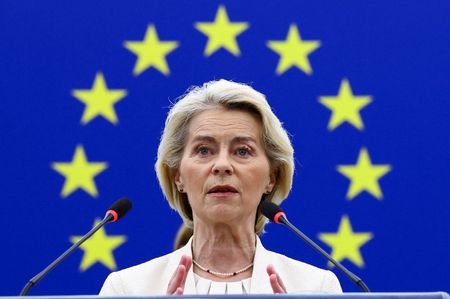
BRUSSELS, Sept 16 (Reuters) - European Commission President Ursula von der Leyen on Wednesday backed the creation of a European Security Council, bringing together leaders from the EU, Britain, Norway, Ukraine and Canada, as she warned threats to peace on the continent were growing.
Von der Leyen also proposed a new system to coordinate responses to so-called hybrid incidents, often attributed to Russia, that fall below the threshold of conventional military attacks but undermine European security - such as sabotage, arson and drone incursions.
Her initiatives reflect a growing desire by European officials to take more responsibility for the continent's security, amid doubts over whether they can rely on U.S. President Donald Trump to come to their aid through the NATO military alliance.
However, with few details immediately forthcoming, some analysts warned the initiatives could duplicate structures within NATO, leading to potential confusion, and amount to little more than talking shops.
VON DER LEYEN SAYS SECURITY THREATS IN EUROPE ARE MOUNTING
"Russia's war of aggression on Ukraine rages on. And threats are mounting on our soil," von der Leyen, head of the 27-nation European Union's executive body, said in her annual State of the Union speech to the European Parliament in Strasbourg.
Citing incidents such as an attempted drone attack on Leipzig airport last month that German authorities have attributed to Russia, von der Leyen said Europe's doctrine, institutions and decision-making had not kept pace with a new reality.
"Europe needs its own counter-hybrid playbook," she said, proposing an "emergency security protocol" that any EU member could trigger to coordinate a European response.
Russia has rejected Germany's accusations over the Leipzig incident and accused NATO countries of falsely blaming Moscow for other incidents to ramp up tensions between the two sides.
Von der Leyen said the Commission would set out ideas to make a European Security Council a reality.
She did not detail how such a Council would work. But her Defence Commissioner, Andrius Kubilius, has suggested it might sometimes involve just EU members and at other times include other countries.
In a paper published in January this year, he suggested it have a mix of permanent members - large countries such as Germany, France, Italy, Spain and Poland -and others involved on a rotating basis.
Von der Leyen mentioned Canada among countries that could be involved. In the same speech, she stressed the EU's close links to Canada and said she wanted to open the door to an "associate membership" of the bloc.
SOME GIVE PROPOSALS SWIFT WELCOME, OTHERS STRESS IMPORTANCE OF HARD POWER
Norway and Finland welcomed the security proposal. "Europe must be able to take more responsibility for its own security and strengthen its own defence," Finnish Prime Minister Petteri Orpo posted on X.
But other officials were more cautious. Estonian Foreign Minister Margus Tsahkna said: "NATO remains the cornerstone of European security, and EU efforts in security and defence must complement and strengthen the Alliance."
Marta Prochwicz, a defence expert at the European Council on Foreign Relations, said the Security Council proposal was "a step in the right direction". But, she added, "if it remains a talking shop, without deeper defence-industrial cooperation, joint ventures, interoperable equipment and joint training of forces, it will not make Europe any safer".
Oana Lungescu, a distinguished fellow at British-based defence think tank RUSI and a former NATO spokesperson, said it was hard to see how Russia would be deterred by such a council.
"What deters Russia is massive defence production and will to impose costs," Lungescu posted on X.
(Reporting by Andrew Gray and Lili Bayer; Editing by Kirsten Donovan)